
Resources
When to Hire a Development Agency vs Building an In House Team
The real cost, speed, control, and risk trade-offs between an agency and an in-house team, genuine hybrid models, and when each actually wins.

Ahmad Saeed
Full-Stack Engineer, Devity Technologies
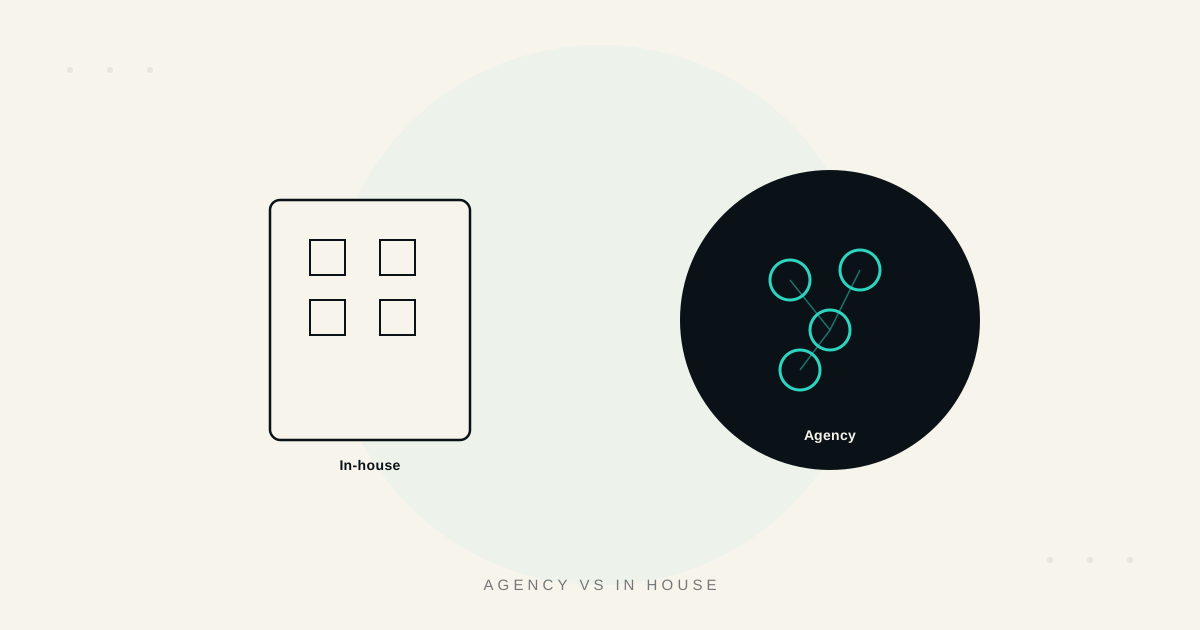
The in-house versus agency decision is one every growing company eventually faces, and it deserves a genuinely honest answer rather than a default assumption in either direction. This guide covers the real trade-offs, cost, speed, control, and risk, genuine hybrid models, and when each approach actually wins.
| In-house | Agency | Hybrid | |
|---|---|---|---|
| Cost structure | Fixed, ongoing | Tied to actual work | Mix of both |
| Time to productivity | Slower, real recruitment time | Fast, established team | Fast build capacity, retained ownership |
| Genuine control | Deepest, most direct | Real, if structured properly | Both, balanced |
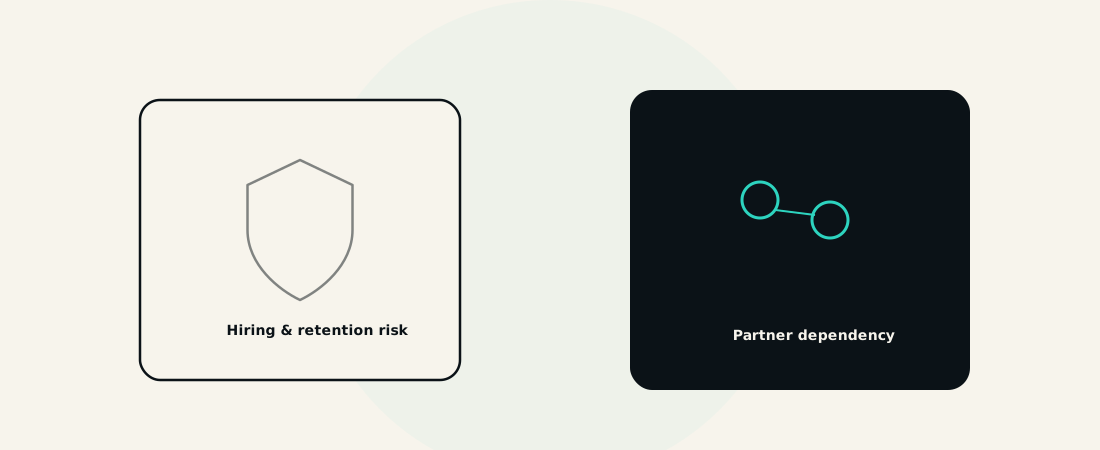
| Main risk | Hiring and retention | Partner dependency | Requires coordinating both well |
Cost
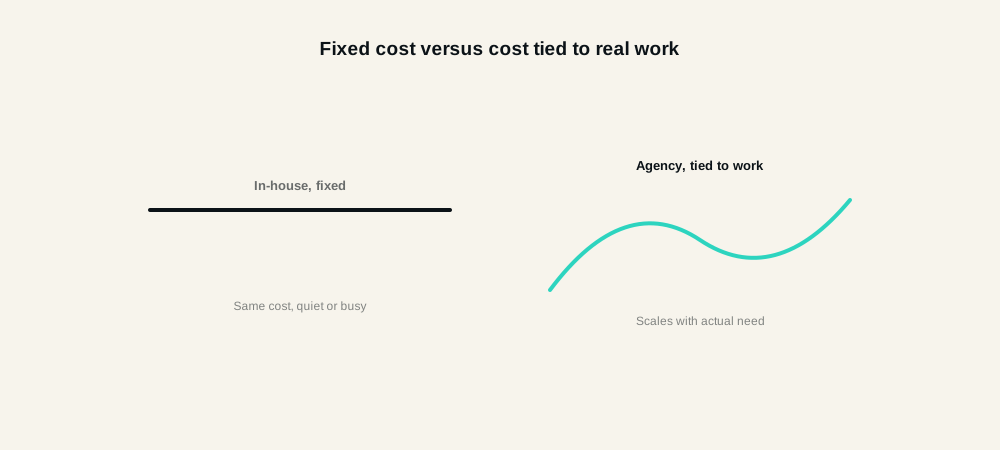
An in-house hire carries real, ongoing fixed cost, salary, benefits, recruitment expense, and management overhead, regardless of how much actual development work exists at any given moment, a cost that continues through quieter periods just as much as busy ones.
An agency's cost is more directly tied to actual project work, you pay for capacity when you genuinely need it, without carrying the fixed cost of full-time headcount during a slower period, a real, practical advantage for a company with variable or still-uncertain development needs.
The total cost comparison depends heavily on genuine, sustained workload. A company with consistent, ongoing development needs may find in-house genuinely more cost-effective over a long horizon, a company with variable or project-based needs often finds an agency's flexibility the more efficient structure.
Speed
An agency typically offers faster time to genuine productivity, an established team with existing process and tooling can start meaningful work almost immediately, where building an in-house team from scratch means real recruitment time before any development work even begins.
In-house teams can move faster on deep, ongoing product work once established, genuine, accumulated product knowledge held by a team that lives inside the codebase daily removes a real, recurring ramp-up cost an external partner faces on each new piece of work.
Control
An in-house team offers deeper, more direct day-to-day control, immediate access to the people doing the work, and product knowledge that accumulates entirely inside the company rather than partially residing with an external partner.
An agency still offers real, genuine control through proper structure, direct communication access, defined process, and full IP ownership, covered in more depth in our guide to who owns the code, the control gap between the two models is smaller than commonly assumed, provided the agency relationship is structured properly.
Risk
In-house carries real hiring and retention risk, a bad hire, a key person leaving, or a skills gap the team doesn't currently have all represent genuine, concentrated risk a small in-house team faces directly.
An agency carries a different risk profile, dependency on an external partner's continued availability and quality, mitigated by the same due diligence covered in our guide to vetting a remote or offshore development team, genuine verification, references, a real trial engagement before committing to a larger one.
Hybrid Models
A hybrid approach, an agency providing build capacity while a small, in-house team retains product ownership and continuity, is a genuinely common, well-functioning structure for a growing company, not a compromise, often the actual optimal balance between flexibility and deep product ownership.
This lets a company scale development capacity up or down without the full commitment of hiring and, if needed, letting go of full-time staff, while keeping genuine, accumulated product knowledge in-house through a smaller core team that stays consistent over time.
A concrete example of this working well: a growing SaaS company retains a small, two-person in-house team, a product lead and a senior engineer, who hold deep, continuous product knowledge and make key architectural decisions, while an external agency provides the bulk of ongoing feature development capacity. The in-house team never becomes a bottleneck trying to do all the building themselves, and the agency never operates without genuine, informed product context, since the in-house pair stays closely involved in every decision, a structure that captures real strengths from both models rather than compromising on either.
When Each Wins
In-house wins for a company with sustained, high-volume, ongoing development needs, and the resources to invest properly in recruitment, management, and retention.
An agency wins for a company needing to move quickly without the time cost of building a team from scratch, with variable or still-uncertain development needs, or lacking the internal resources to manage an engineering team well yet.
A hybrid wins for a growing company wanting genuine flexibility alongside real, accumulated product continuity, often the most practical structure for a company past its earliest stage but not yet large enough to justify a fully built-out internal team.
In Practice
Our web platform development service works within both pure-agency and hybrid structures, depending on what genuinely fits a client's stage and needs, not a one-size-fits-all pitch for either model. Our free technical audit is a useful, no-obligation way to talk through which structure actually fits your specific situation.
The companies that get this decision right are rarely the ones who defaulted to whichever model felt more prestigious, they are the ones who honestly weighed their real workload, resources, and stage against the genuine trade-offs each model carries.
FAQ
Questions, Answered.
Read next
More on Web Platforms
API First Architecture: Building Software That Scales and Integrates
What API-first architecture actually means, the real benefits, how it enables genuine integration and reuse, and when it matters versus when it's unnecessary overhead.
Build vs No Code for Web Apps: Where the Line Really Is
Where no-code web app builders genuinely excel, where they break down, and how to think about performance, ownership, and the migration path before you commit.
Core Web Vitals: A Practical Guide to a Faster, Higher Ranking Site
What LCP, INP, and CLS actually measure, the fixes that move each metric, how to measure them correctly, and the real business impact of getting them right.