
Resources
Who Owns the Code? IP, Source and Handover Explained
IP ownership basics for a software project, what your contract should say, source and repo access, handover, and what to insist on before you sign anything.

Ahmad Saeed
Full-Stack Engineer, Devity Technologies

Few things create more real, avoidable anxiety for a founder than discovering, after the fact, that IP ownership was never actually settled clearly. This guide addresses the fear directly, IP basics, what your contract needs to say, source and repository access, handover, and exactly what to insist on before signing anything.
| Ask for | Why it matters |
|---|---|
| Explicit IP assignment language | Ownership does not transfer automatically just because you paid |
| Ongoing repository access | Real progress you can verify, not periodic screenshots |
| Full handover on completion | Source, docs, and credentials, not just a compiled app |
| Written handover checklist | Protects you if the relationship needs to end, for any reason |
IP Basics
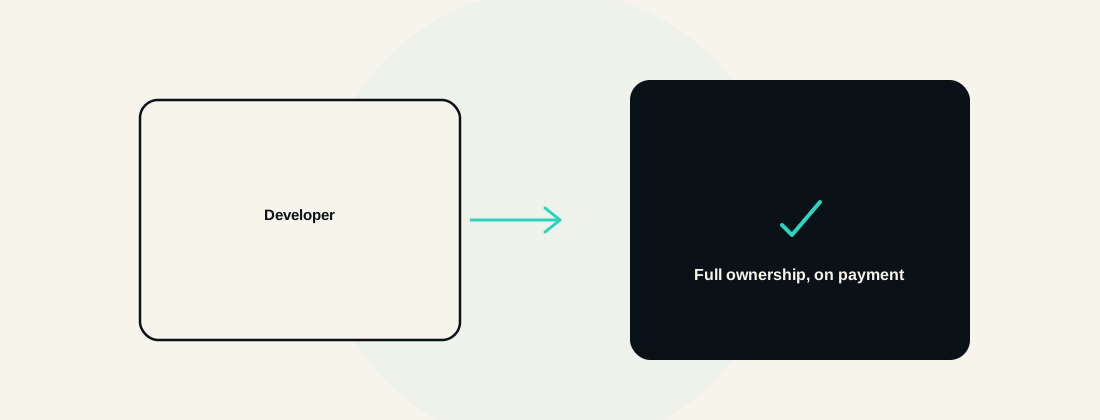
Ownership does not transfer automatically simply because you paid for the work. Without explicit IP assignment language in a contract, default legal rules in many jurisdictions can leave the developer holding the rights to what they built, even though you funded it entirely, a genuinely counterintuitive but real risk worth understanding clearly upfront.
"Work for hire" language is not universally sufficient on its own. Depending on jurisdiction and the exact wording used, this phrase alone may not achieve full, unambiguous IP transfer, a properly drafted contract needs specific, direct assignment language, not just a general phrase assumed to cover it.
Contracts
Explicit IP assignment language, stating clearly and directly that all rights transfer to you upon payment, full stop, no ambiguity, no partial retention, no conditions attached beyond payment itself, is the single most important clause in any development contract.
Confirm the assignment covers everything genuinely relevant, the code itself, associated documentation, design assets, and any custom tooling built specifically for your project, not just the final, compiled application with everything else left in a grey area.
Source and Repo Access
Access to the actual source code repository should be a standard, ongoing part of any engagement, not a special request or something withheld until a project concludes. You should be able to see real, current progress directly, not just periodic screenshots or a demo you cannot independently verify.
Full repository access at the end of a project is a baseline expectation, not a bonus. Any hesitation about handing over complete, working source code once a project is paid for is one of the clearest, most direct warning signs available, covered in more depth in our guide to red flags when hiring a development agency.
Handover
A genuine handover includes far more than a code export. Full source code, clear documentation of the architecture and any non-obvious decisions made along the way, and complete credentials and access to every third-party service the project depends on, hosting, domains, APIs, analytics, all of it.
Enough context for someone else to actually continue the work is the real test of a proper handover, not just "does the code technically exist," but "could a different, competent developer pick this up and understand it well enough to keep building on it without starting over."
Insist on this being written into the contract explicitly, not left as an informal, good-faith expectation, a defined handover process with a specific checklist protects you directly if the relationship with a partner ever needs to end, for any reason, at any point.
A concrete illustration of why this matters: a founder ends a development relationship on good terms, receives a code export, and only discovers months later, when a new developer tries to actually pick up the work, that critical environment variables and third-party service credentials were never included, and the original team is no longer easily reachable to provide them. A written handover checklist, agreed at the start of the engagement, would have made this a routine, uneventful step rather than a genuine, costly scramble months after the fact.

In Practice
We treat full IP assignment and complete, ongoing repository access as a standard, non-negotiable part of how we work, not a premium feature reserved for larger engagements. If you want a straight, direct answer on how ownership works before committing to anyone, that conversation costs nothing and takes only a few minutes.
The founders who avoid IP disputes are rarely the ones who got lucky with an honest partner, they are the ones who insisted on explicit assignment language, ongoing access, and a real, written handover process before ever signing anything, and treated any hesitation on these specific points as the clear signal it actually is.
FAQ
Questions, Answered.
Read next
More on Choosing & Trust

Fixed Price vs Time and Materials: Which Contract Protects You
How fixed-price and time-and-materials contracts actually work, who carries the risk in each, when each one genuinely fits, and why a hybrid is often the smarter choice.
How to Budget for a Software Project Without Nasty Surprises
A practical guide to budgeting a software project realistically, scoping for budget, genuine contingency, change control, phasing, and tracking spend as you go.

How to Vet a Remote or Offshore Development Team
A genuine due diligence framework for vetting a remote or offshore development team, references, trials, communication and timezone fit, and IP and security.