
Resources
React Native vs Native Development: The Honest Trade Offs
How close React Native genuinely gets to native performance in 2026, the real cost and speed trade-offs, when native is actually required, and what maintenance looks like for each.

Prem Kumar
Mobile Engineer, Devity Technologies
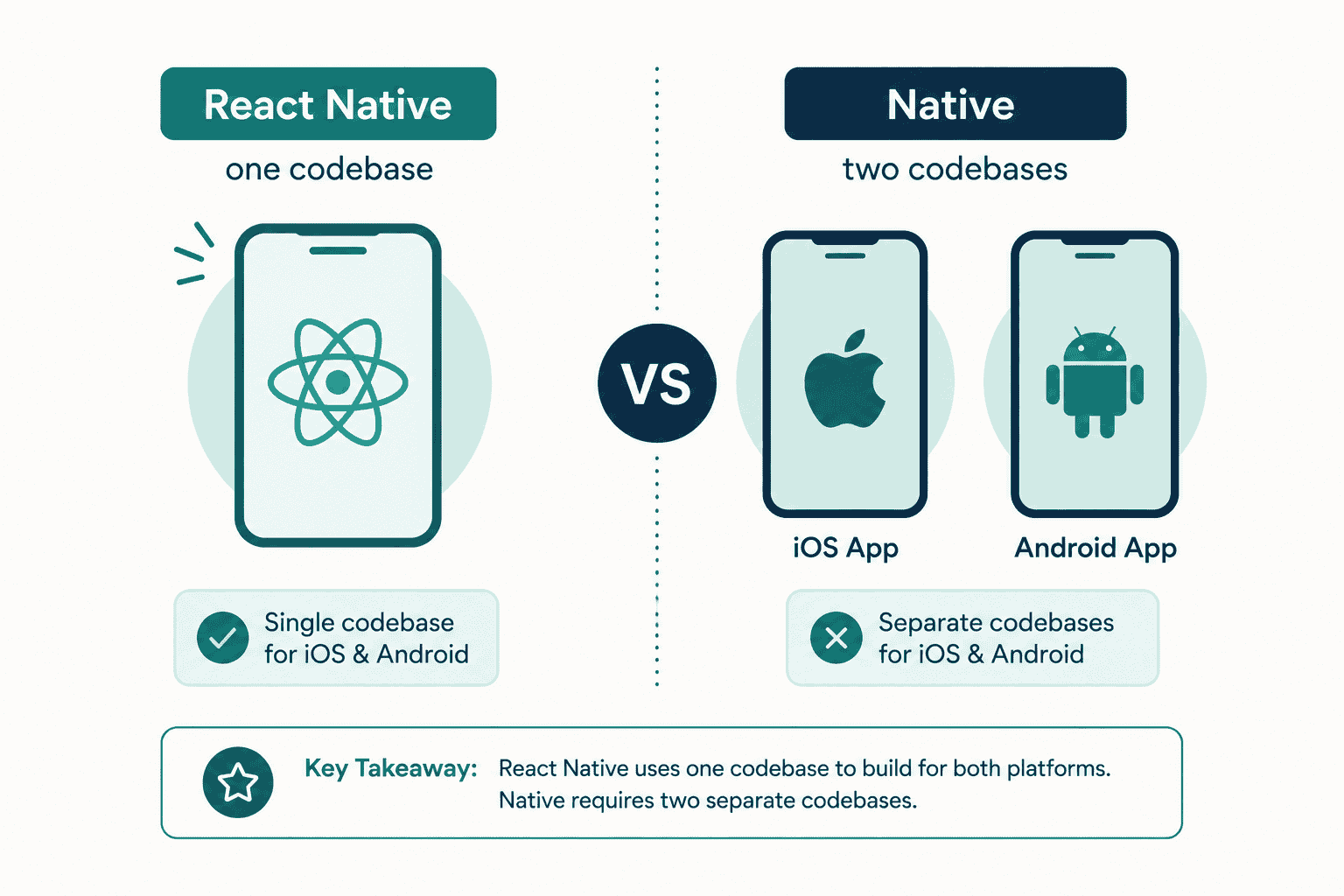
"React Native is slower than native" is one of the most repeated claims in mobile development, and one of the least examined. It was true, meaningfully so, several years ago. It is a far weaker claim today. This guide gives an honest, current comparison, what performance parity actually looks like in 2026, the real cost and speed trade-offs, when native genuinely is the right call, and what ongoing maintenance looks like for each path.
The Short Comparison, Then the Detail
| React Native (2026) | Native (Swift / Kotlin) | |
|---|---|---|
| Architecture | Bridgeless, JSI direct communication since 0.82 | Direct platform-native execution |
| JavaScript engine | Hermes V1, bytecode precompiled, default since 0.84 | Not applicable |
| Codebase | One, shared across iOS and Android | Two, separate per platform |
| Performance for standard apps | At or very close to native | Native ceiling |
| Performance for processor-intensive work | Slightly behind native | Native ceiling |
| Cost | Lower, one codebase to build and maintain | Higher, effectively two builds |
| Time to market | Faster, feature parity by default | Slower, features built twice |
| Best fit | Standard business apps, most consumer and enterprise products | Cutting-edge platform features, processor-intensive workloads |
Performance Parity in 2026: What Actually Changed
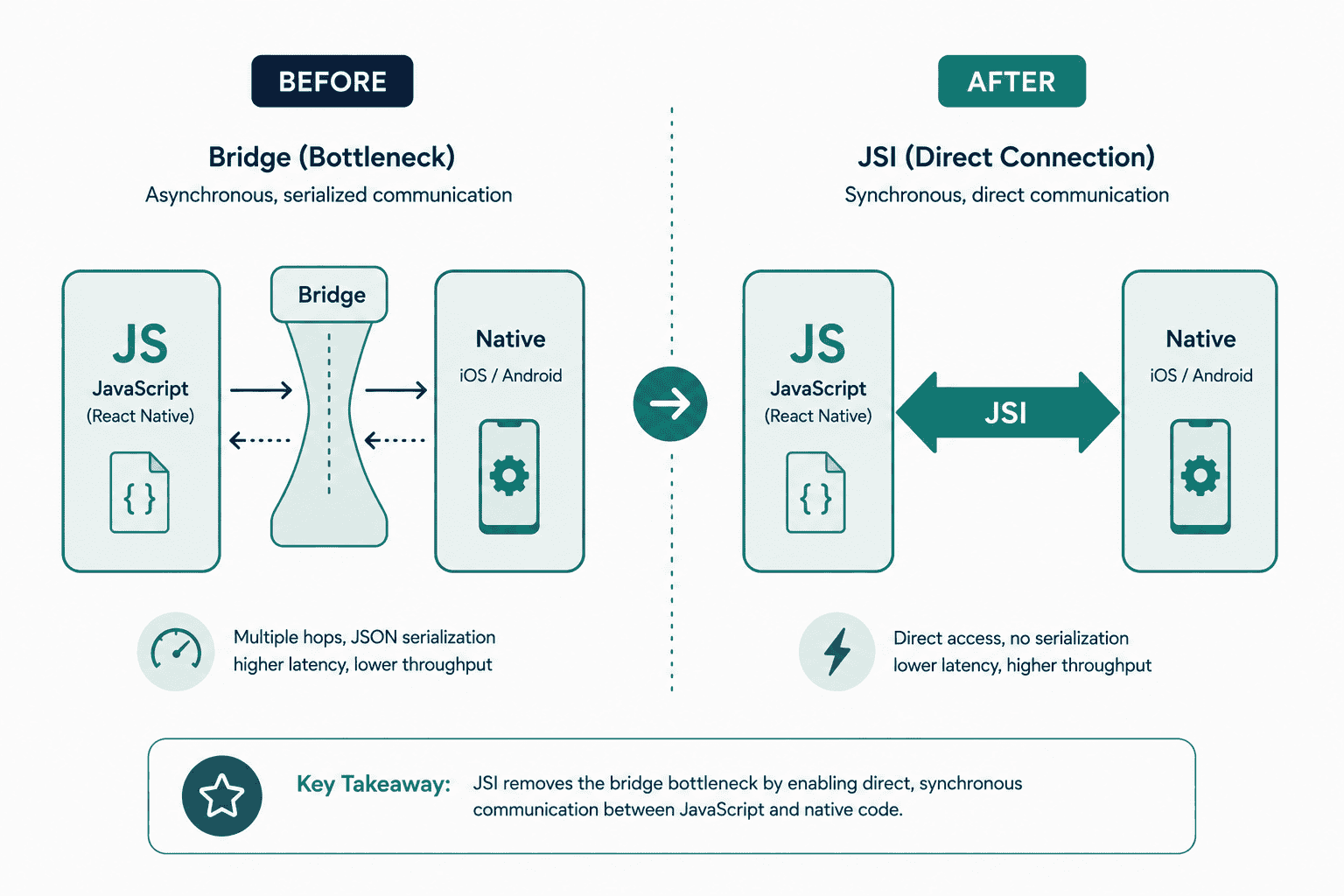
The reputation React Native earned years ago was built on a real architectural bottleneck, the old bridge, which required every call between JavaScript and native code to be serialized into JSON, passed across an asynchronous boundary, and deserialized on the other side. That overhead was genuinely visible in janky scrolling, delayed touch response, and slow list rendering.
That bridge is gone. As of React Native 0.82, the legacy bridge was permanently removed, and the New Architecture, built on JSI, Fabric, TurboModules, and Codegen, is now the only architecture React Native apps run on. JSI lets JavaScript and native code communicate directly and often synchronously, eliminating the serialization step that caused most of the old overhead. Hermes V1, the JavaScript engine now used by default since version 0.84, compiles JavaScript to bytecode ahead of time and brought a rewritten compiler and improved garbage collection, further reducing startup time and memory use.
The practical result reported by teams who have migrated: meaningfully faster cold starts, smoother list rendering, and reduced memory usage compared to the pre-Bridgeless architecture. For a standard business app, forms, lists, dashboards, typical navigation, this closes the performance gap to the point where it is no longer a meaningful factor in most decisions. The gap has not disappeared entirely, but it has moved from "obviously noticeable" to "requires a benchmark to detect" for the overwhelming majority of real-world use cases.
Independent production migrations reported after adopting the New Architecture commonly cite cold starts improving by roughly 40%, rendering performance improving by a similar margin, and memory usage dropping by around a quarter. These are not marketing figures from React Native's own team, they are numbers reported by teams who migrated real, shipped apps and measured the before and after directly. That kind of independently reported improvement is a stronger signal than any single benchmark, since it reflects real production conditions rather than a controlled test environment.
Cost and Speed: Where the Real Difference Still Lives
Even with the performance gap narrowed, the cost and development-speed difference between the two approaches remains real and significant, arguably more decisive now than raw performance is.
Development cost. React Native means writing the large majority of your app once and shipping to both iOS and Android. Native means building and maintaining two separate codebases in two different languages, Swift for iOS and Kotlin for Android, effectively duplicating a meaningful share of the engineering effort.
Time to market. A single shared codebase means feature parity between platforms by default, rather than needing to build, test, and ship the same feature twice, once for each platform, often with two different teams or the same team context-switching between two different technical environments.
Talent pool and hiring. React Native draws on the much larger JavaScript development community, which tends to mean faster hiring and a wider pool of candidates than sourcing separate, specialised Swift and Kotlin developers for a native build.
Iteration speed after launch. Testing a new feature or an experiment across both platforms simultaneously, rather than building and validating it twice on separate schedules, matters more than it might first appear once a product moves from initial build into an ongoing cycle of real user feedback and iteration. A team shipping weekly updates feels this difference constantly, not just at the initial build stage.
None of this means native is a bad choice, it means the cost of choosing native is real and ongoing, not a one-time premium, and it should be weighed against a genuine, specific reason to pay it, not assumed as the safer default.
When Native Is Actually Required
Being honest about this list matters, since overstating it is how agencies justify a more expensive build regardless of whether the project actually needs it.
Cutting-edge platform features on day one. When an app needs to use a brand-new OS capability the moment it ships, before cross-platform bridges have caught up to support it, native is the only reliable path.
Processor-intensive, real-time work at the performance ceiling. High-end gaming, professional-grade video or audio processing, and similarly demanding workloads still benefit from native's direct hardware access in ways cross-platform frameworks, even with the New Architecture, do not fully close.
Deep, sustained use of platform-specific APIs. An app built heavily around capabilities unique to one platform's ecosystem, rather than functionality common to both, often fits native development more naturally than forcing a cross-platform abstraction over something that was never meant to be shared.
Existing native codebases with significant ongoing investment. If a business already has a mature, well-maintained native app with a large existing codebase, the case for a full rewrite in React Native needs to be genuinely strong, migration has real cost and risk that a fresh build does not.
Outside of these situations, for the large majority of business apps, standard interfaces with typical interaction patterns, React Native is not a compromise, it is the sensible, well-supported default.
Maintenance: The Ongoing Cost Most Comparisons Skip
The maintenance difference compounds every year an app stays in production, and it is often underweighted compared to the upfront build decision.
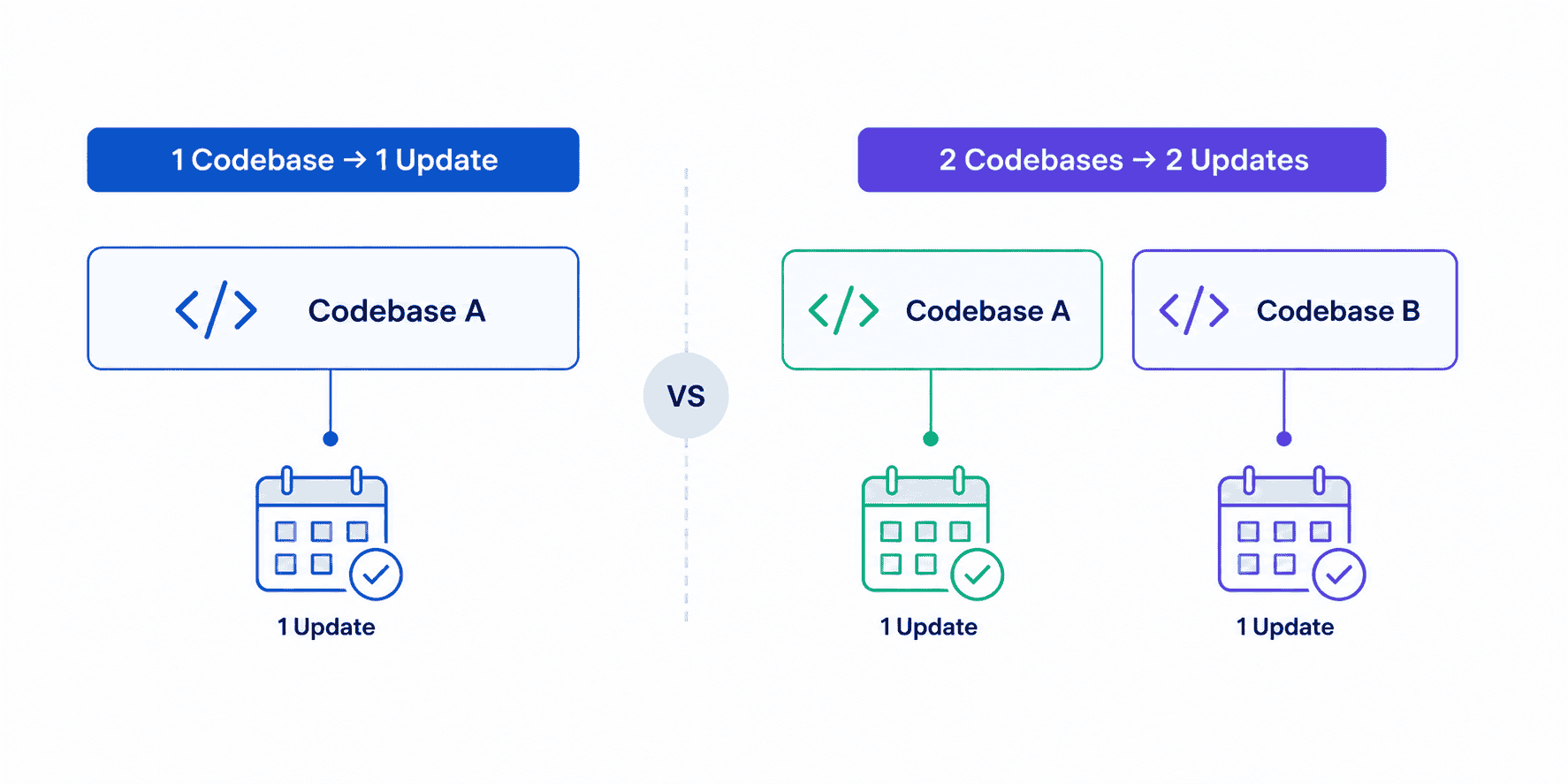
One codebase means one place to fix things. A bug fix, a security patch, or a small feature request in a React Native app is built once and ships to both platforms. The same fix in a native app means implementing, testing, and shipping it twice, in two different languages, potentially by two different specialists.
Platform updates still need attention either way. Both approaches require ongoing work to handle new OS releases, but a shared codebase means that work happens once per year across the whole app, rather than twice, once for each native codebase, doubling the surface area that needs reviewing after every major Apple and Google release.
Team continuity is simpler with one codebase. A React Native team can generally cover the whole app. A native team typically needs distinct iOS and Android specialists, and losing either one creates a real gap that is harder to backfill quickly than losing a member of a unified team.
In Practice
This comparison sits alongside the broader decisions covered in our complete guide to mobile app development in the UK, and if you are also weighing React Native against Flutter specifically rather than against native, our dedicated comparison of the two covers that decision in the same honest detail. If you want a specific, honest read on whether your own app genuinely needs native or is well served by cross-platform, our mobile application development service is a good place to have that conversation directly.
The honest 2026 answer is this: React Native's old performance reputation is out of date, and native is no longer the safe default it once was for most business apps. Native still earns its place for a specific, real set of use cases, but for everything else, the deciding factor has shifted from raw performance to cost, speed to market, and how sustainably the app can be maintained over the years it will actually be in use.
FAQ
Questions, Answered.
Read next
More on Mobile Applications
App Store Optimisation and Launch Strategy for New Apps
The real ASO basics, how to build a listing that converts, managing reviews, a genuine launch plan, and how post-launch iteration actually drives growth.

Designing Mobile UX That Keeps Users Coming Back
Real mobile UX practices that drive genuine retention, onboarding, performance, navigation, accessibility, and what actually keeps users coming back.

From Web App to Mobile App: When and How to Make the Leap
Real reasons to go mobile, how much code and logic you can actually reuse, honest cost, and how to phase the transition from a web product to mobile properly.