
Resources
React Native vs Flutter: Which to Choose in 2026
A genuinely balanced 2026 comparison of React Native and Flutter on performance, ecosystem, hiring, and cost, plus where each one actually wins.

Prem Kumar
Mobile Engineer, Devity Technologies
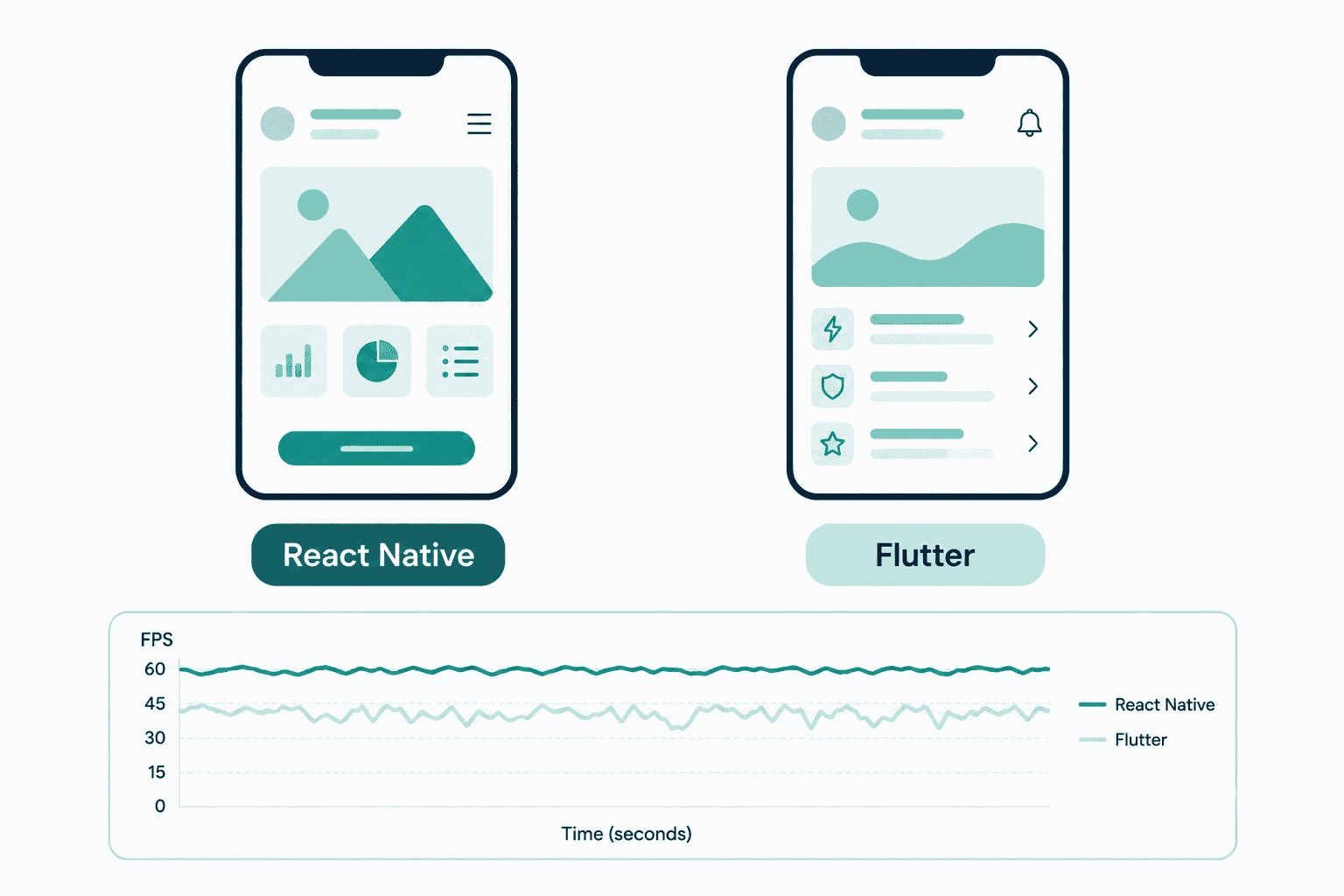
Flutter versus React Native is one of the most searched comparisons in mobile development, and also one of the most commonly answered with recycled 2022 opinions that no longer reflect how either framework actually performs today. Both have shipped major architectural changes since then. This is a genuinely balanced, current comparison, performance, ecosystem, hiring, cost, and where each framework actually wins, based on where things stand in 2026, not where they stood three years ago.
The Short Comparison, Then the Detail
| React Native | Flutter | |
|---|---|---|
| Language | JavaScript / TypeScript | Dart |
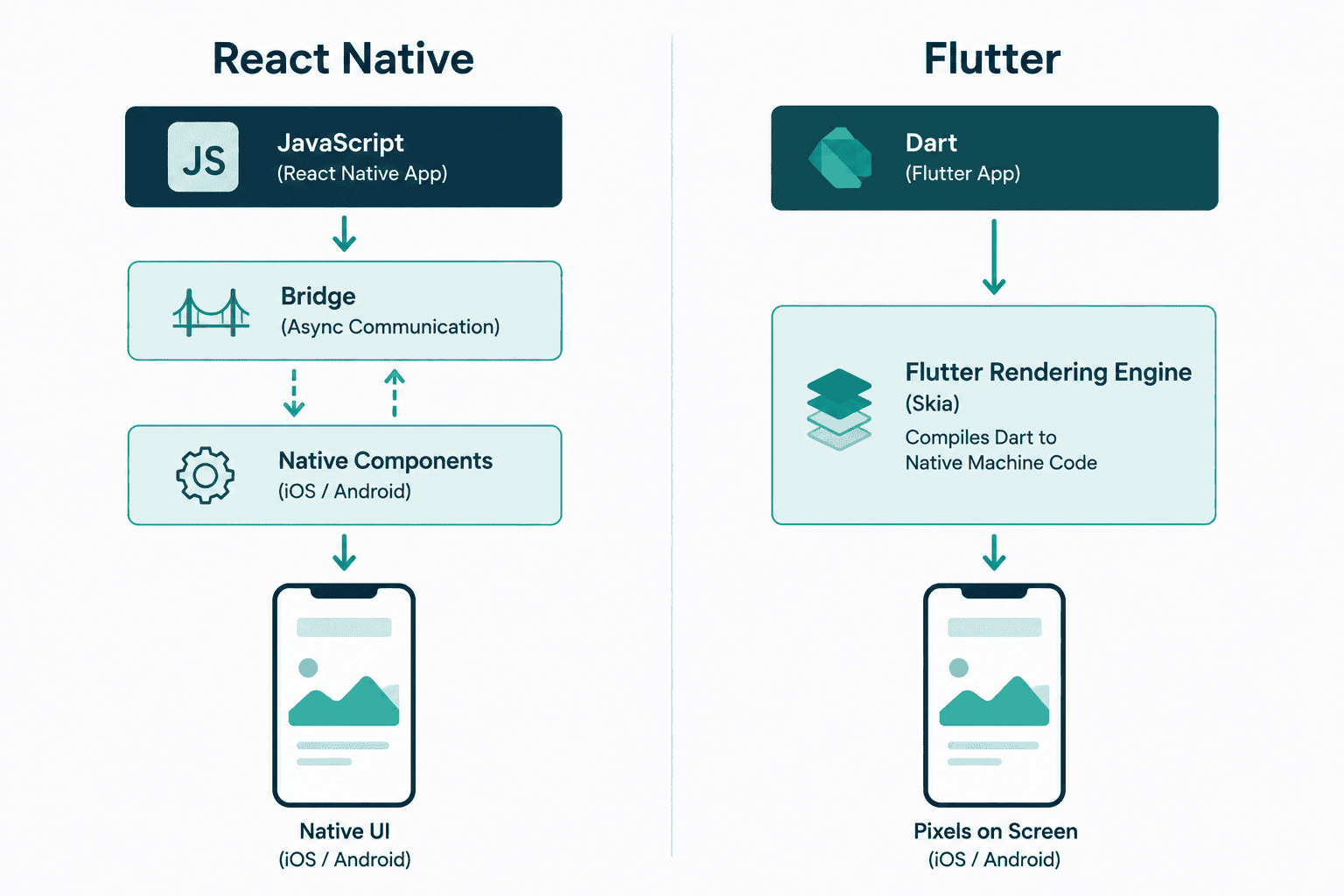
| Rendering approach | Real native UI components via Fabric | Own rendering engine (Impeller), draws every pixel itself |
| Performance profile | Faster cold start, lower battery use | Higher, more consistent frame rates on complex UI |
| Market share (2026) | Roughly 35 to 38% | Roughly 46% |
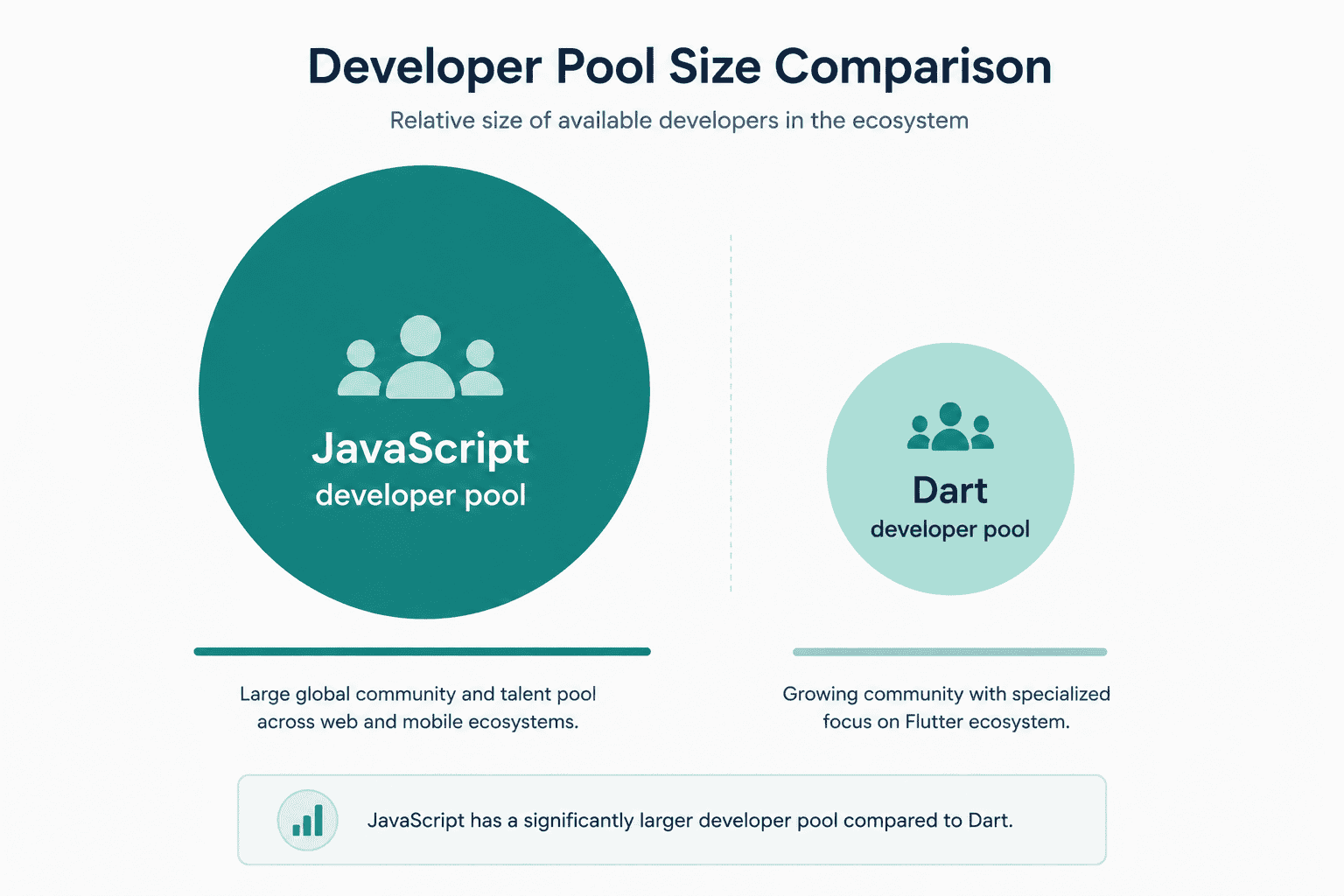
| Talent pool size | Larger, 3 to 5x Flutter's Dart pool | Smaller, growing faster year over year |
| Visual consistency across platforms | Good, uses native components per platform | Excellent, pixel-identical by design |
| Backed by | Meta | |
| Best fit | Teams with existing JavaScript or React experience | Teams prioritising animation, visual polish, or multi-platform reach |
Performance: The Gap Has Narrowed, Not Disappeared
Both frameworks made real architectural leaps recently. React Native's New Architecture, built around Fabric, JSI, and TurboModules, has been the default since version 0.76, enabling synchronous communication between JavaScript and native code that closes most of the responsiveness gap that used to define the framework's reputation. Flutter's Impeller rendering engine, now the default and only renderer on modern platforms, removed the shader-compilation stutter that used to affect first renders, and compiles Dart ahead of time into native machine code.
The current, independently benchmarked picture: Flutter tends to hold a real edge on raw rendering performance for complex, animation-heavy interfaces, typically landing around 58 to 60 frames per second against React Native's low 50s in recent test suites. React Native counters with a faster cold start, commonly cited at roughly 200 milliseconds quicker, and lower battery consumption, since it renders through real native UI components rather than bundling its own rendering engine.
The honest conclusion most current benchmarking converges on: for the large majority of business apps, forms, lists, dashboards, typical navigation and interaction patterns, this performance gap is no longer wide enough to be the deciding factor on its own. It becomes genuinely relevant primarily for apps with heavy, sustained animation or highly custom visual design, where Flutter's rendering approach has a real, measurable advantage.
Ecosystem: Two Different Kinds of Maturity
React Native's ecosystem is built on JavaScript, which means access to the largest programming language community in the world, a vast library of existing packages, and a natural fit for teams that already have web React experience. Meta continues to run React Native across Facebook, Instagram, and Messenger at genuinely massive scale, meaning architectural changes get real-world production stress-testing before reaching your own codebase.
Flutter's ecosystem is younger but has matured significantly, with built-in testing tools, a unified rendering approach that gives pixel-perfect visual consistency across platforms, and an expanding reach beyond mobile into desktop and, more recently, embedded devices. Google's own products and several high-profile consumer apps run on Flutter in production.
Neither ecosystem is objectively more mature across every dimension. React Native wins on raw package breadth and community size. Flutter wins on having a single, cohesive framework where UI consistency and built-in tooling do not depend on assembling third-party pieces yourself.
This distinction matters differently depending on what you are building. A team building a fairly standard app, authentication, a data feed, a few common integrations, benefits enormously from React Native's sheer volume of existing, battle-tested packages covering nearly any common requirement. A team building something more custom, with interaction patterns and visual design that do not map onto common off-the-shelf components anyway, benefits less from that package breadth and more from Flutter's consistent, self-contained rendering approach, since there is less value in a large package ecosystem when much of the interface is being custom-built regardless.
Hiring: The Practical Constraint Most Comparisons Underweight
This is where the two frameworks diverge most concretely, and it is worth taking seriously as a real project constraint, not an afterthought.
React Native draws from the JavaScript talent pool, which is roughly three to five times larger than Flutter's Dart-specific pool. For a founder needing to hire quickly, or a team that already has JavaScript or React web developers who could reasonably pick up React Native, this is a genuine, practical advantage that shows up directly in hiring timelines and cost.
Flutter's hiring pool is smaller in absolute terms but growing faster year over year, and Dart is generally considered approachable to learn for a developer with existing programming experience. For a team building from scratch with no existing language commitment either way, this gap matters less than it does for a team trying to reuse existing engineers.
Cost: Closer Than the Headline Numbers Suggest
Both frameworks deliver meaningful cost savings, commonly cited in the range of thirty to sixty percent, compared to building genuinely separate native iOS and Android codebases, since both let a single team ship to both platforms from largely one codebase.
Where a real cost difference tends to show up is less about the framework itself and more about team availability and existing skills. If your team already knows JavaScript, React Native has a real head start on both timeline and cost. If you are hiring fresh either way, the frameworks are close enough in raw development cost that the decision should rest on other factors, not a meaningful price gap between them.
Where Each Framework Actually Wins
React Native wins when your team already has JavaScript or web React experience, when hiring speed and talent pool size matter to your timeline, when your app is a fairly standard business application without heavy custom animation needs, and when you want the reassurance of a framework running in production at Meta's own scale.
Flutter wins when visual consistency and animation quality are core to your product's experience, when you are building something visually ambitious or interaction-heavy from the start, when your roadmap genuinely includes expanding beyond mobile into desktop, and when your team is starting fresh with no existing language commitment pulling toward JavaScript.
A hybrid approach is a real, valid option some larger organisations use, Flutter for a polished, customer-facing app where visual consistency is the priority, React Native for internal tools where development speed and reusing an existing JavaScript team matters more than pixel-perfect animation. This is not a compromise so much as recognising that different parts of a product can have genuinely different priorities.
If you strip away every other consideration, the single most useful question to ask honestly is this: what does your team already know, and does your product's success depend more on animation-heavy visual polish or on shipping quickly with people who already understand your chosen language. Nearly every other factor in this comparison, cost, hiring speed, ecosystem fit, follows from the answer to that one question more directly than from any abstract benchmark score.
The 2026 Updates, Summarised
For a founder who last looked at this comparison a couple of years ago, the specific changes worth knowing: React Native's New Architecture is now the default in new projects, not an opt-in experiment, closing most of the old performance gap. Flutter's Impeller engine is now the only renderer on modern platforms, eliminating the first-render stutter that used to be a real, visible issue. Both frameworks have reached genuine production maturity, and the current market split sits roughly in the mid-40s percent for Flutter and mid-to-high-30s percent for React Native, with both continuing to power apps serving hundreds of millions of users.
In Practice
This comparison sits alongside the broader decisions covered in our complete guide to mobile app development in the UK, including the wider native-versus-cross-platform question this article assumes you have already resolved in favour of cross-platform. If you want an honest recommendation for your specific app, team, and timeline rather than a generic answer, our mobile application development service is a good place to have that conversation directly.
Neither framework is the objectively correct choice in 2026, both are genuinely production-ready, well-supported, and capable of delivering an excellent app. The right decision comes down to your team's existing skills, how central animation and visual polish are to your specific product, and how much hiring flexibility actually matters for your timeline, not which framework happened to win the loudest argument online this year.
FAQ
Questions, Answered.
Read next
More on Mobile Applications

App Store Optimisation and Launch Strategy for New Apps
The real ASO basics, how to build a listing that converts, managing reviews, a genuine launch plan, and how post-launch iteration actually drives growth.

Designing Mobile UX That Keeps Users Coming Back
Real mobile UX practices that drive genuine retention, onboarding, performance, navigation, accessibility, and what actually keeps users coming back.

From Web App to Mobile App: When and How to Make the Leap
Real reasons to go mobile, how much code and logic you can actually reuse, honest cost, and how to phase the transition from a web product to mobile properly.