
Resources
How to Build a Mobile App MVP That Investors Take Seriously
How to scope a mobile app MVP investors actually take seriously, must-haves versus nice-to-haves, realistic timeline and cost, and what investors genuinely look for.

Prem Kumar
Mobile Engineer, Devity Technologies
A mobile app MVP built to impress investors and one built to validate a real product are not always the same thing, and conflating them is a common, costly mistake. This guide covers how to scope a mobile MVP properly, what genuinely counts as must-have versus nice-to-have, a realistic timeline and cost, and what investors are actually looking for, which is rarely what founders assume.
Scope
The same scoping discipline that applies to any MVP applies directly here, covered in more depth in our guide to building an MVP, the smallest version of the product that lets you validate whether real users want it, not a smaller version of your full product vision.
For a mobile app specifically, this means resisting the pull toward polish before validation. A beautifully designed app with five secondary features and no proof anyone actually uses the core one is a weaker asset in front of an investor than a rougher app with clear evidence the primary hypothesis holds. Scope around the one core loop your product depends on, and build that loop properly before adding anything else.
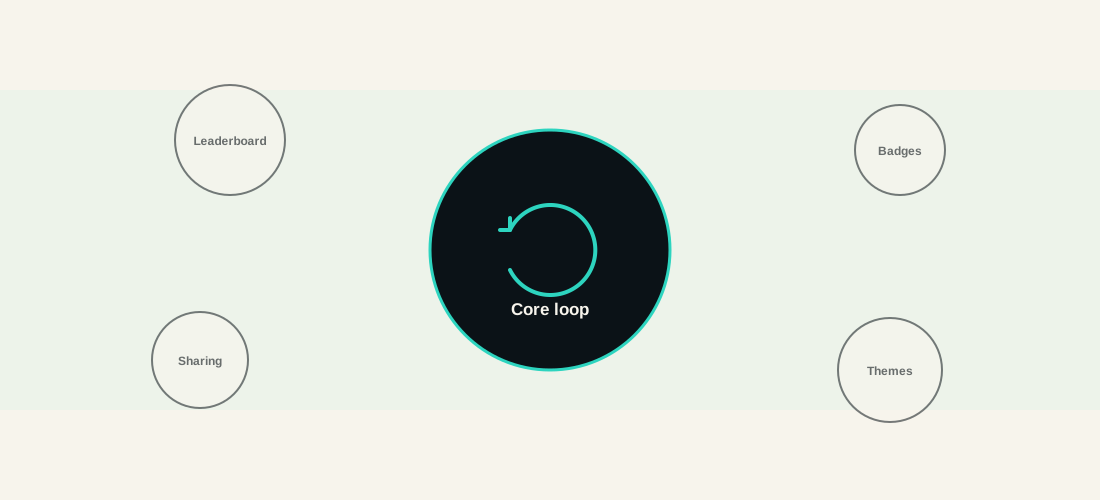
A concrete example makes this tangible. A social fitness app whose core hypothesis is that users will stay more consistent with workouts when paired with a friend needs exactly one thing built well, the pairing and check-in loop, tested against whether paired users actually show better consistency than unpaired ones. A leaderboard, achievement badges, and integration with wearable devices might all belong in the eventual product, but none of them test the core hypothesis, and building them first only delays the one piece of evidence that actually matters for a fundraising conversation.
Must-Have vs Nice-to-Have
Must-have covers whatever is required for a real user to experience your core value proposition, start to finish, and for you to observe whether they actually do. If a feature is not directly load-bearing for that loop, it does not belong in the MVP, regardless of how quick it feels to add.
Nice-to-have covers everything that would improve the experience without being necessary to test the core hypothesis, a polished onboarding flow, a referral system, deeper personalisation. These matter for a mature product and are frequently a distraction at MVP stage, since they consume budget and time without answering the one question the MVP actually exists to answer.
A useful discipline specific to mobile: if a feature exists mainly to make the demo look more impressive rather than to generate genuine usage data, it is very likely a nice-to-have wearing a must-have's justification.
| Feature type | Must-have | Nice-to-have |
|---|---|---|
| Core loop | The one action the hypothesis depends on | N/A, always included |
| Onboarding | Simple enough not to block the loop | Polished, branded, multi-step |
| Notifications | Only if core to the loop itself | Rich, personalised push campaigns |
| Social features | Only if the hypothesis is social | Leaderboards, sharing, badges |
| Design system | Consistent and usable | Fully custom, animated, branded |
Timeline
For a properly scoped mobile MVP, eight to twelve weeks from discovery through to something real users can download and use is a realistic range, consistent with the timelines covered in our complete guide to mobile app development in the UK. This breaks down roughly into discovery and scoping, design focused on the core loop rather than a full design system, the build itself, and initial testing on real devices before release.
Timelines stretching well beyond this range are usually a scope signal, not a complexity signal, the same pattern that applies to MVPs generally applies here specifically. A founder under real fundraising time pressure should treat a ballooning MVP timeline as a prompt to cut scope further, not to accept a longer build.
Cost
A lean, properly scoped mobile MVP typically costs between fifteen and forty thousand pounds, depending on integration complexity, design polish, and how many platform-specific capabilities the core loop genuinely requires. Cross-platform development, typically React Native, is the right default for almost every startup MVP, one codebase covering both iOS and Android at meaningfully lower cost and faster timeline than a native build, which matters directly when the goal is reaching real user data as efficiently as possible.
Spending significantly beyond this range before validating real demand is usually a signal that scope has quietly grown past what an MVP is meant to be, building toward an imagined future product rather than testing the actual hypothesis in front of you right now.
What Investors Actually Look For
This is where founder assumptions and investor reality most often diverge, and getting it wrong wastes the exact budget and time an MVP was meant to spend efficiently.
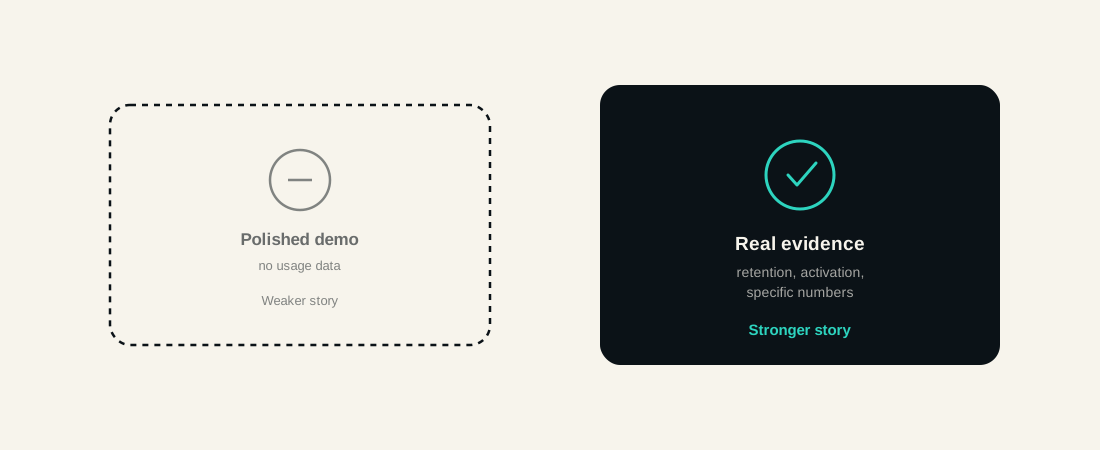
Real evidence over polish. A working demo shows the product exists. It does not show anyone wants it. Investors who have seen hundreds of polished demos are looking specifically for signs of genuine usage, retention over multiple sessions, activation rates, users returning without being prompted, not just a smooth click-through.
A clear, specific hypothesis and what was learned testing it. Investors respond well to founders who can say precisely what they believed, what they built to test it, and what the real data showed, including where it was not what they expected. This demonstrates the kind of honest, evidence-driven thinking investors are actually betting on, more than the app itself.
Evidence of capital efficiency. An MVP built lean, for a defensible cost, that generated real signal is a stronger story than an expensive, over-built app that still has no usage data to show. Investors are evaluating how you spend money as much as what you built with it, since that pattern is a preview of how you will handle their capital too.
Team execution, not stack choice. Investors rarely care whether the MVP was built native or cross-platform, in this framework or that one. What the technology choice actually signals to them is whether you made a sensible, efficient decision under real constraints, which is a proxy for how you make decisions generally, not a technical evaluation in its own right.
Specific numbers, not vague enthusiasm. "Users love it" is not evidence. "Forty percent of users who tried the core loop returned within a week without any prompt" is. Investors are trained to be skeptical of qualitative claims and responsive to specific, checkable numbers, even small ones from a limited early user base, since a small number with real rigour behind it is more credible than a large, vague claim with none.
In Practice
This guide sits directly between two things we cover in more depth elsewhere, the general discipline of scoping any MVP properly, and the specific realities of mobile development, native versus cross-platform, timeline, and cost. If you are building a mobile MVP and want it scoped in a way that actually generates the evidence investors respond to, not just a polished demo, our mobile application development service is a good place to start that conversation.
The founders who raise successfully on the strength of a mobile MVP are rarely the ones with the most polished app, they are the ones who scoped tightly, spent efficiently, and came back with real evidence that real users engaged with the core thing the business is actually betting on.
FAQ
Questions, Answered.
Read next
More on Mobile Applications
App Store Optimisation and Launch Strategy for New Apps
The real ASO basics, how to build a listing that converts, managing reviews, a genuine launch plan, and how post-launch iteration actually drives growth.

Designing Mobile UX That Keeps Users Coming Back
Real mobile UX practices that drive genuine retention, onboarding, performance, navigation, accessibility, and what actually keeps users coming back.
From Web App to Mobile App: When and How to Make the Leap
Real reasons to go mobile, how much code and logic you can actually reuse, honest cost, and how to phase the transition from a web product to mobile properly.