
Resources
Technical Co Founder Alternatives: Building Without One
The real options for building a product without a technical co-founder, the genuine risks of each, working with an agency well, retaining IP and control, and honest cost.

Ahmad Saeed
Full-Stack Engineer, Devity Technologies
Not having a technical co-founder is one of the most common, and most anxiety-inducing, problems a non-technical founder faces, and it is treated online as far more of a dead end than it actually is. This guide covers the real options for building without one, the genuine risk specific to each, how to work with an agency well, retaining IP and control, and what it honestly costs.
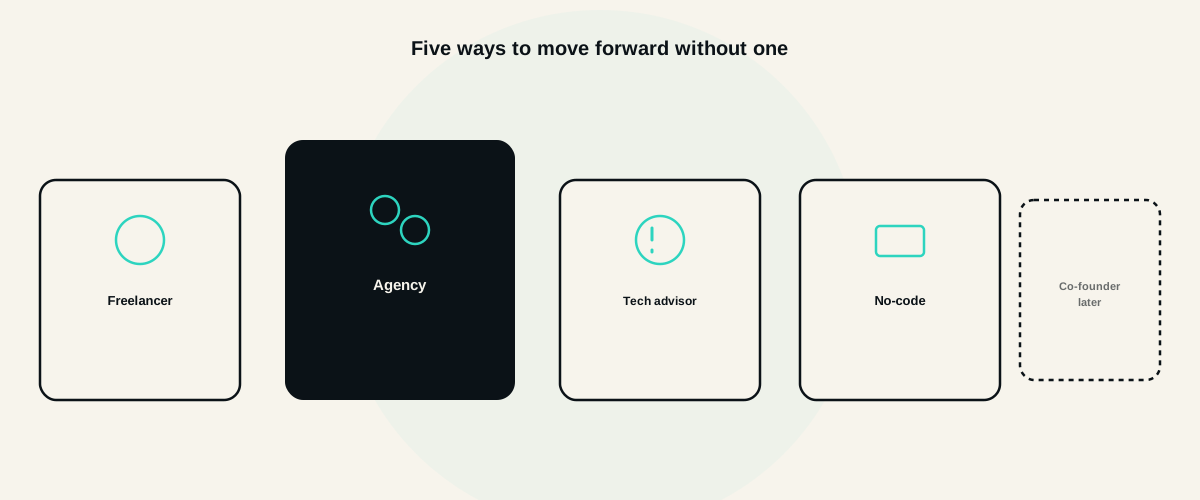
| Option | Best for | Main risk |
|---|---|---|
| Freelance developer | Simple, well-defined builds, tight budget | Single point of failure, no built-in QA |
| Development agency | Most non-technical founders, properly resourced work | Quality varies enormously, needs real vetting |
| Technical advisor + builder | Founders who want independent oversight | Added ongoing cost |
| No-code tools | Very simple products, fastest validation | Ceiling on complexity, possible migration later |
| Technical co-founder later | Post-traction, once genuinely findable | Time and effort of the search itself |
The Options
A freelance developer offers flexibility and typically the lowest hourly cost, at the cost of limited capacity, no design or QA support built in, and real risk if that one person becomes unavailable partway through your build.
A development agency offers a properly resourced team, design, engineering, and process together, at a higher cost than a single freelancer, with quality varying enormously between agencies, making genuine vetting essential rather than optional.
A technical advisor or fractional CTO provides genuine technical judgement and oversight without full-time commitment, often paired with either a freelancer or an agency actually doing the build, adding a real layer of independent technical accountability many non-technical founders otherwise lack entirely.
No-code and low-code tools let a non-technical founder build a genuinely functional first version directly, without hiring anyone at all, appropriate specifically for simpler products, and a real limitation once your product's needs outgrow what the platform can support.
Recruiting a genuine technical co-founder later, once the company has real traction, is still an option worth keeping in view, starting without one is not the same as committing to never having one.
The Risks
Being honest about this matters more than picking a side, since every option carries real, specific risk, not just the ones founders instinctively worry about.
Losing the ability to evaluate technical work critically. This is the risk that cuts across every option, without genuine technical judgement of your own, you are dependent on trusting whoever you hire, with a limited independent way to verify whether their decisions and their work are actually good. This risk does not disappear by picking the "safest" option, it needs to be actively managed, through a trusted technical advisor, a genuinely transparent partner, or investing in enough of your own technical literacy to ask sharper questions.
Misaligned incentives, particularly with a freelancer or agency billing by the hour with no real stake in the product's actual success, a partner motivated purely by billable time has a different incentive than one genuinely invested in your outcome.
Continuity risk, a single freelancer leaving, or an agency's staff turnover disrupting a longer engagement, can stall a project at a genuinely critical moment, with no easy way to pick up where things left off if documentation and handover were never treated seriously.
Outgrowing a no-code foundation without realising it until the limitation is actively blocking a specific, needed feature, at which point a migration becomes a more urgent, more expensive project than it would have been if planned for earlier.
The emotional pressure of not having deep technical knowledge yourself is a real, if less discussed, risk in its own right, it can lead to either over-trusting the first confident-sounding partner who removes the immediate discomfort, or over-correcting into paralysis, endlessly second-guessing every technical decision without a way to actually resolve the uncertainty. Recognising this pressure honestly, and building in a genuine second opinion, whether a trusted advisor or simply a second vetting conversation before committing, helps counter both failure modes.
Working With an Agency Well
An agency is often the most balanced option for a non-technical founder specifically because it replaces a single point of failure with a properly resourced team and process, provided the agency itself is genuinely vetted, not just the cheapest or most available option.
Start with a small, defined engagement, an MVP or a discovery phase, covered in more depth in our guide to building an MVP, rather than a large, open-ended commitment, so you can genuinely evaluate fit before a bigger, harder-to-reverse decision.
Look for genuine product thinking, an agency that asks why a feature matters and pushes back constructively on scope, not one that simply builds whatever is requested without engaging with what you are actually trying to achieve. We cover this distinction, and the broader question of what to look for in a startup development partner, in our guide to choosing the right development partner for your startup.
Demand real, direct communication access, not a sales-focused account manager standing between you and the people actually doing the work, since you need genuine technical conversations you can actually follow and act on.
Retaining IP and Control
This is the area where a non-technical founder is most exposed, and where genuine diligence matters most.
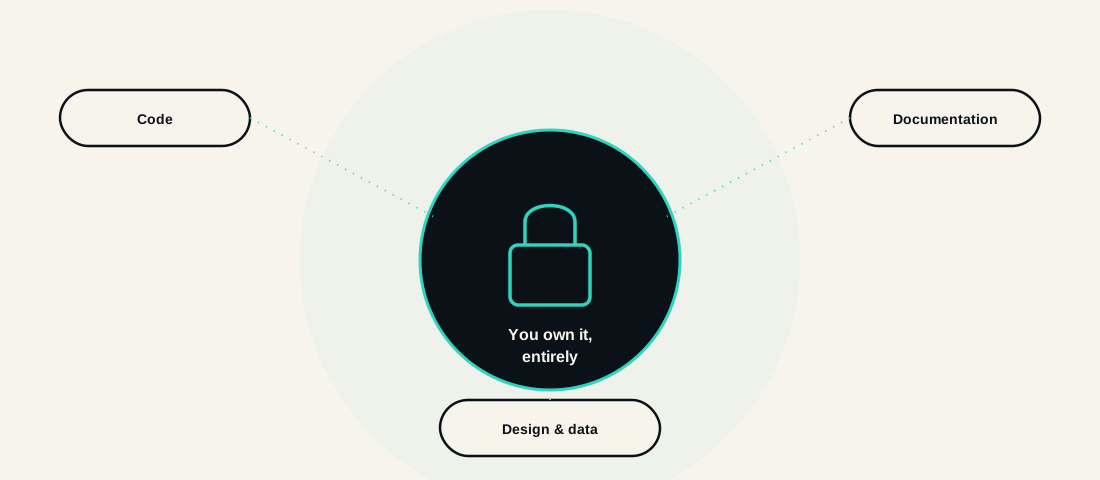
You should own the code, the design, and the documentation entirely, once the project is paid for. This is a basic, non-negotiable expectation from any legitimate partner, not a premium feature to negotiate for. Any hedging on this point, retained partial rights, unclear terms, restrictions on future use, is one of the clearest warning signs available when evaluating any partner.
Get real documentation and a genuine handover plan, not as an afterthought but as a standard, expected deliverable, so that if you ever need to move to a different team, a new developer could actually work from what you have, not start again from nothing.
Understand exactly what you are actually getting, source code you can take anywhere, or access to a platform you do not fully control. A no-code tool, in particular, deserves specific scrutiny here, know clearly whether you can export your work and data if you ever need to leave that platform.
Cost
A freelancer typically offers the lowest hourly rate, with total project cost varying enormously based on scope and how efficiently the engagement is actually managed, since there is no built-in project management layer keeping things on track the way an agency structure provides.
An agency engagement, for a lean, properly scoped MVP, typically runs fifteen to forty thousand pounds, consistent with the ranges covered in our guide to building an MVP, reflecting a properly resourced team rather than a single individual's time.
A fractional CTO or technical advisor adds a real, ongoing cost on top of whichever build option you choose, but for many non-technical founders this cost pays for itself directly, through better vendor selection, sharper technical questions asked at the right moments, and a second set of eyes on decisions that would otherwise be made entirely on trust.
No-code tools carry the lowest upfront cost by a wide margin, with the real cost showing up later if and when a migration to something more capable becomes necessary, a cost worth planning for as a possibility from the start, not a surprise to be dealt with only once it actually arrives.
In Practice
This is exactly the situation we work with regularly, non-technical founders who need a genuine technical partner, not just a contractor executing instructions, and who need real transparency about scope, cost, and ownership from the very first conversation. If you have an idea and no technical co-founder and want an honest read on the right path forward, that conversation costs nothing to have.
The founders who navigate this well are rarely the ones who found a workaround for not having deep technical knowledge themselves, they are the ones who chose their alternative deliberately, understood its specific risks honestly, and insisted on real ownership and transparency from whoever they ultimately trusted to build the thing.
FAQ
Questions, Answered.
Read next
More on MVP & Startup
Choosing the Right Development Partner for Your Startup
What early-stage founders should actually look for in a development partner, technical and product fit, communication, equity versus cash, and the red flags specific to startup engagements.
From Idea to Launch: A Realistic Product Timeline
A genuinely realistic MVP timeline, discovery, design, build, test, and launch, with real durations for each stage and what actually speeds it up or slows it down.
How Startups Should Think About Technical Debt Early
Good technical debt versus bad, building an MVP that can actually change, when refactoring is genuinely worth it, and the real cost of ignoring debt at the earliest stage.