
Resources
How Startups Should Think About Technical Debt Early
Good technical debt versus bad, building an MVP that can actually change, when refactoring is genuinely worth it, and the real cost of ignoring debt at the earliest stage.

Ahmad Saeed
Full-Stack Engineer, Devity Technologies
Technical debt gets treated as something to worry about later, once a startup has scaled and a small, scrappy codebase has grown into something genuinely large. This is exactly backward. The decisions made at MVP stage determine how expensive that debt becomes later, and thinking about it deliberately now is far cheaper than discovering the consequences after a funding round has raised the stakes. This guide covers good debt versus bad, building for genuine change, when to actually refactor, and the real cost of ignoring debt at the earliest stage.
Good Debt vs Bad Debt
This distinction is the single most useful framework for a technical founder to hold, and it is frequently missing from how technical debt gets discussed.
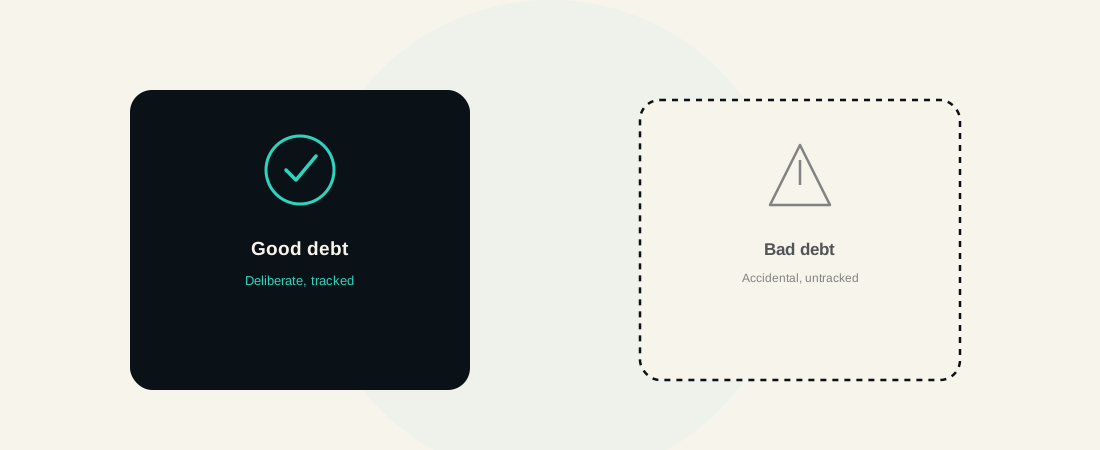
Good technical debt is a deliberate, understood shortcut, taken consciously to validate a hypothesis quickly, with a clear, specific understanding of what was skipped and why, and a real intention to address it once validation actually succeeds. Hardcoding a value that will eventually need to be configurable, skipping a comprehensive test suite for a feature still likely to change significantly, these are reasonable, even correct, choices at MVP stage.
Bad technical debt is an accidental shortcut nobody tracked or decided on deliberately, code that grew messy simply because nobody paused to consider the consequences, not because a conscious trade-off was made. The distinguishing factor is not the shortcut itself, plenty of good decisions look identical to bad ones on the surface, it is whether the trade-off was made deliberately, with genuine awareness of what was being traded away.
| Good debt | Bad debt | |
|---|---|---|
| How it happens | A deliberate, understood trade-off | An accidental shortcut nobody tracked |
| Awareness | The team knows exactly what was skipped and why | Nobody notices until it causes a problem |
| Plan to address it | Exists, tied to a real trigger | None |
| Effect over time | Manageable, tracked | Compounds silently |
Building for Change
An MVP does not need to be architecturally perfect, but it does need to be genuinely changeable, since the entire point of an MVP is that it will change substantially based on what you actually learn from real users.
Clean separation between core business logic and specific implementation details matters more than almost any other single architectural decision at this stage, it means a database choice, a specific third-party service, or a particular framework detail can change later without requiring a full rewrite of how the product actually works.
Avoid decisions that are genuinely difficult to reverse. Some technical choices are cheap to change later if they turn out wrong, and some are expensive and disruptive to unwind. The specific database technology chosen is often reversible with real but manageable effort. A data model built around assumptions that turn out to be fundamentally wrong is often far more expensive to fix, since it touches nearly everything else built on top of it.
Document the shortcuts you deliberately take, even briefly, a short, honest note on what was skipped and why is enough to turn an invisible, accidental piece of debt into a tracked, deliberate one a future decision can actually be made about.
When to Refactor
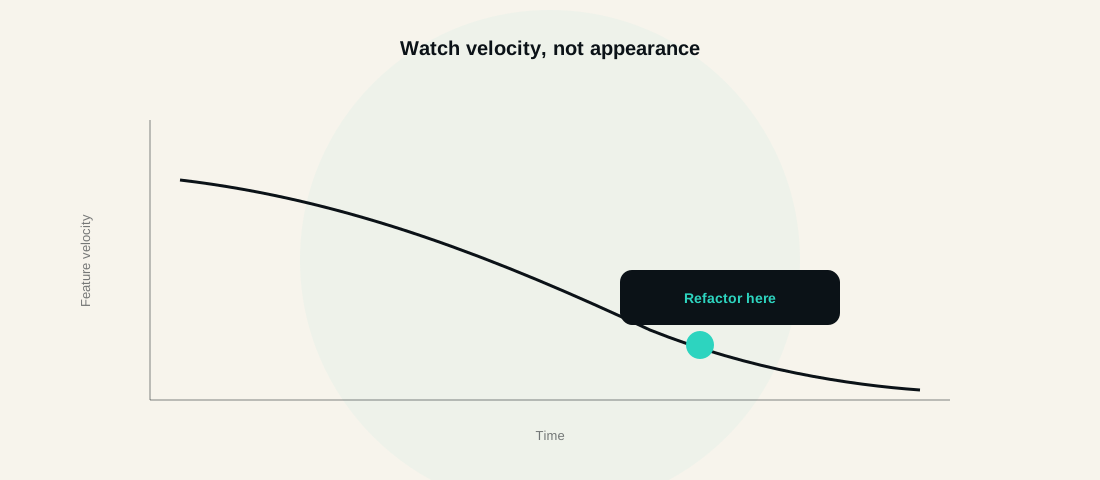
The right signal for when to refactor is measurable impact on velocity, not a fixed schedule and not simply because a piece of code looks imperfect to whoever is currently looking at it.
Refactor when technical debt is measurably slowing the team down, when adding a new feature increasingly requires untangling old shortcuts first, or when a specific area of the codebase has become the place bugs disproportionately originate from, these are real, observable signals worth acting on directly.
Do not refactor purely because code could theoretically be cleaner. Code that works reliably and isn't currently slowing anything down is not automatically worth the engineering time to improve, that time is usually better spent on the next feature that actually needs building, provided the debt itself isn't compounding in the background.
Prioritise refactoring the specific areas the product is actively built around, the core, frequently touched parts of the codebase benefit far more from being clean than a peripheral feature rarely revisited, refactoring effort is not evenly valuable across an entire codebase, and treating it as though it were wastes real engineering time on the wrong priorities.
The Cost of Ignoring It
This is where genuine, compounding cost actually shows up, and it is worth understanding clearly rather than treated as an abstract, distant concern.
Debt compounds. A shortcut that would have taken a day to properly address early can take considerably longer once several other decisions have been built directly on top of it, each addition making the underlying problem harder and riskier to untangle than it was the day before.
Ignored debt eventually blocks the features that actually matter. At a certain point, accumulated technical debt does not just slow development down, it actively prevents shipping the specific features that would justify further investment or the next funding round, a genuinely dangerous position for a startup to find itself in at exactly the moment speed matters most.
A funded founder's stakes are genuinely higher than a pre-funding founder's. Once real capital and investor expectations are involved, the cost of technical debt discovered too late is not just engineering time, it is credibility with people who are actively watching how efficiently that capital gets deployed.
A concrete illustration: a startup ships an MVP with a data model built around an assumption, that every customer has exactly one account, that seemed entirely reasonable at the time. Eight months and real customer growth later, a genuine business need emerges for multi-account customers, and the team discovers this assumption is woven through nearly every part of the system, authentication, billing, permissions, reporting. What should have been a two-week feature addition becomes a multi-month structural rework, precisely because the original shortcut was never tracked as a deliberate, revisitable decision, just an assumption nobody thought to question until the business had already grown around it.
In Practice
Thinking about technical debt deliberately from the MVP stage onward is exactly the discipline covered in our broader guide to building an MVP, and it is a genuine architectural conversation worth having directly with an engineer, not left to be discovered accidentally once the codebase has already grown significantly. If you want a technical read on whether your current MVP's architecture is carrying deliberate, manageable debt or accidental, compounding risk, that conversation is worth having now, not after the next funding round has raised what is genuinely at stake.
The technical founders who navigate this well are rarely the ones who avoided all technical debt entirely, that is neither possible nor actually desirable at MVP stage, they are the ones who took on debt deliberately, tracked it honestly, and refactored based on real, measured impact rather than either ignoring it completely or obsessing over code quality the MVP genuinely didn't need yet.
FAQ
Questions, Answered.
Read next
More on MVP & Startup

Choosing the Right Development Partner for Your Startup
What early-stage founders should actually look for in a development partner, technical and product fit, communication, equity versus cash, and the red flags specific to startup engagements.
From Idea to Launch: A Realistic Product Timeline
A genuinely realistic MVP timeline, discovery, design, build, test, and launch, with real durations for each stage and what actually speeds it up or slows it down.
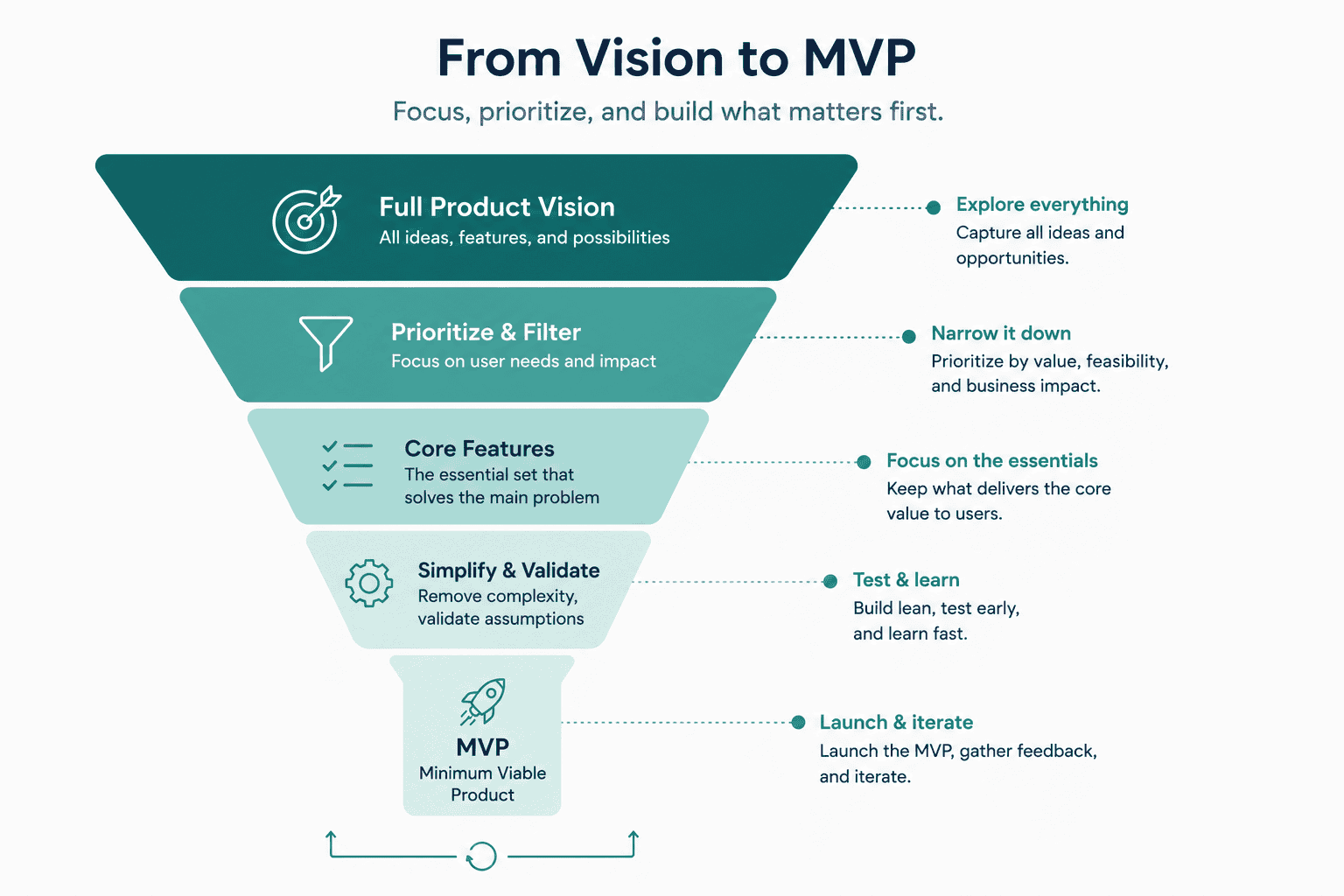
How to Build an MVP: A Founder's Step by Step Guide
A grounded, step by step guide to building an MVP, defining the real problem, scoping it right, timeline, cost, and the mistakes that sink most first products.