
Resources
In House vs Agency vs Offshore: The Honest Comparison
A genuinely honest comparison of in-house, agency, and offshore software development on cost, quality, control, communication, and risk, and when each one actually fits.

Ahmad Saeed
Full-Stack Engineer, Devity Technologies
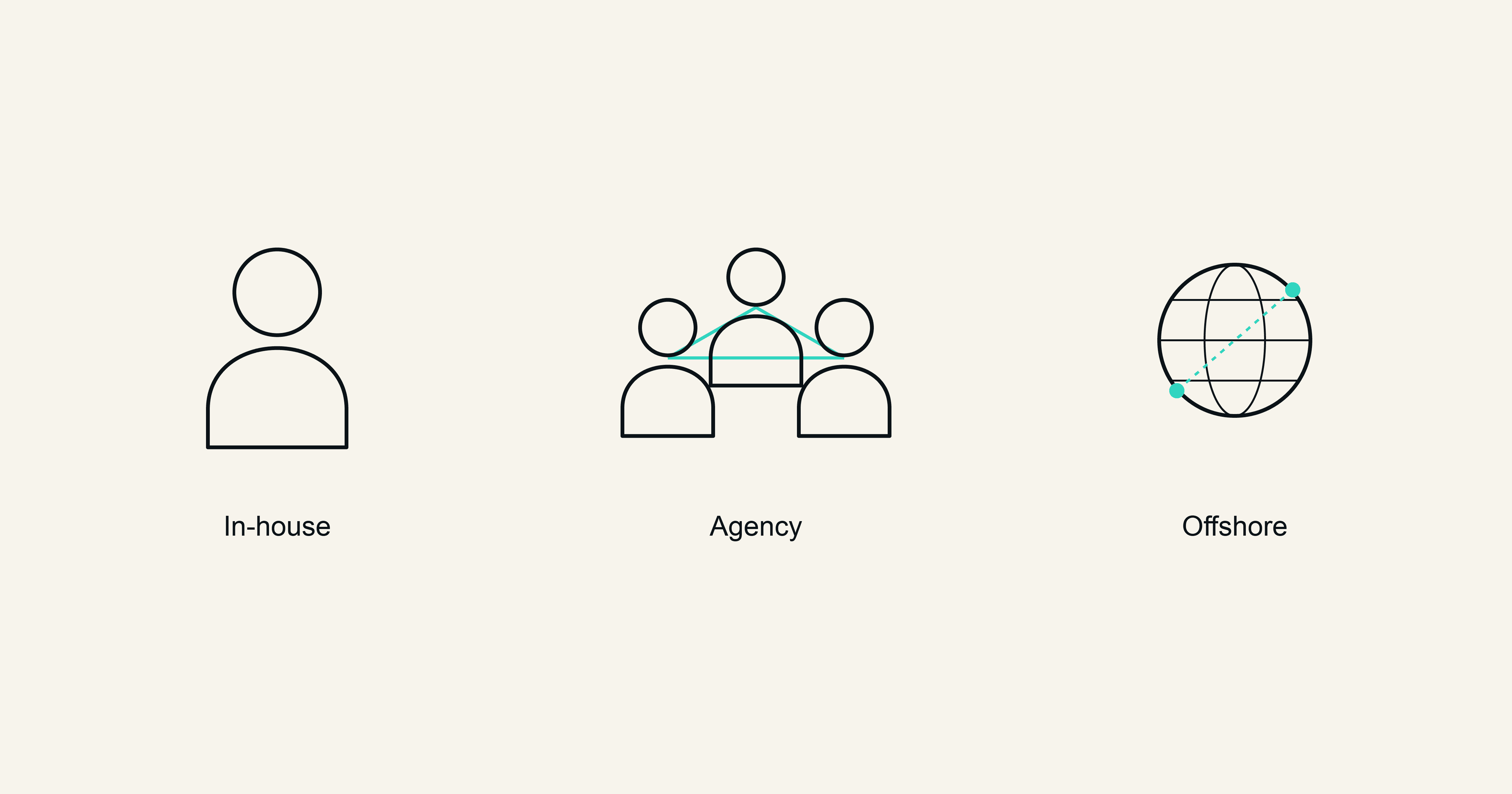
The in-house versus agency versus offshore question gets answered dishonestly more often than not, usually by whoever is selling one of the three options. This is an attempt at a genuinely fair comparison, cost, quality, control, communication, and risk, covered honestly for all three, including where offshore development's old reputation is out of date and where it genuinely still carries real risk worth taking seriously.
The Short Comparison, Then the Detail
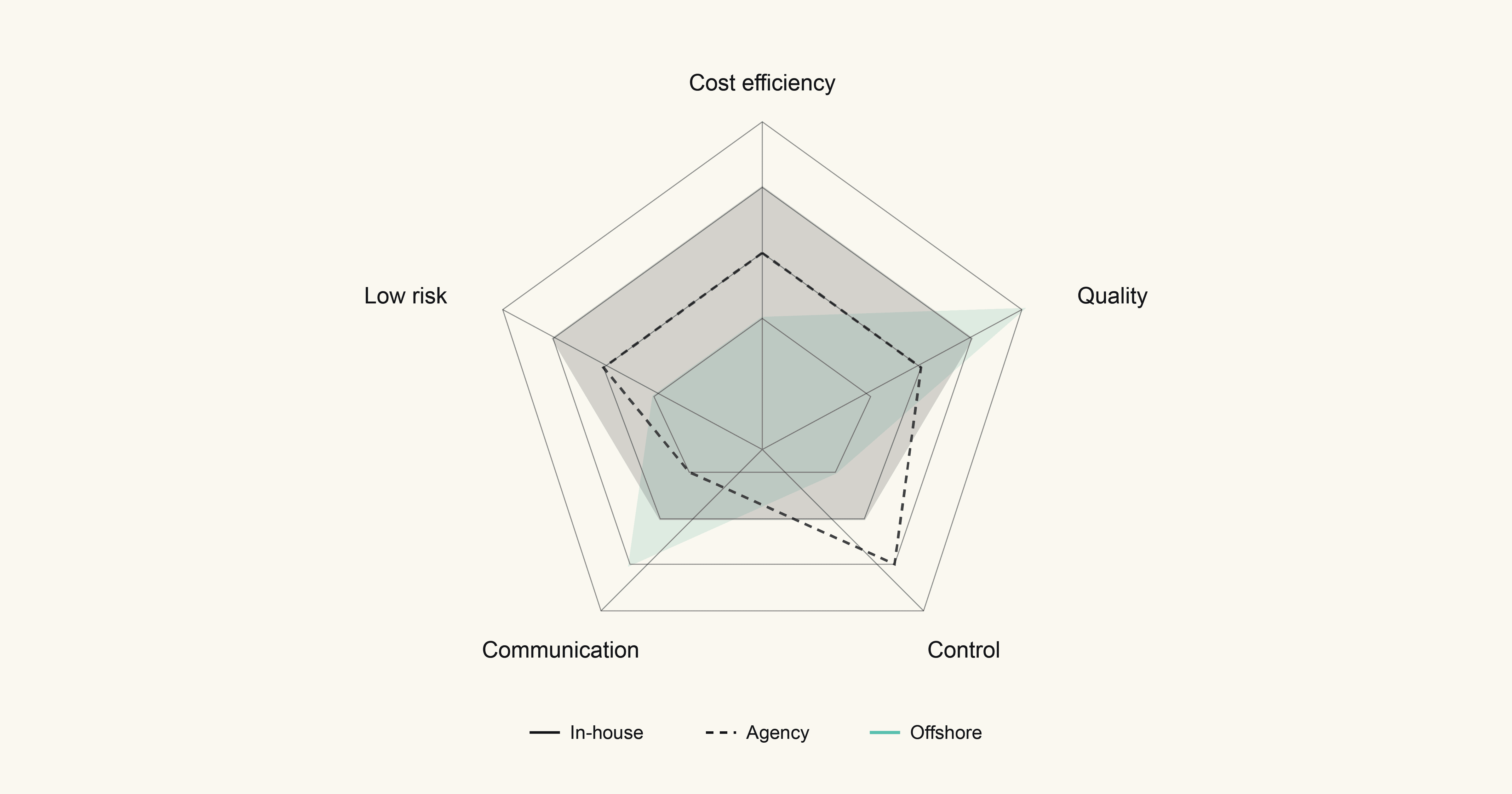
| In-House | Agency | Offshore / Remote | |
|---|---|---|---|
| Cost per person | Highest, salary plus benefits and overhead | Mid-range, varies by location and model | Lowest headline rate, real savings vary by team quality |
| Control | Highest, direct employment | Moderate, buying an outcome, not direct hours | Can be high with a dedicated team |
| Ramp-up time | Slowest, recruitment plus onboarding | Fast, team already assembled | Fast, but time zone fit matters |
| Product knowledge continuity | Strongest over time | Moderate, depends on account continuity | Strong with a dedicated, stable team |
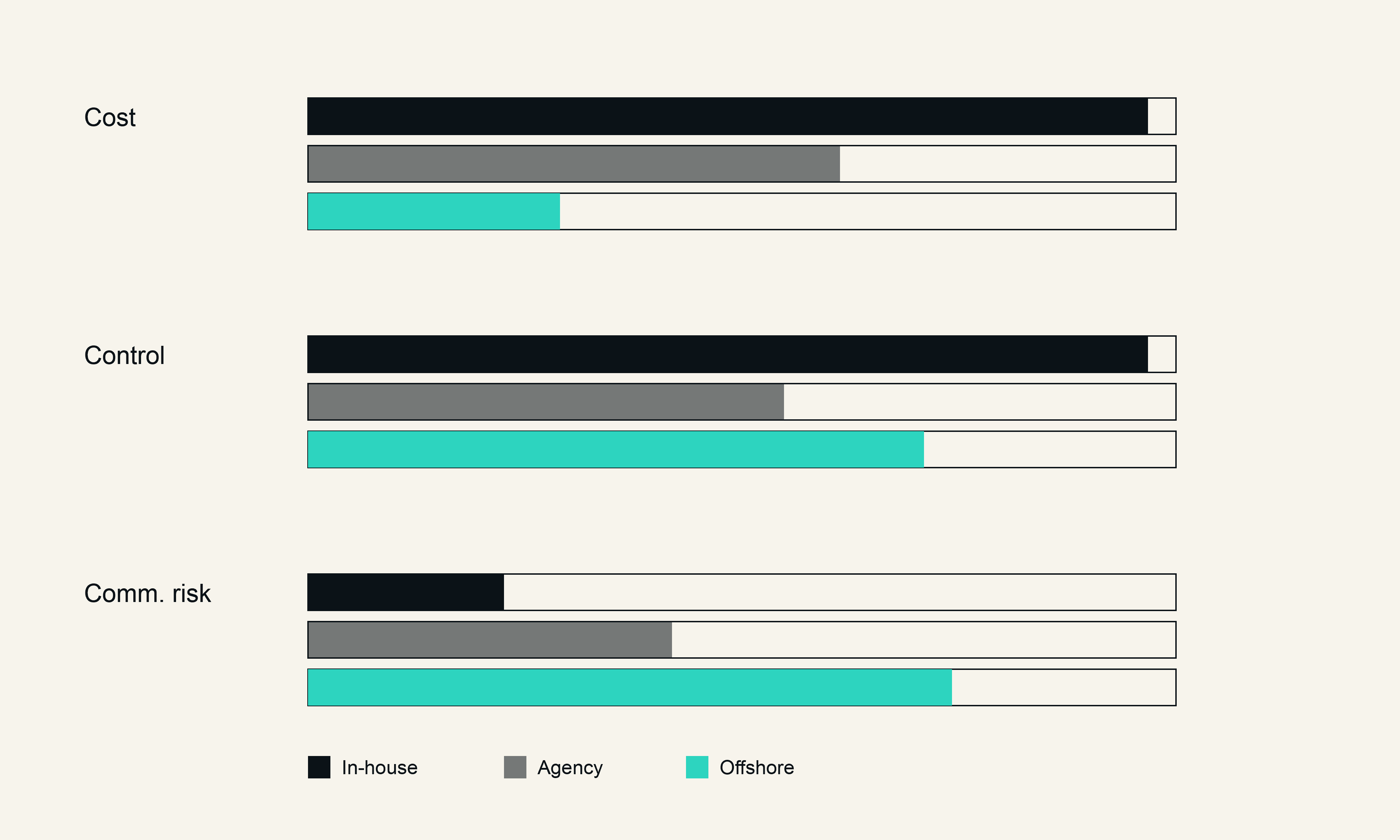
| Communication risk | Lowest, same time zone and culture | Low to moderate | Highest variable, depends on the specific team |
| Best fit | Core, ongoing, central work | Defined projects, seasonal capacity | Cost-sensitive, well-specified work |
Cost: The Real Numbers, Not Just the Headline Gap
In-house is consistently the most expensive option per person, once you account for salary, benefits, recruitment cost, management overhead, and the ramp-up time before a new hire is genuinely productive. Senior engineering talent in major Western markets commands substantial annual salaries before any of those additional costs are even factored in.
Agencies typically sit above offshore rates and below full in-house cost, though the range varies enormously depending on the agency's location, seniority mix, and business model. A meaningful detail often missed: traditional staffing agencies commonly mark up a contractor's actual pay significantly, and some charge a separate conversion fee if you later want to hire that person directly, costs that only become visible once you are already committed.
Offshore development offers the clearest headline cost advantage, senior developer rates in lower-cost regions commonly run a fraction of equivalent Western market rates. This gap is genuinely real, not a myth, but the honest caveat is that the true cost comparison needs to include communication overhead and any rework caused by misalignment, which can quietly erode the headline savings if the specific team's process and communication discipline are weak.
Quality: A Team Problem, Not a Geography Problem
This is the area where outdated assumptions do the most damage to good decision-making. Offshore development has matured substantially, distributed engineering practices, structured workflows, and modern collaboration tooling that once felt genuinely risky offshore are now standard practice at reputable offshore teams, not the exception.
The honest truth is that quality varies far more by the specific team's seniority, process discipline, and communication culture than by which broad category, in-house, agency, or offshore, they fall into. A poorly managed in-house team can produce weak, inconsistent work just as easily as a poorly chosen offshore contractor. A genuinely senior, well-run offshore team can outperform an underqualified local agency charging considerably more. Geography is a weak proxy for quality, evaluating the specific team in front of you is a far more reliable signal.
The practical implication is that due diligence should focus on the team, not the category. Real code samples, a genuine reference you can speak with directly, and specific questions about how the team has handled a past project going sideways all reveal far more about likely quality than any assumption based on where the team happens to be located.
Control: What You Actually Give Up and Keep
In-house offers the highest degree of direct control, the team works exclusively on your product, absorbs your company culture, and builds deep, compounding product knowledge over time that is genuinely difficult to replicate any other way.
Agencies typically retain more control over their own process and internal team structure than an in-house hire would, since you are buying a service and outcome rather than directing individual employees day to day. This is not automatically worse, a mature agency's own process discipline is often a genuine asset, but it does mean less granular control than direct employment.
Offshore teams, particularly dedicated teams working exclusively on your product rather than split across many clients, can offer control much closer to an in-house arrangement than the term "offshore" often implies, the meaningful distinction is dedicated versus shared attention, not simply geography.
Communication: Where Real Risk Actually Lives
Communication is the genuine risk factor most comparisons underweight relative to cost, and it deserves to be treated as seriously as any other line item in the decision.
Time zone overlap determines how much real-time collaboration is realistically possible. A team with little to no working-hours overlap forces async-only communication, which works for well-defined, well-documented work and struggles for anything requiring frequent, fast back-and-forth clarification.
Language and cultural fluency affect how easily nuance, priorities, and unstated assumptions actually transfer, independent of raw English proficiency, this includes shared context about how business is typically discussed, what "urgent" actually means, and how directly feedback gets communicated.
Process and documentation discipline matter more than physical proximity ever did. A remote or offshore team with excellent written communication, clear documentation, and disciplined async updates can genuinely outperform a co-located team with sloppy communication habits, distance is not the root cause of poor communication, weak process is.
Risk: The Honest List
In-house risk centres on key-person dependency and slow ramp-up, losing a critical team member creates a real gap, and hiring a replacement takes meaningful time before they reach full productivity.
Agency risk centres on alignment and continuity, a portion of an agency's attention is shared across other clients, and staff turnover on the agency's side can disrupt continuity on a long engagement without you having direct visibility into it.
Offshore risk centres specifically on communication breakdown and, in weaker arrangements, genuinely inconsistent quality control, both of which are real and worth taking seriously, but are properties of a specific team's discipline, not an inherent property of the offshore model itself.
A risk that cuts across all three is a weak handover or transition, whether onboarding a new in-house hire, switching agencies, or changing offshore providers. The cost of losing accumulated product knowledge and rebuilding shared context is real regardless of which model you are moving between, which is why continuity, not just the initial hiring decision, deserves ongoing attention rather than a one-time evaluation.
When Each Model Actually Fits
In-house fits when the work is core, ongoing, and central enough to the business that deep, compounding product knowledge justifies the higher cost, and when the business has the scale to justify full-time roles rather than project-based work.
An agency fits when you need a properly resourced team with design, engineering, and process already assembled, for a defined project or a season of heavier work, without the overhead of building that capability internally from scratch.
A dedicated offshore or remote team fits when cost efficiency genuinely matters, the work can be well-specified and documented, and the team you choose has demonstrated real communication discipline, not just a lower rate card.
A hybrid approach, a lean in-house core supplemented by an external team for specific needs or additional capacity, is increasingly common for good reason, it is not a compromise between the three options, for many growing businesses it is genuinely the best fit, combining the product continuity of a stable core team with the flexibility external capacity provides.
In Practice
Devity's own model sits deliberately in that blended space, a small, senior team based remotely, working direct hours with UK and Australian clients, without the layered account-management structure or the junior-heavy staffing pyramid that inflates cost at many larger agencies. This is not a claim that our model is right for every business, the honest framework above still applies, evaluate the specific team, not the category they fall into. If you want to talk through which model genuinely fits your specific project, our approach and background are worth a look, and our guide to choosing an automation partner covers many of the same vetting questions worth asking regardless of which model you land on.
The businesses that make this decision well are not the ones chasing the cheapest rate card or defaulting to whichever model feels safest by reputation, they are the ones who evaluate the actual team in front of them, ask the uncomfortable questions about communication and continuity honestly, and choose based on what the specific work genuinely requires.
FAQ
Questions, Answered.
Read next
More on Choosing & Trust
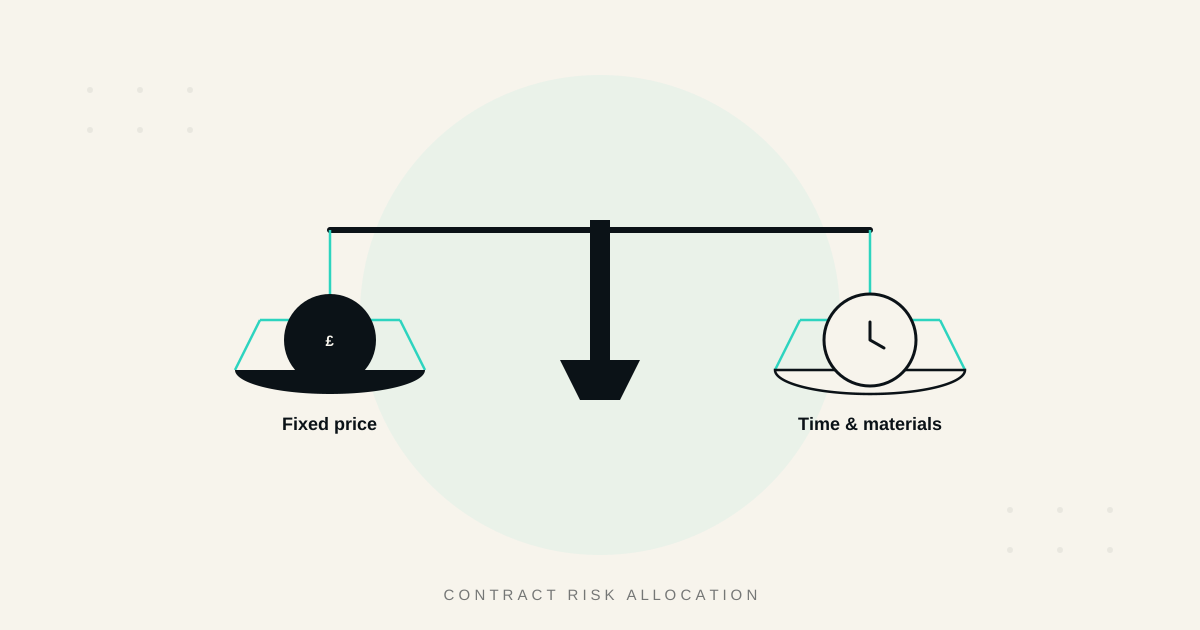
Fixed Price vs Time and Materials: Which Contract Protects You
How fixed-price and time-and-materials contracts actually work, who carries the risk in each, when each one genuinely fits, and why a hybrid is often the smarter choice.
How to Budget for a Software Project Without Nasty Surprises
A practical guide to budgeting a software project realistically, scoping for budget, genuine contingency, change control, phasing, and tracking spend as you go.
How to Vet a Remote or Offshore Development Team
A genuine due diligence framework for vetting a remote or offshore development team, references, trials, communication and timezone fit, and IP and security.