
Resources
How to Choose an AI Automation Agency in the UK
A practical, honest checklist for vetting AI automation agencies, the questions to ask, how to spot a no-code shop dressed up as engineering, and what real ROI evidence looks like.

Mohid Bhatti
AI Systems Engineer, Devity Technologies
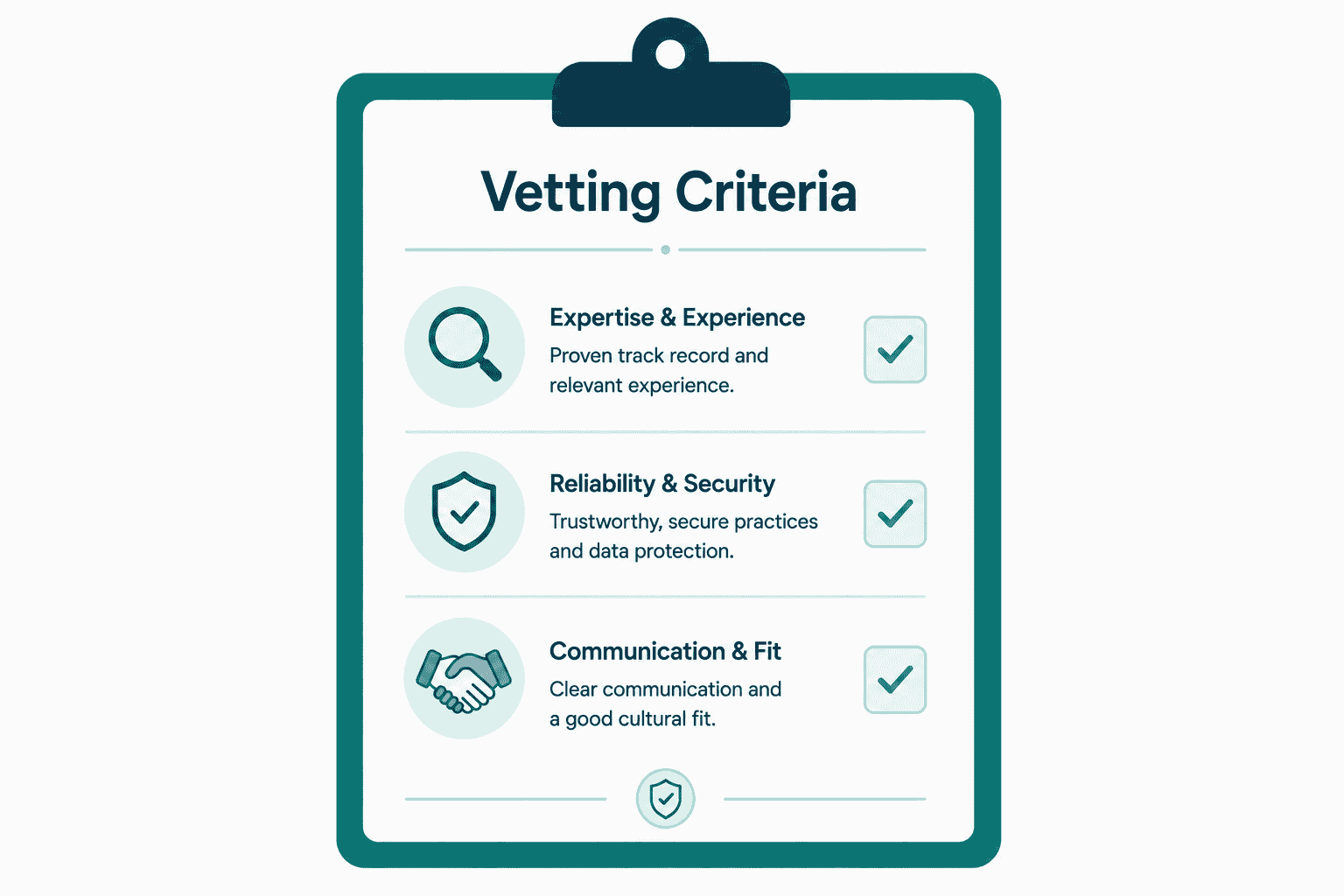
The AI automation agency market in the UK has grown fast enough that nearly every website now uses the same language, intelligent agents, automated workflows, measurable outcomes, regardless of whether real engineering sits behind it. This guide is a practical, honest checklist for evaluating a vendor, the questions worth asking directly, how to tell genuine engineering from a no-code implementation wearing different branding, what real ROI evidence actually looks like, the compliance questions too many buyers skip, what proper support should include, and why starting small is the right instinct, not a compromise.
Questions to Ask in the First Conversation
A handful of direct questions reveal more in twenty minutes than a proposal document will in twenty pages.
Ask them to explain your project back to you, in one paragraph. After discussing your workflow, a genuinely engaged agency should be able to summarise it clearly, the workflow, the business reason behind it, the tools involved, who is affected, and how success will be measured. If that summary comes back vague or generic, the discovery conversation has not actually landed yet, no matter how confident the pitch sounded.
Ask how many similar systems they have actually shipped to production, not built for a demo or a case study slide. Production use surfaces problems a demo never encounters, and an agency with real production experience will have specific, sometimes unglamorous stories about what broke and how it was fixed.
Ask whether they use their own product internally. An agency that has never put its own automation approach to work on its own operations is telling you something about how much they trust it under real conditions.
Ask for a reference you can actually contact, not just a logo on a case studies page. A short conversation with a genuine past client tends to reveal more about how an engagement actually felt than any amount of marketing copy.
Ask how they would handle a scope change discovered mid-project. Real automation projects almost always surface something unexpected once real workflows and real data are involved. An agency with a calm, clear process for handling that, rather than either rigid inflexibility or an open-ended arrangement with no cost discipline, tends to produce both a better outcome and fewer unpleasant surprises on the final invoice.
No-Code vs Custom: Spotting the Difference Before You Sign
This is the distinction that determines whether a system holds up under real, evolving business conditions or quietly becomes fragile the moment something unexpected happens.
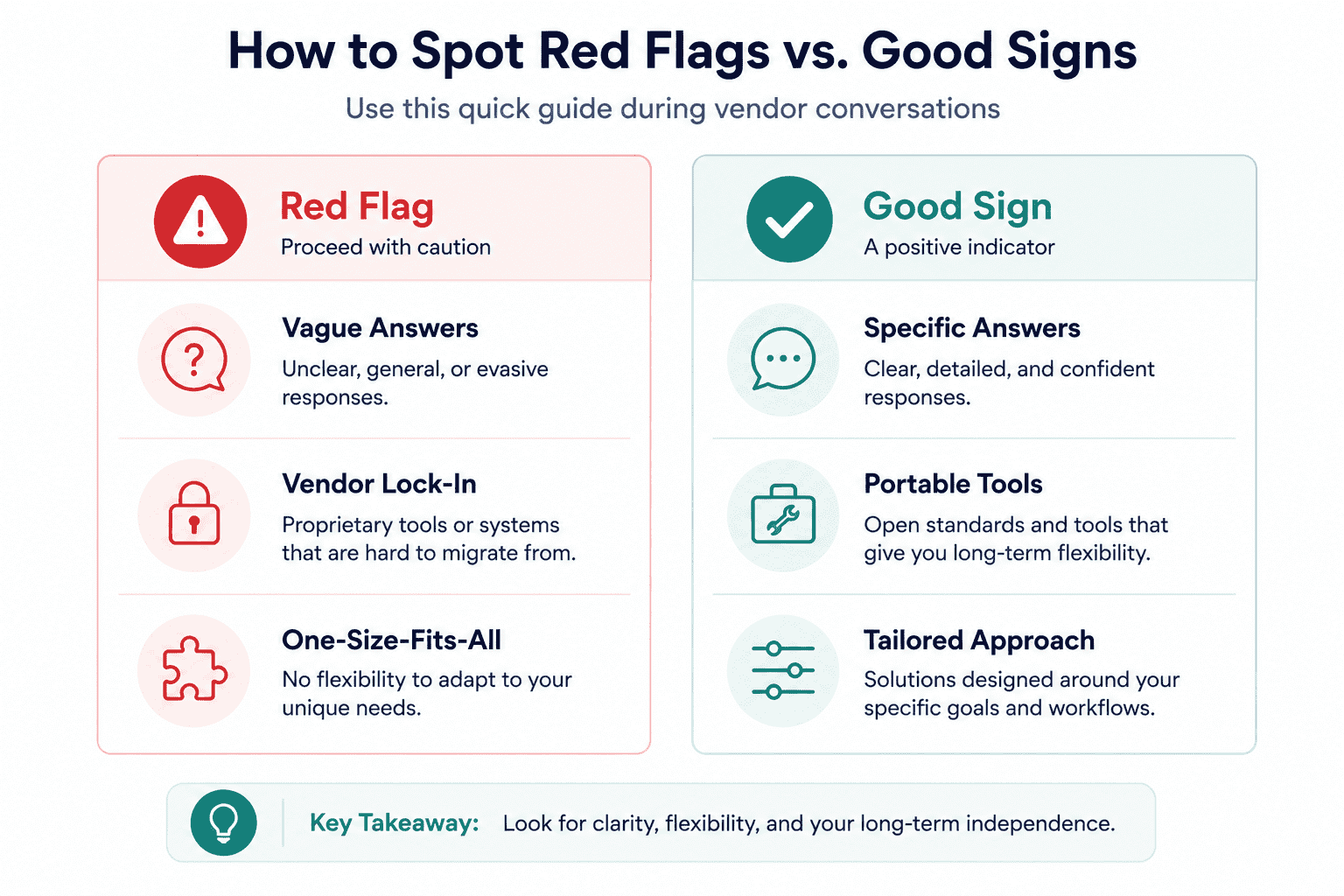
Ask directly what happens when the automation encounters an input it has not seen before. A no-code implementation typically fails silently or stalls, since it is following fixed, predefined logic. A genuinely engineered system should have monitoring, fallback handling, and a clear, specific answer for what happens next, not a shrug.
Ask whether they are proposing a tool or a system. If the answer to nearly every requirement is "we will build that in n8n" or an equivalent no-code platform, you are likely working with an implementer, which is not necessarily wrong for a simple, well-defined workflow, but is worth knowing clearly before you commit budget expecting something more.
Ask about vendor lock-in specifically. An agency building on standard, portable infrastructure and open tooling leaves you with real options later. One building you entirely into a proprietary platform means leaving later effectively means starting over.
What Real ROI Evidence Actually Looks Like
Nearly every agency claims measurable outcomes. Genuine evidence looks meaningfully different from a marketing claim.
Specific numbers tied to a specific workflow, not a vague industry average. "Businesses like yours typically save 30%" is a marketing statistic. "This client's manual reconciliation dropped from fifteen hours a week to four" is evidence, since it is tied to a real, checkable outcome.
A defined success metric agreed before the build started, not invented afterward to fit whatever happened. An agency that insists on agreeing what success looks like, hours saved, cost per document, forecast accuracy, before writing any code is telling you something important about how the rest of the engagement will run.
Willingness to show you the actual system, not just a results slide. A genuine live demo of a comparable system, even a sanitised one, reveals far more than a case study summary ever will.
Transparent pricing tied to the value being delivered, not a single opaque number. An agency willing to break down what is driving the cost, discovery, integration complexity, ongoing support, gives you something to actually evaluate. A single total with no breakdown asks you to trust the number without understanding what it represents.
Compliance: The Question Too Many Buyers Skip
Data handling deserves specific, direct attention before any commitment, not as an afterthought once you have already signed.
Ask where your data is actually processed and stored, and whether that aligns with UK GDPR requirements. Ask which AI models are involved, and what those providers' own data retention and training policies are, since your data's journey does not end at the agency you hired. Ask specifically about subprocessors, any third-party tools or services the agency's system depends on, since each one is another party with some level of access to your data, and a responsible agency should be able to name them, not treat the question as an inconvenience. Ask whether the system logs its own decisions in a way that can be audited later, which matters considerably more in regulated industries but is good practice regardless of sector. A partner who treats these questions as routine, rather than an inconvenient interruption to the sales process, is generally a strong signal about how the rest of the engagement will go.
Support: What Happens After Launch
Automation that is not monitored after go-live tends to degrade quietly, not dramatically, small breakages accumulate as your underlying systems and data change, until the automation that once worked well is quietly wrong more often than anyone realises.
Ask specifically whether support is a genuine ongoing arrangement, a monthly retainer, defined monitoring, a clear process for updates, or whether it quietly ends the moment the final invoice is paid. Ask what happens when the system makes a mistake, whether there is human escalation, how errors are surfaced, and how quickly they get addressed. An agency with a clear, specific answer here has clearly done this before. One that treats the question as unusual has probably not been asked to think about it seriously.
Start Small, Then Scale
An agency insisting on a large, full-scope commitment before proving the approach on one real, well-defined workflow is asking you to carry more risk than necessary, often for their benefit as much as yours.
A properly run pilot, targeting one specific workflow with a clear, agreed success metric, is the standard, sensible way to begin, not a sign of insufficient ambition. It gives you real evidence before a larger investment, and it gives the agency a genuine opportunity to prove their approach against your actual business, not a generic demo scenario. Once a pilot has validated the approach, expanding to additional workflows or a fuller implementation is a far better-informed decision than committing to everything at once based on a proposal alone.
A sensible sequence tends to look like this: prove value on one clearly bounded workflow, let your team build confidence and trust in the system through real daily use, then expand to adjacent workflows once the first success is genuine and repeatable, not assumed. Agencies pushing straight to a large, multi-workflow rollout before any of this has happened are usually optimising for a bigger initial contract, not a better outcome for your business.
In Practice
Running these criteria against any agency you are evaluating, including us, is the right instinct, not something to feel awkward about. If you want to see how a real conversation about your specific workflow goes, our AI automation service starts every engagement with exactly this kind of discovery, defining scope and success metrics honestly before anything gets built.
The agencies worth working with are rarely the ones with the most polished pitch deck, they are the ones willing to answer these questions specifically, honestly, and without hedging, since that is a far more reliable signal of what the actual engagement will be like than anything in a proposal document.
FAQ
Questions, Answered.
Read next
More on AI Automation
10 High ROI Automations Every SME Should Consider in 2026
Ten concrete, high-ROI automations for UK SMEs, with real effort and payoff for each, plus how to prioritise and where to actually start.
AI Automation for Accountants and Finance Teams
How AI automation actually applies to accounting firms and finance teams, invoice and reconciliation, document extraction, reporting, MTD compliance, and real ROI.
AI Automation for Professional Services Firms
Real AI automation for professional services, client intake, document workflows, reporting, genuine time recovery, and honest ROI.