
Resources
AI Automation for Accountants and Finance Teams
How AI automation actually applies to accounting firms and finance teams, invoice and reconciliation, document extraction, reporting, MTD compliance, and real ROI.

Mohid Bhatti
AI Systems Engineer, Devity Technologies
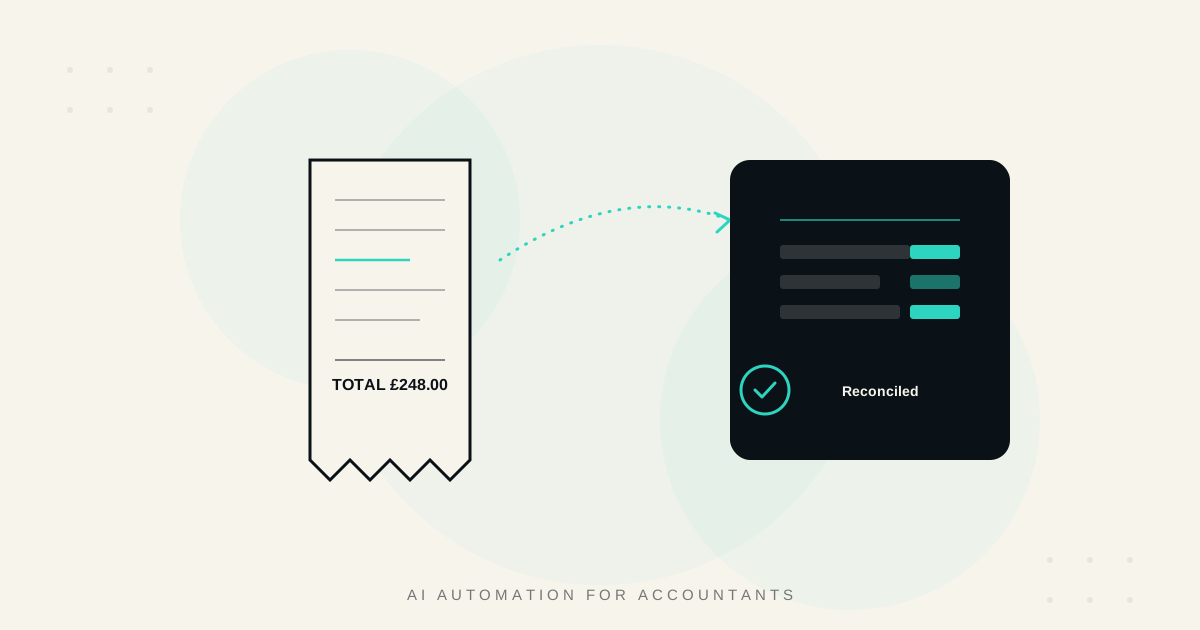
Accounting is one of the clearest, most measurable fits for AI automation anywhere in business, high volume, repetitive, rule-governed work, sitting alongside a genuine compliance backdrop that most generic automation content ignores entirely. Despite years of available tooling, a significant majority of invoice data across UK firms is still keyed in by hand, a genuine, persistent friction cost most practices have simply learned to absorb rather than fix. This guide covers where automation actually applies for accountants and finance teams, invoice and reconciliation, document extraction, reporting, the compliance reality specific to this sector, and a real, honest ROI picture.
Invoice and Reconciliation Automation
This tends to be the highest-leverage starting point for a first automation project, high volume, relatively low complexity, and a manual baseline substantial enough to make the before-and-after difference genuinely visible.
Invoice matching, checking supplier invoices against purchase orders and delivery records automatically, removes one of the most repetitive tasks in accounts payable, and is typically the highest-volume, lowest-complexity starting point for a first automation project.
Bank reconciliation automation identifies high-confidence matches between bank feed transactions and ledger entries automatically, flagging only genuine discrepancies, duplicates, or unusual patterns for human review, rather than requiring a person to check every single line manually.
Automated transaction coding, categorising transactions consistently ahead of VAT and MTD submissions, reduces the volume of manual ledger entry work directly, and does so with a consistency that manual coding, done under time pressure across a busy team, does not always achieve.
A useful way to think about where automation genuinely fits within a practice's broader workload is sorting tasks into three categories, since not everything currently done manually is actually a good automation candidate.
| Category | Examples | Approach |
|---|---|---|
| Automate | Invoice matching, bank reconciliation, transaction coding | High volume, structured, rule-governed |
| Outsource or overflow | Seasonal spikes, specialised one-off filings | Judgement-heavy but not core strategic work |
| Keep in-house | Client advisory, tax strategy, complex judgement calls | Requires genuine professional judgement |
Document Extraction
Modern AI document intelligence has moved well beyond basic OCR, understanding the actual semantic layout and context of a document, not just recognising individual characters.
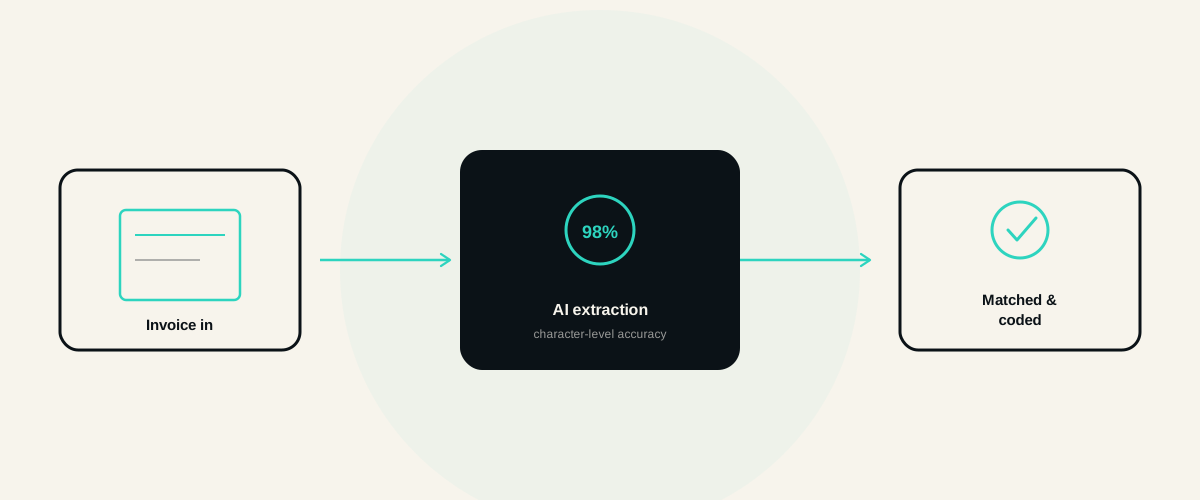
Structured extraction from real UK documents, correctly parsing supplier name, total amount, transaction date, and detailed VAT breakdowns across multi-line invoices, with leading platforms now achieving character-level accuracy in the high nineties percent range. Getting this right for the UK specifically matters, correctly handling UK postcode formats, Companies House registration numbers, and UK-specific VAT presentation is a genuinely different problem than generic document extraction built for a different market.
Receipt capture from clients directly, a mobile-first workflow where a client photographs a receipt, AI extracts and categorises the data, and a team member reviews before filing, is increasingly the standard pattern replacing manual data entry from paper or forwarded emails entirely.
Reporting
Real-time financial visibility, rather than a picture that is only accurate as of the last manual reconciliation, changes how proactively a finance team or practice can actually operate, catching a cash flow issue while there is still time to act on it, not weeks after the fact.
Automated anomaly detection in reporting, flagging an unusual transaction pattern or a duplicate entry automatically, catches issues a manual monthly review might miss simply due to volume, surfacing them for review immediately rather than at the next scheduled check.
Cash-flow forecasting informed by real, current data, rather than a static monthly snapshot, gives finance teams and practice partners a genuinely forward-looking view, useful specifically because it updates continuously as new transactions land, not just once a month when someone finally has time to rebuild the spreadsheet.
Compliance
This is where genuine, sector-specific understanding actually matters, and where generic automation content tends to say nothing useful at all.
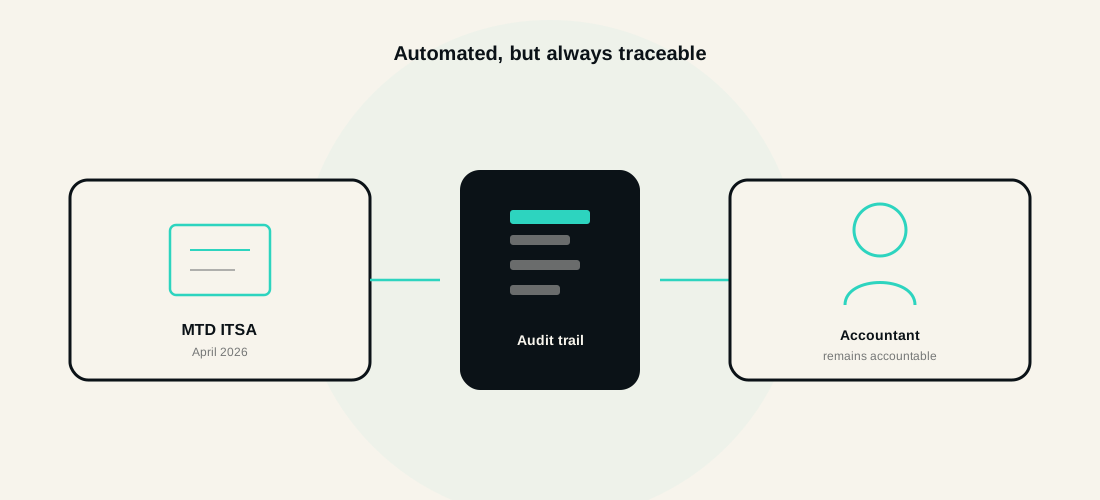
Making Tax Digital for Income Tax Self-Assessment, in effect from April 2026 for sole traders and landlords with qualifying income over a defined threshold, has made digital record-keeping a legal requirement, not just good practice, for a large and growing segment of UK taxpayers, creating a genuine, recurring compliance workload well suited to automation given its structured data and predictable quarterly deadlines.
HMRC's own AI monitoring is a development worth knowing about directly, HMRC has deployed AI to analyse incoming MTD data streams and issue automated notifications when a submission deviates from typical patterns for that industry. This makes careful, consistent, well-reconciled data more important than ever, whether that consistency comes from AI-assisted processing or disciplined manual work.
Accountability remains entirely with the accountant. UK professional guidance published in early 2026 is explicit and unconditional on this point, accountants remain legally responsible for all tax submissions regardless of which tools were used to prepare them. This means every automated action needs a clear, traceable audit trail, not a black-box process nobody on the team can explain if HMRC or a client ever asks a specific question about how a figure was arrived at.
Sample ROI
The clearest way to think about ROI here follows the same honest calculation that applies to any automation decision, calculate your current cost of manual processing, hours spent on invoice entry, reconciliation, and chasing missing details, multiplied by real staff time, and compare it against the cost of a properly scoped automation pilot.
Firms starting with invoice processing specifically, still the most common recommended first automation target given its combination of high volume and relatively low complexity, typically see a measurable reduction in hours within the first month or two of real use, since the manual baseline this replaces is usually substantial enough to make the before-and-after difference genuinely visible in the numbers, not just a subjective sense of things feeling smoother.
In Practice
Accounting and finance is exactly the kind of vertical where genuine engineering depth, correct UK-specific document parsing, a real audit trail, and compliance-aware architecture, matters more than a generic automation template repurposed from another industry. Our AI automation service is built around exactly this kind of sector-specific rigour, and we cover the same compliance discipline in more general depth in our guide to GDPR-compliant automation, much of which applies directly to how financial data should be handled in this context too.
The firms getting genuine value from automation are not the ones chasing the flashiest AI feature, they are the ones who started with the highest-volume, lowest-complexity task, kept a clear, traceable audit trail from day one, and never lost sight of the fact that the accountant, not the software, remains accountable for what gets submitted.
FAQ
Questions, Answered.
Read next
More on AI Automation
10 High ROI Automations Every SME Should Consider in 2026
Ten concrete, high-ROI automations for UK SMEs, with real effort and payoff for each, plus how to prioritise and where to actually start.

AI Automation for Professional Services Firms
Real AI automation for professional services, client intake, document workflows, reporting, genuine time recovery, and honest ROI.
AI Automation for UK Businesses: The Complete 2026 Guide
What AI automation actually is beyond no-code tools, where it delivers real ROI, and how to choose a partner who can build it properly.