
Resources
AI Automation for UK Businesses: The Complete 2026 Guide
What AI automation actually is beyond no-code tools, where it delivers real ROI, and how to choose a partner who can build it properly.

Mohid Bhatti
AI Systems Engineer, Devity Technologies
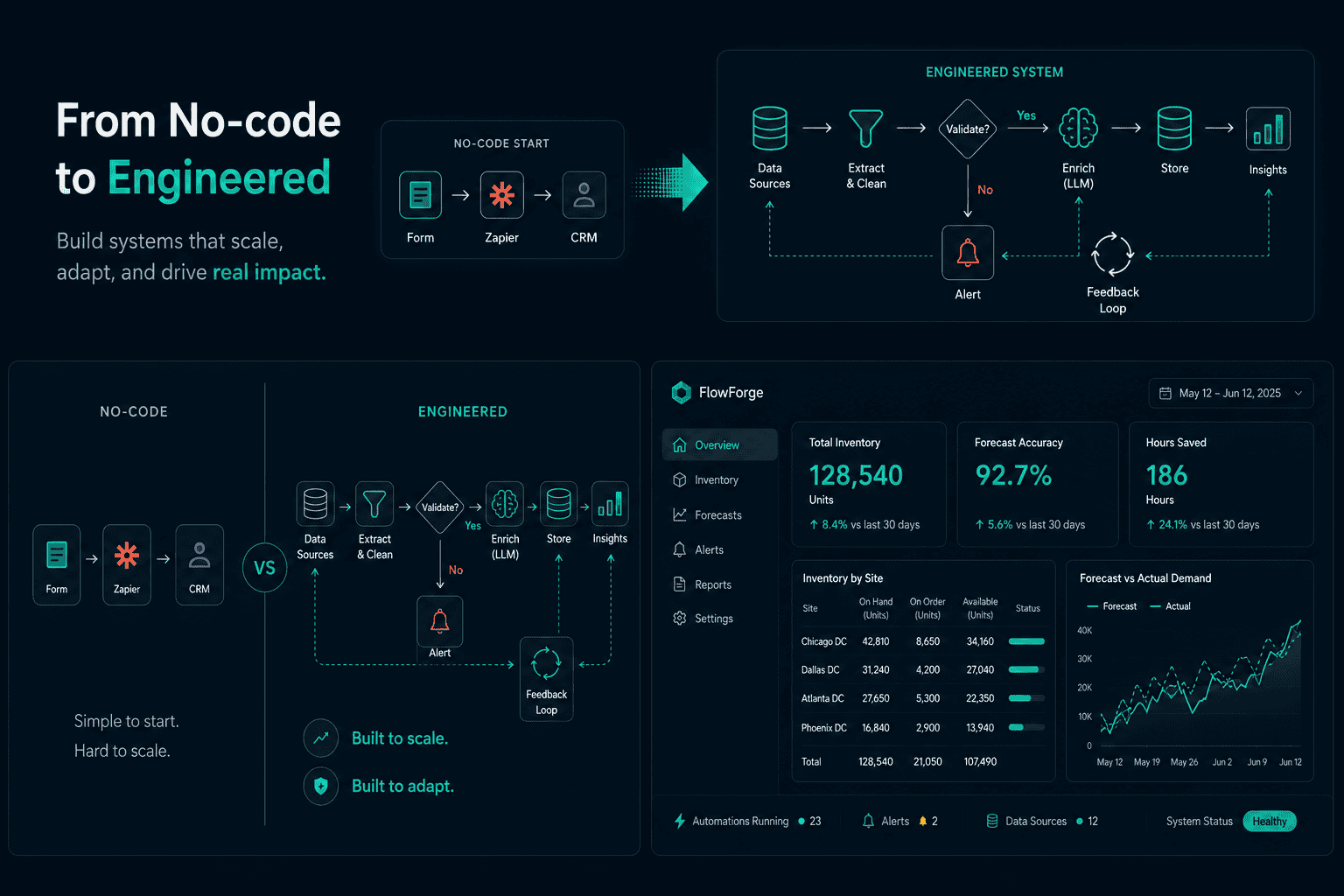
If you have spent any time researching AI automation for your UK business, you have probably noticed the same pattern everywhere. Every agency promises to save you time, cut your costs, and transform your operations. Almost none of them explain what is actually happening under the hood, or why the system they are proposing will still be running reliably in eighteen months.
That gap is the entire point of this guide. AI automation is not one thing. It ranges from a five-minute Zapier connection between two apps, all the way to a custom-built system that reads unstructured documents, makes decisions against your business rules, and reports its own accuracy back to you. Both ends of that spectrum get marketed under the same phrase, and the difference between them is usually the difference between an automation that quietly breaks in month four and one that keeps compounding value for years.
This guide covers what AI automation really means beyond no-code tools, where it actually delivers ROI, how to decide between building custom and buying off the shelf, what to look for in a partner, the compliance questions that UK buyers should be asking, and realistic UK pricing. By the end, you should be able to tell the difference between a genuinely engineered system and a rebadged no-code workflow, regardless of who you end up working with.
What AI Automation Actually Means, Beyond No-Code
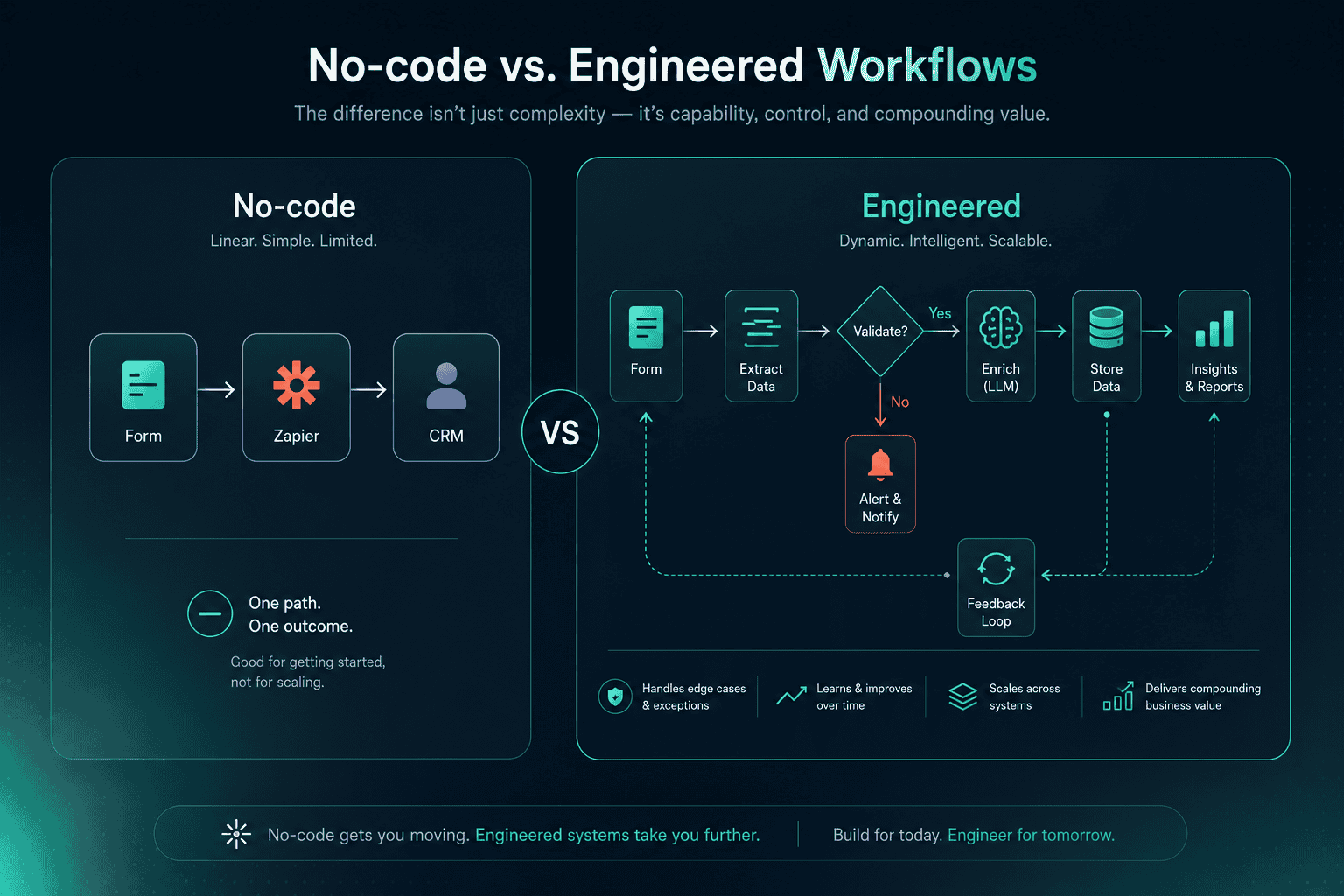
Most of what gets called "AI automation" in the UK market today is built on tools like Zapier, Make, or n8n, connecting existing apps together with simple trigger-and-action logic, sometimes with an AI step bolted on for text generation or classification. These tools are genuinely useful, and for a single, well-defined workflow, they are often the right call.
The limitation shows up as soon as a process needs judgement rather than a fixed rule. A no-code workflow can move a lead from one system to another when a form is submitted. It struggles when the task is "read this fifty-page contract and flag anything that deviates from our standard terms," or "reconcile inventory across fourteen warehouses and reroute stock before a shortage happens." That is where engineered AI automation starts, and it looks meaningfully different:
- Custom LLM agents that are built against your specific data and processes, not a generic template
- Retrieval-augmented generation (RAG) pipelines that give an AI system accurate, current, context-aware answers instead of relying on what a general model already knows
- Workflow orchestration that chains multiple decisions and systems together, not a single trigger-and-action step
- Data extraction and document processing that turns unstructured PDFs, emails, and forms into structured, usable data
- Forecasting models that predict demand, churn, or operational load, rather than just reacting to what already happened
- Voice and vision AI, for businesses where the input is a phone call or an image, not a form field
The practical difference is this. No-code automation connects existing steps. Engineered automation replaces the judgement a person used to apply. Both are valid, but only one of them is what most UK businesses actually mean when they say they want "AI automation" to genuinely change how their operations run.
Where AI Automation Actually Delivers ROI
The businesses that get real value from AI automation are rarely chasing automation for its own sake. They are targeting a specific, quantifiable bottleneck. The clearest ROI shows up in a handful of consistent patterns:
Manual data entry and reconciliation. Any process where a person is currently copying information between systems, checking it against a spreadsheet, or manually reconciling numbers across departments is close to the ideal automation candidate. The time saved is easy to measure, and the error rate for humans doing repetitive reconciliation is almost always higher than an automated system's.
Document-heavy workflows. Contracts, invoices, compliance forms, and applications that currently require a person to read, extract, and re-key information are a strong fit for document extraction and RAG-based systems.
Repetitive customer-facing tasks with predictable structure. Booking confirmations, order status queries, and first-line support questions can often be automated without sacrificing quality, freeing your team for the conversations that actually need a human.
Forecasting and planning that currently relies on gut feel or a static spreadsheet. Demand planning, inventory management, and churn prediction are all areas where a properly trained model consistently outperforms manual estimation, especially at any meaningful scale.
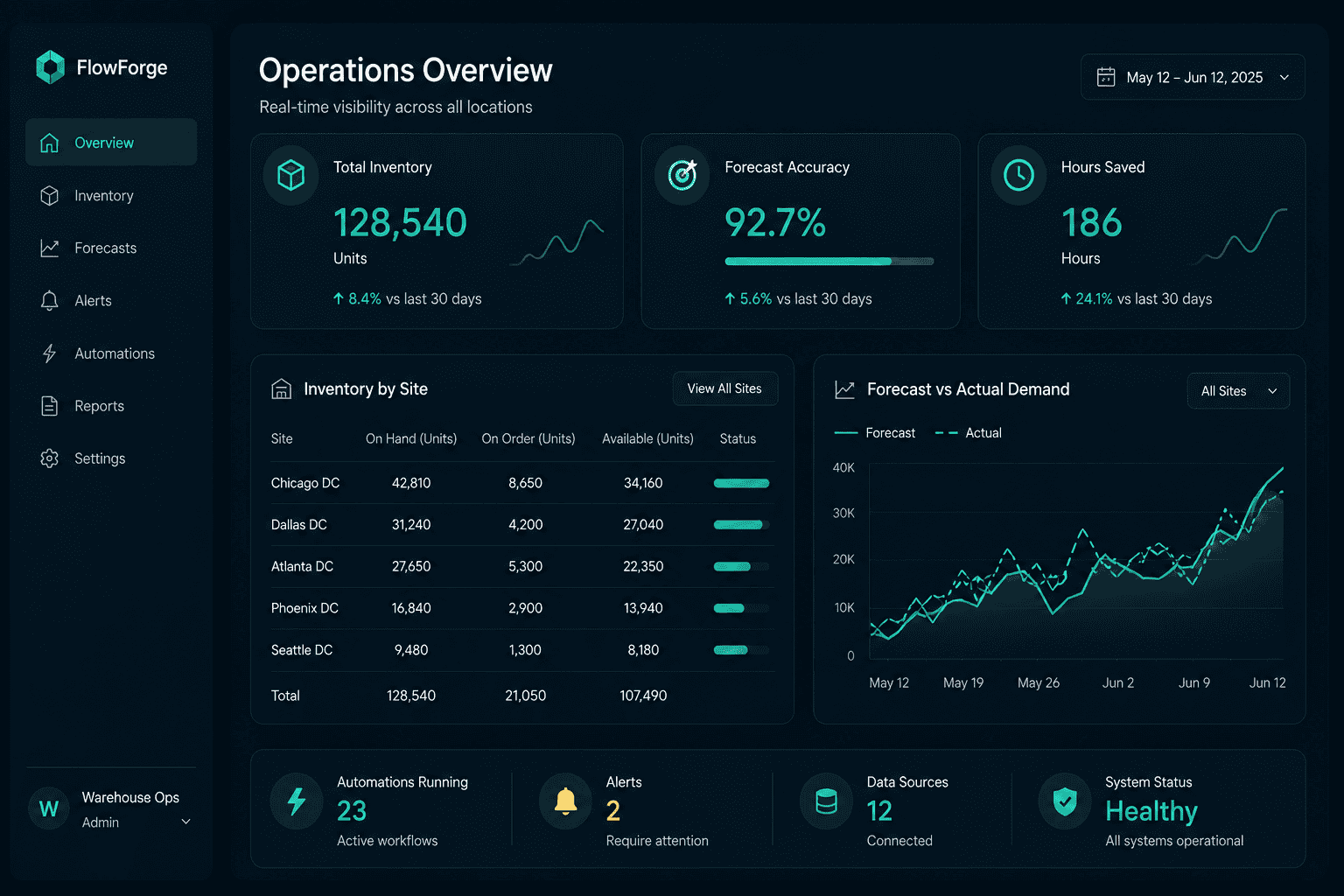
A real example makes this concrete. A logistics operation running fourteen warehouses was previously managing demand planning and stock movement through spreadsheets and manual reconciliation between sites. After a custom AI orchestration layer was built, including predictive demand modelling, automated reroutes, and a unified operations dashboard, the business cut its manual workflow by 40%, reached 94% forecast accuracy, and saved over 320 hours of operational time per week. That is not a hypothetical projection. It is what a properly engineered system looks like when it is pointed at a real, quantifiable bottleneck instead of a vague ambition to "use more AI."
It is worth being honest about where ROI does not show up as quickly, too. Automating a process that is inconsistent or poorly defined to begin with tends to just automate the inconsistency, faster. The businesses that see the fastest payback are the ones that have already mapped their process reasonably well, even if it is still manual, because that clarity is what lets an automation system be built against a clear, correct rule rather than guessing at intent. If your process changes depending on who is doing it, that is usually a sign to fix the process first, then automate it, rather than the other way around.
There is also a difference between automation that saves time and automation that changes what is possible. Saving 300 hours a week on reconciliation is valuable on its own. But the more interesting shift happens when a business can do something it genuinely could not do manually at all, forecasting demand across fourteen sites with a level of accuracy no spreadsheet-based process could realistically sustain, for example. That second category is where the return on investment stops being purely about labour cost and starts becoming a genuine operational advantage.
Build vs No-Code: How to Actually Decide
This is the question most UK businesses get stuck on, and most agencies have a financial incentive not to answer it honestly, because no-code implementation is faster and cheaper to sell, whether or not it is the right long-term fit.
Here is a straightforward way to think about it:
| Consideration | No-code (Zapier, Make, n8n) | Custom-engineered build |
|---|---|---|
| Best for | Single, well-defined workflows with a clear trigger and action | Complex logic, unstructured data, or decisions that require judgement |
| Speed to launch | Fast, often days | Slower to build properly, typically weeks |
| Ongoing cost | Per-task or per-zap platform fees that scale with volume | Higher upfront investment, lower marginal cost at scale |
| Reliability at scale | Can become fragile and expensive as workflow complexity grows | Built to handle production load and edge cases from the start |
| Data control | Data passes through third-party platforms | Can be fully self-hosted and controlled |
| Where it breaks | Multi-step logic, unstructured inputs, high-volume production use | Overkill for a genuinely simple, single-step task |
The honest answer is that both approaches are legitimate, and the right choice depends on the actual complexity of what you are automating. A single-step notification workflow does not need a custom-engineered system. A process that involves reading unstructured documents, making a judgement call, and triggering downstream actions across multiple systems usually outgrows no-code tools quickly, and that is the point where most businesses either hit a wall or quietly accept a system that is far less reliable than it should be.
How to Choose an AI Automation Partner in the UK
The AI automation space in the UK is young and crowded, and the barrier to calling yourself an "AI automation agency" is currently very low. A handful of questions will tell you quickly whether you are talking to an implementer or a genuine engineering team:
Ask what happens when the automation encounters something it has not seen before. A no-code workflow typically fails silently or breaks. A properly engineered system should have monitoring, fallback logic, and a clear process for handling edge cases.
Ask for evidence, not just a promise. A credible partner should be able to show quantified results from real work, not just a list of tools they are comfortable with.
Ask whether they are proposing a tool or a system. If the answer to almost every problem is "we will build that in n8n," you are likely working with an implementer, not an engineering team. That is not necessarily wrong for a simple need, but it is worth knowing which one you are hiring.
Ask about data handling and compliance up front, not as an afterthought once you have already signed. This matters enough that it deserves its own section.
Ask what a realistic timeline and support plan looks like after launch. Automation that is not monitored and maintained after go-live tends to degrade quietly over time as your underlying systems and data change.
Ask to see how they define success before the project starts, not after it ends. A partner who insists on agreeing a measurable outcome (hours saved per week, cost per document processed, forecast accuracy, or whatever metric is relevant to your case) before writing any code is telling you something important about how the rest of the engagement will run. A partner who cannot answer that question clearly is usually planning to define success retroactively, based on whatever the system happens to do.
It is also worth paying attention to how a prospective partner talks about the limits of their own approach. An agency that is honest about where no-code tools are genuinely the better choice, even when a more expensive custom build would earn them more revenue, is a far stronger signal of trustworthiness than one that pushes every enquiry toward the same solution regardless of fit. The AI automation market in the UK is still young enough that a lot of positioning is more marketing than engineering. The partners worth working with tend to be the ones willing to say "you probably do not need a custom build for this yet" as often as they say the opposite.
Compliance: The Question Most Buyers Forget to Ask
Compliance is one of the most consistently underserved areas in UK AI automation, despite being one of the top concerns for buyers once they start looking closely. A few things worth confirming with any partner before you sign anything:
- Where is your data actually processed and stored, and does that align with UK GDPR requirements
- What is the lawful basis for any personal data the automation will handle
- Which AI models are being used, and what their own data handling and retention policies are
- Whether the system logs its own decisions in a way that can be audited later
- Whether the partner is willing to put data handling commitments in writing, not just verbally
A partner who treats these questions as routine, rather than an inconvenience, is generally a good signal about how the rest of the engagement will go.
What AI Automation Actually Costs in the UK
Pricing in this space varies enormously depending on scope, but a realistic range for UK businesses looks roughly like this:
- A single, well-scoped automation (one workflow, one clear outcome): often in the low thousands of pounds
- A multi-step system involving document processing, multiple integrations, or a forecasting component: typically mid four figures to the low tens of thousands
- A full operational transformation, spanning multiple departments or a genuinely custom AI agent layer: can run from the tens of thousands upward, depending on complexity
The number that actually matters is not the price tag on its own, but the payback period against the hours or cost it removes. A system that costs several thousand pounds but saves a team 300 hours a month pays for itself within weeks. The businesses that get this wrong are usually the ones that chose the cheapest option without checking whether it would actually hold up at their real volume and complexity.
A Results Snapshot
To bring this back to something concrete: the fourteen-warehouse logistics example referenced earlier is a genuine, delivered engagement, not an illustrative scenario. A team drowning in spreadsheets and manual stock reconciliation across fourteen sites now runs on a single AI orchestration layer with predictive demand modelling and automated rerouting. The results were a 40% reduction in manual workflow, 94% forecast accuracy, and more than 320 hours of operational time saved every week. See the full case study. If you want to see what a properly engineered version of this looks like for your own operations, our AI automation service covers exactly this kind of build.
That is the difference this guide has been building toward. Not "AI automation" as a buzzword, but a specific, engineered system pointed at a specific, measurable business problem.
FAQ
Questions, Answered.
Read next
More on AI Automation
10 High ROI Automations Every SME Should Consider in 2026
Ten concrete, high-ROI automations for UK SMEs, with real effort and payoff for each, plus how to prioritise and where to actually start.
AI Automation for Accountants and Finance Teams
How AI automation actually applies to accounting firms and finance teams, invoice and reconciliation, document extraction, reporting, MTD compliance, and real ROI.
AI Automation for Professional Services Firms
Real AI automation for professional services, client intake, document workflows, reporting, genuine time recovery, and honest ROI.