
Resources
How to Validate Your Startup Idea Before You Build
Real validation methods for a startup idea, talking to users properly, using prototypes honestly, knowing when to actually build, and avoiding wasted effort along the way.

Ahmad Saeed
Full-Stack Engineer, Devity Technologies
The excitement of a new idea creates real pressure to start building immediately, and that instinct is exactly what leads to months of work spent on something nobody actually wanted. This guide covers genuine validation methods, how to talk to users properly, using prototypes honestly, knowing when you've actually validated enough to build, and avoiding the specific ways this process commonly wastes real time and money.
| Method | Cost | What it tests |
|---|---|---|
| Structured conversations | Lowest, just your time | Whether a real, recurring problem exists |
| Landing page | Low | Genuine interest, measured by real action |
| Clickable prototype | Moderate | Whether the proposed flow makes sense |
| Pre-sale or paid pilot | Requires real commitment | Actual willingness to pay |
Validation Methods
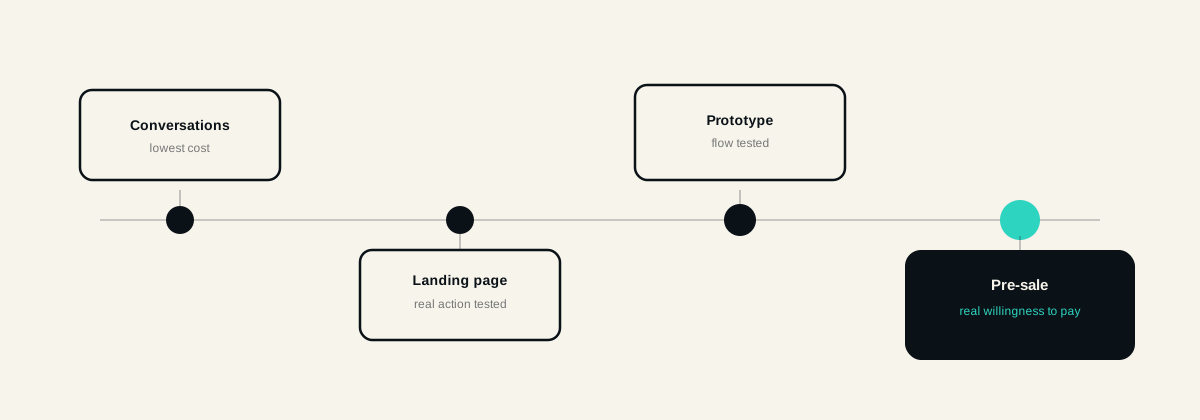
Validation is not a single step, it is a set of methods that build confidence progressively, from cheap and fast to more involved, each one worth exhausting before moving to the next.
Structured user conversations are the cheapest, fastest validation method available, and the one most founders skip too quickly in favour of building something to show people instead of simply asking them directly.
A landing page testing real demand, describing the product and measuring genuine interest, an email signup, a waitlist join, a pre-order, tests whether people will take a real action, not just say something sounds interesting in the abstract.
A clickable prototype, with no real functionality behind it, tests whether the actual proposed flow and interface make sense to a real user, surfacing confusion or friction before any functional code gets written to support it.
A genuine pre-sale or paid pilot, where a potential customer commits real money or a real contract before the product fully exists, is the strongest validation signal available, since it tests actual willingness to pay, not just polite, low-cost interest.
Talking to Users Properly
This is the method most founders get wrong, not because they skip it, but because they run it in a way that produces reassuring, misleading answers rather than genuine insight.
Avoid leading questions entirely. "Would you use this?" consistently produces overly optimistic answers, since people are naturally polite and tend to imagine themselves using something interesting-sounding without factoring in the real friction of actually changing their behaviour.
Ask about their current behaviour, not their hypothetical future behaviour. "Walk me through the last time you dealt with this problem" surfaces real, specific detail a hypothetical question never will, exactly what they actually did, what frustrated them, and what they tried instead.
Listen for what they say unprompted, not just their answers to your specific questions. A genuine, unprompted complaint about a problem you hadn't even directly asked about is far stronger validation than an agreeable answer to a leading question you asked directly.
Talk to enough people to see a genuine pattern, roughly ten to fifteen structured conversations with the right people is usually enough to tell whether a real, recurring problem exists, fewer risks drawing conclusions from noise rather than a real, repeatable signal.
A concrete example of the difference this makes: a founder asking small business owners "would you use an app that automates your invoicing?" will get a stream of polite, agreeable answers regardless of whether a real problem exists. The same founder asking "walk me through how you handled invoicing last month" surfaces something far more useful, whether they already use a tool that works fine, whether they genuinely struggled and can describe exactly where, or whether invoicing simply isn't painful enough for them to have thought about it at all, three very different, far more honest signals than a single agreeable "yes."
Prototypes, Used Honestly
A prototype is a validation tool, not a shortcut to skip the harder work of talking to real people first.
Use a prototype to test a specific flow or interaction, not the whole product vision at once, a focused prototype testing one specific, critical interaction produces clearer, more actionable signal than a broad, ambitious one trying to demonstrate everything simultaneously.
Watch what people actually do with it, not just what they say afterward. Where someone hesitates, where they click something that wasn't meant to be clickable, where they get genuinely confused, tells you more than their verbal feedback once the session ends and social politeness kicks back in.
Resist the urge to make a prototype too polished too early. A rough, honest prototype invites real, critical feedback. An overly polished one can create a false sense that the product is nearly finished, discouraging the kind of blunt, useful criticism that actually improves it.
When to Build
The honest signal that you've validated enough is not certainty, certainty rarely arrives before real usage data exists, it is a specific, testable hypothesis and genuine, demonstrated interest, not just polite encouragement from conversations that were too agreeable to trust fully.
You are ready to build once you can articulate the specific problem clearly, describe who genuinely has it and how you know that, and define the smallest possible version that would actually test whether your proposed solution works, exactly the discipline covered in more depth in our guide to building an MVP, where scoping tightly around a single core hypothesis is what makes a first build genuinely useful rather than an expensive guess dressed up as a product.
Avoiding Waste
Building before validating is the single most expensive mistake in this entire process, months of development spent on a full feature set before confirming anyone genuinely wants the core value proposition at all.
Treating polite interest as genuine validation leads founders to build with false confidence, several encouraging conversations are not the same as confirmed, demonstrated demand, and conflating the two is one of the most common, avoidable ways real time and money get wasted.
Skipping validation because it feels slower than building is a false economy almost every time, the cost of a few weeks spent talking to real users is genuinely tiny compared to the cost of months spent building the wrong thing because that step was skipped.
In Practice
Once your idea is genuinely validated, a specific hypothesis, real demonstrated interest, a clear sense of what to build first, building an MVP properly is the natural next step, and one we cover in full depth separately. If you're at that stage and want to talk through what building it properly actually looks like, that conversation costs nothing to start.
The founders who avoid wasted effort are rarely the ones who moved fastest to build something, they are the ones who talked to enough real people, listened honestly to what they heard, and only committed real budget once a genuine, demonstrated signal justified it.
FAQ
Questions, Answered.
Read next
More on MVP & Startup
Choosing the Right Development Partner for Your Startup
What early-stage founders should actually look for in a development partner, technical and product fit, communication, equity versus cash, and the red flags specific to startup engagements.
From Idea to Launch: A Realistic Product Timeline
A genuinely realistic MVP timeline, discovery, design, build, test, and launch, with real durations for each stage and what actually speeds it up or slows it down.
How Startups Should Think About Technical Debt Early
Good technical debt versus bad, building an MVP that can actually change, when refactoring is genuinely worth it, and the real cost of ignoring debt at the earliest stage.