
Resources
How Much Does It Cost to Build an App in the UK
Real GBP cost ranges for building a mobile app in the UK, what actually drives the price, MVP versus full build, platform choice, and ongoing costs after launch.

Prem Kumar
Mobile Engineer, Devity Technologies
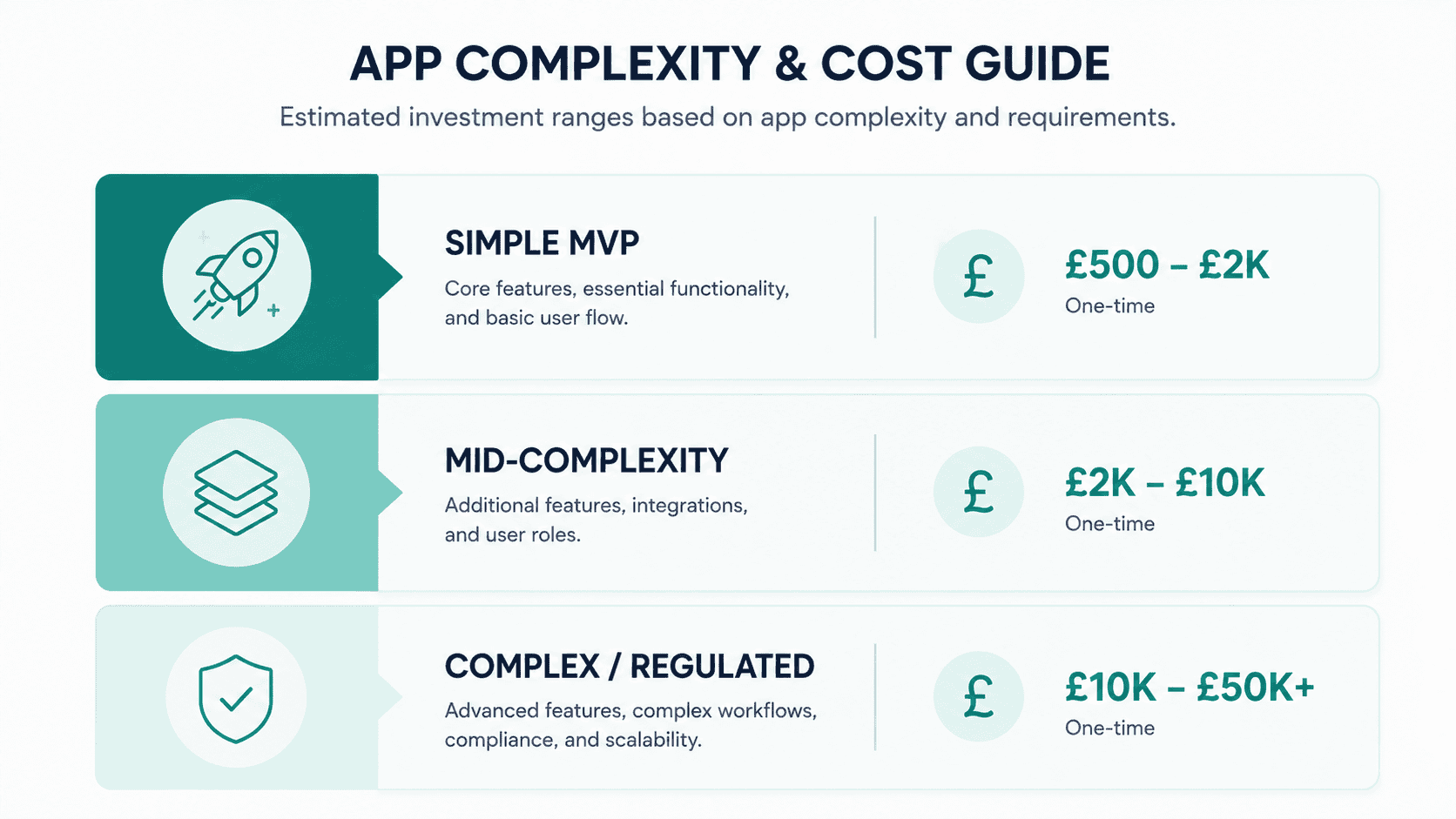
"How much does it cost to build an app" is one of the most searched questions in UK tech, and one of the least clearly answered, mostly because the honest answer depends entirely on specifics most people asking the question have not yet defined. This guide gives real GBP ranges, explains what actually drives the price, covers the MVP-versus-full-build decision, platform choice, and what to budget for after launch.
What Actually Drives the Cost
Feature complexity. A simple app with one core workflow, booking, messaging, a single content feed, costs meaningfully less than an app juggling multiple user roles, real-time features, and several interconnected workflows.
Integrations. Connecting to payment processors, third-party APIs, or an existing backend system is consistently one of the biggest cost swings between two apps that sound similar on paper but require very different amounts of engineering effort underneath.
Design fidelity. A templated interface built on an existing design system costs less than a fully bespoke, brand-led design with custom animations and interactions. Design typically accounts for somewhere between fifteen and twenty-five percent of total build cost, and it is one of the areas founders most commonly under-budget, picturing a polished final result while pricing against a much simpler template.
Platform choice. Covered in more depth below, but native versus cross-platform development has a direct and significant effect on both cost and ongoing maintenance burden.
Compliance requirements. Apps handling payments, health data, or operating in regulated sectors carry real, additional cost for the security practices and audit trails those requirements demand.
Team composition and location. A senior UK-based team costs more per day than a nearshore or offshore team, but the total cost difference is often smaller than the headline day-rate gap suggests, once coordination overhead and rework are factored in. As a reference point, a senior UK full-stack developer typically bills somewhere around £500 to £650 a day, while nearshore teams in Eastern Europe often bill the equivalent of £30 to £60 an hour, a real gap, but one that narrows once communication friction and quality variance are honestly accounted for.
A concrete example makes the complexity driver easier to picture: two apps that both sound like "a booking app" on paper can differ enormously in price. A booking app with one core flow, browse, select a slot, pay, sits toward the lower end of the MVP range. The same concept with multiple staff calendars, automated reminders, a loyalty programme, and a business-side admin dashboard is a meaningfully larger build, even though the one-line pitch sounds nearly identical.
MVP vs Full Build
An MVP is the smallest genuinely usable version of your app, built to validate real demand rather than deliver every feature in your vision at once. A simple, single-platform MVP with three to five core features typically takes eight to twelve weeks and costs between £15,000 and £40,000, depending on integration complexity.
A full build makes sense once an MVP, or strong existing evidence, has already validated demand, and you are ready to invest in the broader feature set, deeper polish, and platform coverage a mature product needs. Mid-complexity apps in this category typically run £40,000 to £90,000, with genuinely complex, multi-platform, or heavily regulated builds reaching £90,000 to £200,000 or more.
The financially responsible path for almost every founder is starting with an MVP. It is not a compromise, it is the version of the product that answers the one question that actually matters before committing a larger budget: will real users adopt and pay for this.
Within either tier, design deserves specific attention as a line item founders routinely under-budget. A templated UI built on an existing design system is genuinely cheaper and faster than a bespoke, brand-led design with custom animation and interaction detail, and for an early MVP focused on validating demand rather than winning a design award, that is usually the right trade-off. The mismatch that catches founders out is picturing the polished, custom-designed version from their inspiration folder while pricing and scoping against a much simpler templated build, then requesting a design overhaul partway through development once the gap becomes visible, which is one of the most common and avoidable sources of mid-project cost creep.
Platform Choice: Where the Real Money Sits
Native development (separate Swift and Kotlin codebases for iOS and Android) delivers the highest possible performance ceiling, at the cost of building and maintaining two entirely separate codebases. This roughly doubles ongoing maintenance effort compared to a single shared codebase, since every feature and every bug fix needs to be built and tested twice.
Cross-platform development, most commonly React Native, lets you build the large majority of your app once and ship it to both platforms from a single codebase. For the vast majority of business apps, standard interfaces with forms, lists, and typical interactions rather than console-grade graphics, cross-platform delivers performance indistinguishable from native at meaningfully lower build and maintenance cost.
The practical guidance is straightforward: unless your app depends heavily on cutting-edge, platform-specific capabilities the moment they release, or needs the absolute performance ceiling for something genuinely processor-intensive, cross-platform is the financially sensible default, not a compromise you settle for.
Ongoing Costs After Launch
An app is not a one-time invoice, and this is the single most commonly underestimated part of an app budget.
A realistic ongoing cost is roughly fifteen to twenty percent of the original build cost per year, covering:
- Hosting and backend infrastructure, growing with your user base
- Third-party services, push notifications, analytics, payment processing fees, which individually look small but add up
- App Store and Play Store considerations, developer account fees and the ongoing work of maintaining store listings and responding to policy changes
- Security patches and OS compatibility fixes, since both Apple and Google release major platform updates roughly annually, and either can break existing app behaviour without warning
- Bug fixes and small feature requests, the inevitable and healthy result of real users actually using the product
Ignoring this line item does not remove the cost, it just delays the moment you discover it, usually at the worst possible time, when the app has already started degrading from lack of attention.
These ranges reflect a properly resourced UK-based team, not the cheapest possible option available. A quote significantly below these bands for a comparable scope is worth questioning, not celebrating, since it usually means something, post-launch support, testing depth, design quality, has been quietly left out.
Getting an Accurate Quote, Not Just a Number
Since two quotes for what sounds like the same app can differ by tens of thousands of pounds, a few habits make the comparison actually meaningful.
Ask what is explicitly included and excluded. A quote should state clearly whether it covers design, App Store submission support, a defined testing phase, and any post-launch bug-fixing window. A lower total that excludes several of these is not necessarily cheaper than a higher one that includes them, it may simply be an incomplete number.
Get the scope written down before the price. A written feature list, even a rough one, that both sides agree on before a number is attached protects against the most common source of mid-project disputes, a misunderstanding about what was actually meant by a feature name like "user profiles" or "notifications."
Ask how the quote handles scope changes. Real products change as real users interact with early versions. A partner with a clear, calm process for handling that change, rather than either an inflexible fixed price or an open-ended hourly arrangement with no visibility, tends to produce both a better product and a more predictable final cost.
Treat a very wide quote range with some suspicion. A team that genuinely understands your requirements should be able to narrow their estimate reasonably tightly. A quote given as "somewhere between twenty and eighty thousand pounds" before any real discovery conversation has happened is a sign the number was generated without enough understanding of what you actually need.
Sample Ranges in GBP
| App type | Typical build cost | Typical timeline |
|---|---|---|
| Simple MVP, single platform | £15,000 to £40,000 | 8 to 12 weeks |
| Mid-complexity app, cross-platform | £40,000 to £90,000 | 3 to 6 months |
| Complex or heavily regulated app | £90,000 to £200,000+ | 6 to 12 months |
These ranges reflect a properly resourced UK-based team, not the cheapest possible option available. A quote significantly below these bands for a comparable scope is worth questioning, not celebrating, since it usually means something, post-launch support, testing depth, design quality, has been quietly left out.
In Practice
For a deeper look at the native-versus-cross-platform decision, the real App Store submission process, and how to choose a development partner, our complete guide to mobile app development in the UK covers the full picture this cost guide builds on. If you have a specific app idea and want an honest, scoped quote rather than a generic range, our mobile application development service is a good place to start that conversation.
The founders who budget well for app development are not the ones chasing the lowest quote, they are the ones who understand what actually drives the number, price in the ongoing cost of running the app alongside the cost of building it, and start with the smallest version that can genuinely prove the idea before committing to anything larger.
FAQ
Questions, Answered.
Read next
More on Mobile Applications
App Store Optimisation and Launch Strategy for New Apps
The real ASO basics, how to build a listing that converts, managing reviews, a genuine launch plan, and how post-launch iteration actually drives growth.

Designing Mobile UX That Keeps Users Coming Back
Real mobile UX practices that drive genuine retention, onboarding, performance, navigation, accessibility, and what actually keeps users coming back.
From Web App to Mobile App: When and How to Make the Leap
Real reasons to go mobile, how much code and logic you can actually reuse, honest cost, and how to phase the transition from a web product to mobile properly.