
Resources
Edge Rendering and Why It Matters for Speed and SEO
What edge computing and edge rendering actually are, how they improve performance for global users, the real SEO impact, and when edge genuinely helps versus when it doesn't.

Ahmad Saeed
Full-Stack Engineer, Devity Technologies

Edge computing gets discussed constantly in modern web development, and rendering "at the edge" specifically has become something of a default assumption for any serious 2026 stack, sometimes for good reason, sometimes purely because it sounds current. This guide explains what edge computing and edge rendering actually are, how they genuinely improve performance for global users, the real SEO impact, and, honestly, when edge rendering helps versus when it does nothing or actively adds unnecessary complexity.
Edge, Explained Properly
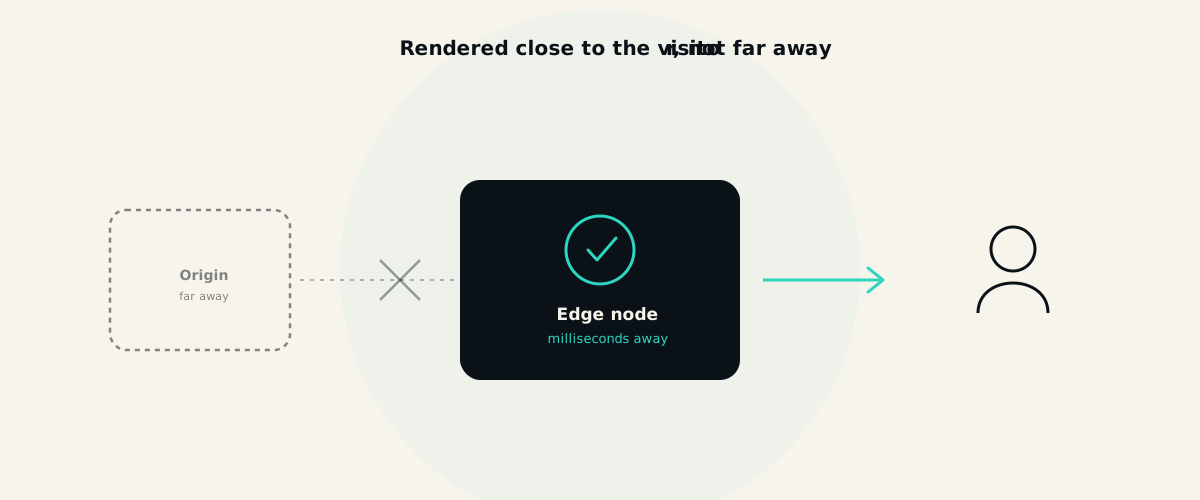
Edge computing means running code on servers distributed geographically close to users, rather than in one single, central location a request always has to reach regardless of where it originated. Instead of every visitor's request travelling to one origin server, potentially thousands of miles away, it is handled at a nearby point of presence instead.
Edge rendering applies this specifically to generating a page's HTML. Rather than a single origin server building the page and sending it out to every visitor worldwide, the rendering work happens at whichever edge location is physically closest to that specific visitor. The practical effect: a visitor in Sydney requesting a page rendered at an edge node in or near Sydney gets a response in a matter of milliseconds, compared to the far longer round trip required if that same request had to reach a distant origin server, get rendered, and travel all the way back.
Edge functions are the underlying mechanism that makes this possible, small pieces of server-side logic, redirects, personalisation, authentication checks, rendering itself, that run at these distributed edge locations rather than centrally. Platforms like Cloudflare Workers, Vercel Edge Functions, Netlify Edge Functions, AWS Lambda@Edge, and Fastly Compute@Edge all provide this capability, each with slightly different strengths and trade-offs.
| Traditional SSR | Static (SSG) | Edge rendering | |
|---|---|---|---|
| Where rendering happens | One central origin server | Built once, ahead of time | Distributed, close to each visitor |
| Best for | Dynamic, personalised content | Content that rarely changes | Distributed audiences, mostly public content |
| Freshness | Real-time, every request | Only as fresh as the last build | Real-time, but rendered locally |
| Global latency | Higher for distant visitors | Low, served from CDN cache | Low, computed near the visitor |
Performance for Global Users
This is where edge rendering delivers its clearest, most measurable benefit, and it scales directly with how geographically distributed your actual audience is.
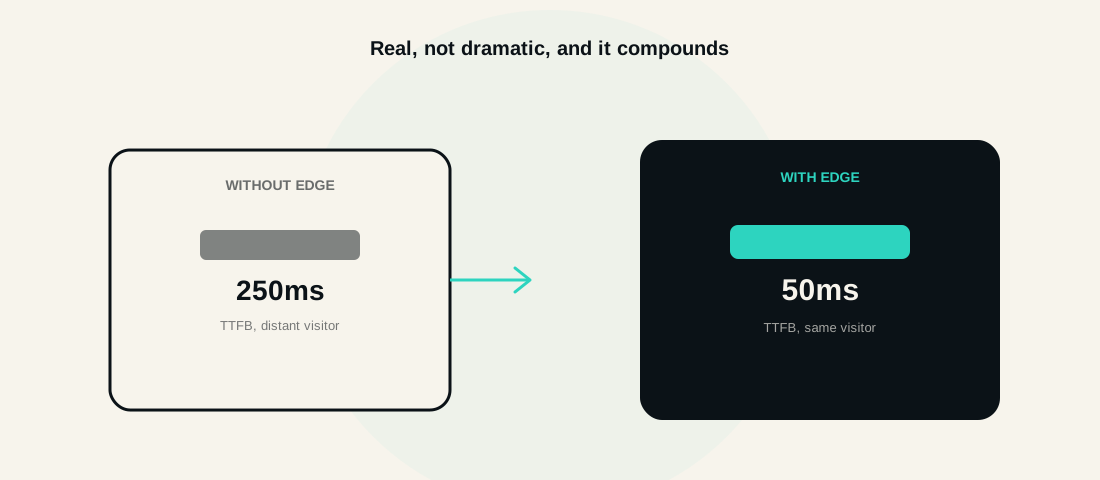
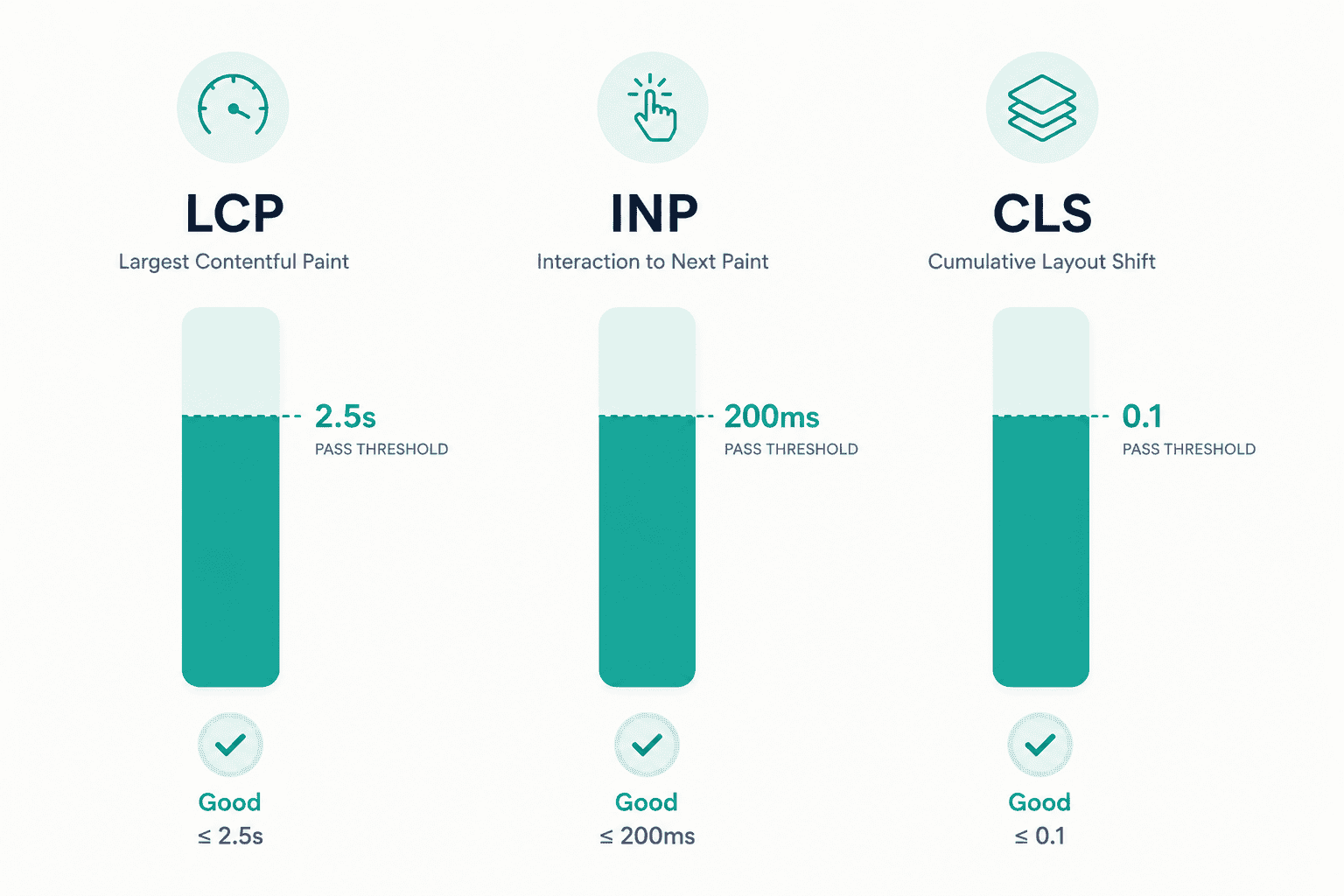
The mechanism is straightforward physics as much as software architecture, network latency is directly tied to physical distance, and moving the rendering work closer to the visitor reduces that distance. Time to First Byte, the time before a browser receives the very first byte of a response, is the metric most directly affected, and edge rendering typically improves it in the range of 10 to 30%, a real, meaningful gain, though not the dramatic transformation some marketing content around edge computing implies. Since Time to First Byte sits upstream of Largest Contentful Paint in the overall loading sequence, a genuine improvement here contributes directly to LCP too, the same metric covered in more depth in our guide to Core Web Vitals.
The benefit compounds specifically for a genuinely global audience. A business whose visitors are concentrated in one region, close to wherever the origin server already sits, sees a meaningfully smaller benefit from edge rendering than a business serving visitors spread across multiple continents, where the physical distance edge rendering actually removes is real and substantial.
A concrete example makes this tangible: an origin server based in Virginia serving a visitor also on the US East Coast has very little distance to cover, and edge rendering offers that visitor almost nothing beyond what a well-configured traditional server already provides. The same origin server serving a visitor in Sydney faces a genuinely long round trip, and rendering that visitor's page at a nearby edge node instead can cut the response time dramatically, precisely because the physical distance being removed is actually significant in that specific case.
SEO Impact
Edge rendering's SEO benefit flows entirely through the same mechanism as its performance benefit, faster loading, particularly faster Time to First Byte and Largest Contentful Paint, is a genuine, if modest, ranking signal, and a real driver of the immediate impression a visitor forms of your site.
Consistent, complete HTML for crawlers is a secondary benefit worth naming directly. Edge rendering, when implemented as a genuine server-rendering strategy rather than a purely client-side approach pushed closer to the user, ensures search engine crawlers receive fully rendered HTML quickly and consistently, rather than needing to execute JavaScript themselves to see the actual content, the same underlying principle covered in our Next.js guide around server-side rendering generally.
Edge rendering is a genuine contributor to SEO, not a silver bullet on its own. It is worth being honest that other performance work, image optimisation, JavaScript bundle reduction, database query efficiency, frequently delivers larger individual gains than edge rendering alone. The realistic framing is that edge rendering is one meaningful lever among several, not a single fix that outweighs the rest of a site's technical performance discipline.
When to Use It, Honestly
This is the section most edge-computing content skips, and it matters more than the pitch for adopting it in the first place.
Genuinely helps when your audience is meaningfully distributed across multiple regions or continents, where the physical distance edge rendering removes is real and substantial, and when your pages are largely public, non-personalised content well suited to being rendered and cached close to the visitor.
Does little to nothing when your traffic is concentrated in one region already close to your origin server, in this case edge rendering saves almost nothing on the actual request path while adding real operational complexity for no meaningful benefit.
Introduces genuine complexity worth weighing carefully for anything requiring consistent state across every instance, a shopping cart, checkout, or account balance, where edge architecture demands careful, deliberate handling to avoid inconsistency bugs that are considerably harder to debug than an equivalent issue on a single central server. The same caution applies to complex authentication and session logic, edge functions generally have less mature session handling than a traditional server, and forcing genuinely complex auth flows onto the edge can introduce real bugs for a performance gain that may not be worth that specific trade-off.
The honest, current framework: adopt edge rendering deliberately for the specific pages and workloads where distributed, mostly public traffic genuinely benefits, rather than defaulting to it everywhere simply because it is the modern, expected choice.
In Practice
We evaluate edge rendering the same way covered honestly above, a genuine architectural decision made deliberately for the specific pages and traffic patterns that benefit, not applied uniformly because it sounds current. This is part of the same modern stack discipline covered in our Next.js guide, and our web platform development service treats this exact trade-off as a real engineering decision worth discussing properly, not a default checkbox.
The sites that get real value from edge rendering are not the ones that adopted it everywhere because it was the current trend, they are the ones who applied it deliberately to the specific pages and traffic patterns where the physics of distance genuinely mattered, and left the rest of the architecture simpler where that complexity would not have paid for itself.
FAQ
Questions, Answered.
Read next
More on Web Platforms
API First Architecture: Building Software That Scales and Integrates
What API-first architecture actually means, the real benefits, how it enables genuine integration and reuse, and when it matters versus when it's unnecessary overhead.
Build vs No Code for Web Apps: Where the Line Really Is
Where no-code web app builders genuinely excel, where they break down, and how to think about performance, ownership, and the migration path before you commit.
Core Web Vitals: A Practical Guide to a Faster, Higher Ranking Site
What LCP, INP, and CLS actually measure, the fixes that move each metric, how to measure them correctly, and the real business impact of getting them right.