
Resources
Workflow Automation Consultant vs DIY Tools: When to Hire an Expert
The genuine limits of DIY automation tools, when complexity actually needs an engineer, the real cost of getting it wrong, and what a consultant adds that a template can't.

Mohid Bhatti
AI Systems Engineer, Devity Technologies
DIY automation tools have genuinely improved, and for the right workflow, they are the correct, proportionate choice. The mistake most businesses make is not choosing DIY, it is staying with it once a workflow has quietly outgrown what the tool can reliably handle. This guide covers the real limits of DIY, when complexity genuinely needs an engineer, what it actually costs to get this decision wrong, and what a consultant adds that a template fundamentally cannot.
| DIY / no-code | A consultant | |
|---|---|---|
| Best for | Simple, linear, low-volume workflows | Genuine complexity, scale, or sensitive data |
| Edge case handling | Often limited to the happy path | Built for real, messy production data |
| Failure visibility | Frequently silent | Real monitoring and alerting |
| Maintainability | Tied to whoever built it | Documented, handover-ready |
| Upfront cost | Low | Higher |
| Cost of getting it wrong | Grows quietly, often unnoticed | Designed to be caught early |
The Genuine Limits of DIY
No-code automation platforms handle a real, meaningful range of business workflows well, straightforward, linear processes with predictable inputs and a small number of steps. Where they genuinely struggle is complexity that grows beyond that scope.
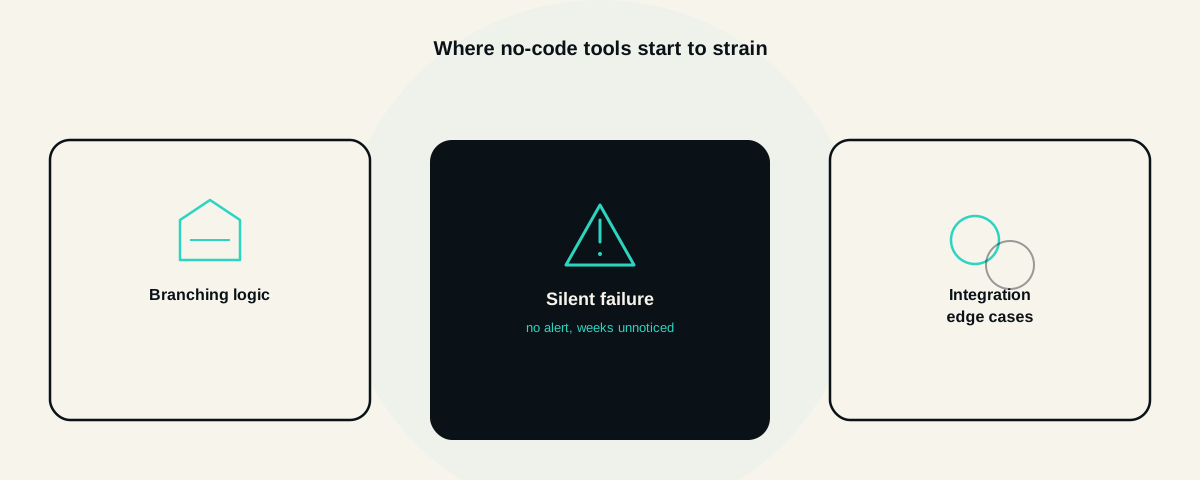
Branching logic with many conditions stretches a no-code tool's visual interface past the point where it stays comprehensible, a workflow with a handful of conditional paths is manageable, one with dozens becomes a tangled, fragile mess that even the person who built it struggles to reason about six months later.
Multiple system integrations with genuine edge cases expose the gap between a tool's demo-friendly happy path and what real production data actually looks like, a malformed record, a temporarily unavailable API, a field that's occasionally empty when it's never supposed to be. DIY platforms handle the expected case well and often handle the unexpected case poorly or not at all.
Silent failure is the pattern that causes the most real damage. A DIY automation that fails without a clear, actionable alert can run incorrectly for days or weeks before anyone notices, quietly generating bad data or missed actions the whole time, precisely because nobody was watching closely enough to catch it early.
When Complexity Needs an Engineer
Genuine business logic, calculations, conditional rules, or decision-making that reflects how your specific business actually operates, benefits from being built properly rather than approximated through a generic tool's limited logic blocks.
Meaningful scale changes the calculus directly, a workflow processing a handful of items a week tolerates a rough, DIY approach that the same workflow at hundreds of items a day genuinely cannot, since errors and inefficiencies compound with volume in a way they simply don't at small scale.
Anything touching sensitive data or a regulated process deserves engineering discipline from the start, proper access control, audit logging, and error handling are not features most no-code tools were built with as a priority, and retrofitting them after the fact is far harder than building them in from day one.
The Cost of Getting It Wrong
This is the part DIY automation advocates rarely discuss honestly, and it matters directly to the actual decision.
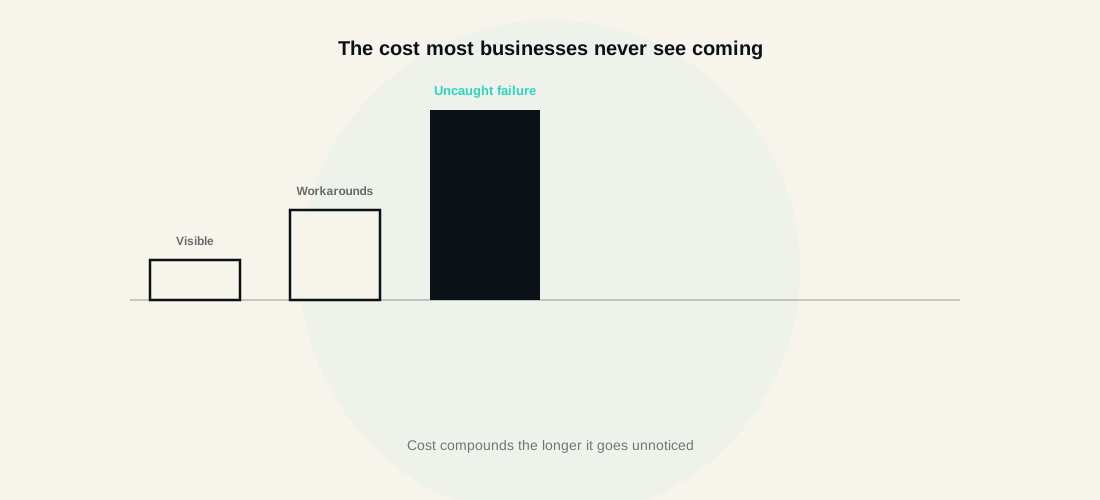
The visible cost is time lost to a broken workflow, staff reverting to the manual process the automation was meant to replace while someone tries to diagnose what actually went wrong, often without clear logs or monitoring to point them toward the real cause.
The less visible cost is compounding technical debt. Each workaround stacked onto a DIY automation to patch a new edge case makes the whole system harder to understand and more fragile the next time something changes, until eventually no single person on the team genuinely understands how the whole thing actually works.
The most expensive cost is a failure nobody caught in time, incorrect data reaching a report, a customer-facing error, a compliance gap that went unnoticed because the automation that was supposed to prevent it had itself silently stopped working correctly weeks earlier.
A concrete way this plays out: a business automates order confirmation emails through a no-code tool, and a change to a connected system's data format causes the automation to silently fail for a subset of orders. With no monitoring in place, this goes unnoticed for three weeks, during which a meaningful number of customers never received confirmation, generating support enquiries, refund requests, and genuine reputational damage, all traceable back to a failure that would have taken minutes to catch with proper alerting in place, and far longer to unwind after the fact.
What a Consultant Actually Adds
Genuine engineering judgement applied to your specific workflow, not a generic template's happy path, proper handling for the edge cases that actually occur in your real data, not just the cases a demo was built to showcase well.
Real monitoring and alerting, so a failure gets caught and flagged immediately, not discovered days later when someone happens to notice the downstream effect of a process that quietly stopped working.
An architecture built for your actual scale and complexity, neither over-engineered for a simple need nor under-built for one that has genuinely outgrown a no-code tool's capabilities, a judgement call that requires real technical experience to make well, covered in more depth in our guide to choosing an AI automation agency.
Documentation and handover that survives staff turnover, so the automation remains genuinely maintainable by whoever is on the team in a year, not dependent on the specific person who happened to build it in a no-code tool understanding their own logic well enough to explain it to someone else later.
In Practice
The honest starting point for this decision is mapping your actual workflow first, before deciding whether DIY or a consultant is the right fit, exactly the discipline covered in our AI automation service. If that map reveals genuine complexity, multiple integrations, real business logic, meaningful scale, that complexity is the actual signal worth acting on, not a guess made without looking closely at the real workflow first.
The businesses that get automation right are not the ones who always build custom, or the ones who always reach for a no-code tool, they are the ones who honestly assessed which category their specific workflow actually falls into, and matched the approach to the real complexity in front of them, not to whichever option felt easiest to start with.
FAQ
Questions, Answered.
Read next
More on AI Automation
10 High ROI Automations Every SME Should Consider in 2026
Ten concrete, high-ROI automations for UK SMEs, with real effort and payoff for each, plus how to prioritise and where to actually start.
AI Automation for Accountants and Finance Teams
How AI automation actually applies to accounting firms and finance teams, invoice and reconciliation, document extraction, reporting, MTD compliance, and real ROI.
AI Automation for Professional Services Firms
Real AI automation for professional services, client intake, document workflows, reporting, genuine time recovery, and honest ROI.