
Resources
What Does AI Automation Cost in the UK
Real GBP pricing models, what actually drives the cost, pilot versus full build, and how to calculate genuine ROI before you commit to an AI automation project.

Mohid Bhatti
AI Systems Engineer, Devity Technologies
"It depends" is technically true and completely unhelpful when you are trying to actually budget for AI automation. This guide gives real GBP ranges, explains what genuinely drives the price up or down, covers the pilot-versus-full-build decision, and shows you how to calculate whether a given automation will actually pay for itself, tied directly to hours saved and real payback time, not vague promises of efficiency.
Pricing Models: How Agencies Actually Charge
Three pricing structures cover most of what you will encounter:
Fixed project fee. You agree a defined scope and pay a set amount for it. This works well for a contained, well-understood build, a single workflow automation or a standalone AI assistant, where the scope is genuinely clear enough to price confidently upfront.
Monthly retainer. You pay an ongoing fee covering a set amount of development and support time. This suits businesses expecting continuous iteration, new automations added over time, or ongoing monitoring and adjustment of existing ones, rather than a single, finished deliverable.
Hybrid. A fixed fee for an initial discovery and pilot phase, where scope can genuinely be defined tightly, followed by either a further fixed fee or a retainer for the full build once real requirements are clearer. This is often the lowest-risk structure for a business new to AI automation, since it limits your exposure before you have real evidence the approach will work for your specific case.
Where the automation is built also affects price meaningfully. UK-based consultancies and engineers typically charge more per day than offshore teams, but the gap is often smaller than it first appears once you account for the coordination overhead, timezone friction, and rework that can come with less direct communication. For regulated industries specifically, finance and healthcare among them, procurement policy often requires onshore delivery regardless of cost, which is worth confirming early if it applies to you.
What Actually Drives the Cost
Number and complexity of integrations. Connecting to your existing systems, a CRM, an accounting platform, a legacy database, is consistently the single biggest driver of cost variation, more than the automation logic itself.
How much judgement the system needs to apply. A workflow that follows fixed rules is cheaper to build than one that needs to read unstructured documents, interpret context, or make decisions that vary based on nuanced input.
Data volume and quality. Clean, well-structured data is straightforward to work with. Messy, inconsistent, or scattered data adds real engineering time before the automation logic itself can even begin.
Compliance requirements. GDPR-aligned data handling is a baseline expectation for most UK businesses now, but sector-specific requirements, financial audit trails, healthcare data standards, add genuine, quantifiable cost on top of that baseline.
AI model usage itself. Ongoing API costs for the underlying AI model scale with how much text or data the system actually processes, this is a real running cost, not a one-time build expense, and it is worth understanding before committing to a system with heavy day-to-day usage.
Whether the automation follows fixed rules or needs genuine engineering judgement. A workflow built entirely on no-code platforms with straightforward, well-documented APIs is cheaper than one requiring custom-engineered logic, bespoke error handling, or integration with a poorly documented legacy system. This distinction, covered in more depth in our comparison of automation platforms, is often the real difference between a quote at the low end of a range and one at the high end for what sounds like a similar project on paper.
Pilot vs Full Build
This decision matters more than most first-time buyers realise, and getting it right significantly reduces your financial risk.
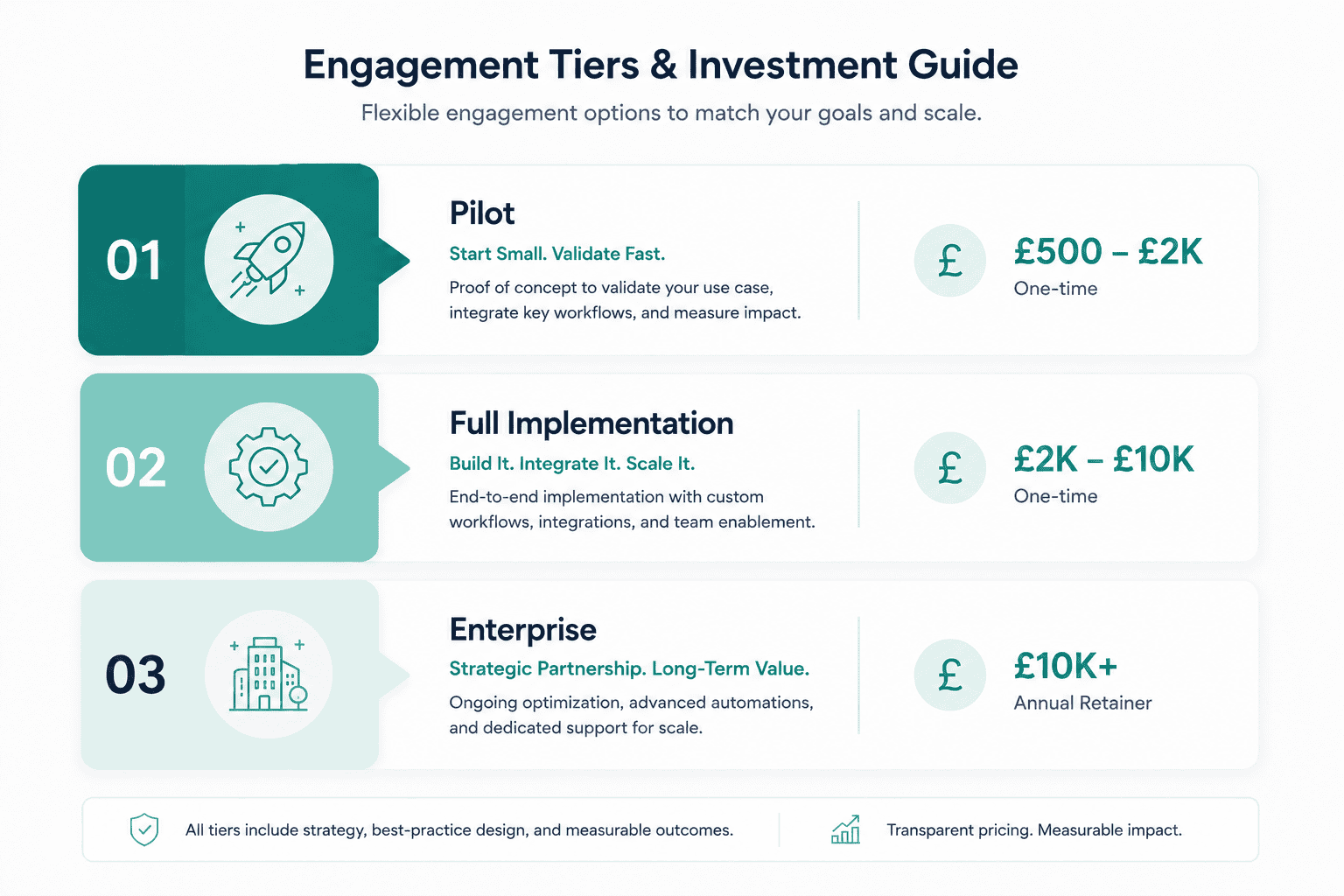
A pilot targets one specific, well-understood workflow, proving the case with limited exposure. It typically takes a matter of weeks, not months, and gives you real, specific data, actual hours saved, actual accuracy achieved, actual cost to run, rather than a projection. This is almost always the smarter starting point unless you already have strong internal confidence, from prior experience elsewhere, that a larger investment is justified.
A full implementation makes sense once a pilot, or strong existing evidence, has already validated the approach, and you are ready to automate multiple workflows or build a more complex system spanning several business processes at once.
Businesses that skip the pilot and commit directly to a large build are taking on meaningfully more risk for the sake of moving slightly faster, a trade that rarely holds up once you actually calculate the numbers involved.
Sample Ranges in GBP
These reflect realistic UK market rates for a properly engineered system, not the cheapest possible implementation available:
| Project type | Typical build cost | Typical monthly running cost |
|---|---|---|
| Focused pilot, one workflow | £500 to £2,000 | £30 to £100 |
| Full implementation, multiple workflows | £2,000 to £10,000 | £100 to £300 |
| Enterprise system with compliance needs | £10,000+ | £300 to £1,000+ |
Discovery and scoping, mapping your actual processes and identifying where automation genuinely makes sense, is often sold as a smaller, fixed-price engagement in its own right, typically £1,500 to £3,000, before any implementation commitment is made.
Cost Red Flags Worth Watching For
No mention of running costs at all. A quote covering only the build, with no discussion of ongoing AI model usage, platform subscriptions, or support, is incomplete. These costs are real and ongoing, and a quote that omits them entirely either has not thought it through or is deliberately presenting a lower number than the true total.
A single number with no breakdown. A responsible quote should let you see roughly where the cost is going, discovery, build, integration complexity, ongoing support, not just one opaque total.
No willingness to start with a pilot. A partner who insists on a large, full-scope commitment before you have any real evidence the approach works for your specific case is asking you to carry more risk than necessary, often for their benefit more than yours.
Vague claims about what the system will actually do. Be specific about what a workflow will handle before committing budget. "AI-powered automation" without a concrete description of what decisions the system makes and what it hands off to a human is a sign the scope has not been properly defined yet.
ROI Framing: The Actual Calculation
The genuine payback calculation is straightforward, and worth doing honestly before committing budget:
Hours currently spent on the manual process, multiplied by the real hourly cost of that time, gives you the annual cost of the status quo. A team spending fifteen hours a week on manual invoice processing at twenty pounds an hour is spending over fourteen thousand pounds a year on that task alone, independent of any automation decision.
Compare that annual figure against the automation's total first-year cost, build cost plus twelve months of running cost. An automation costing six thousand pounds to build that removes seventy-five percent of that manual workload saves over ten thousand pounds in the first year alone, comfortably paying for itself well within that year.
This calculation is what separates a genuine investment decision from a hopeful guess. If the real numbers do not show a clear payback within a reasonable timeframe for your specific workflow, that is valuable information too, either the workflow is not the right first candidate for automation, or the quote you are looking at needs to come down.
A second, larger example makes the same point at a different scale. A team of five spending twenty hours a week combined on manual processes, at a blended cost of fifty pounds an hour, represents roughly fifty thousand pounds a year in labour cost tied to that work. A full implementation costing eighteen thousand pounds to build, plus a further five thousand in first-year support and running costs, removing seventy-five percent of that manual workload, saves around thirty-seven and a half thousand pounds annually. Against a first-year total investment of twenty-three thousand pounds, that puts break-even within the first year, a very different, and much more honest, picture than either a vague promise of efficiency or a headline cost figure shown without the corresponding savings calculation next to it.
In Practice
For the architecture and engineering decisions behind these numbers, our complete guide to AI automation for UK businesses covers what genuinely engineered automation looks like versus a no-code implementation, which is directly relevant to why costs vary as much as they do between providers. If you want to see where the real ROI opportunities sit in your own operations before committing any budget, our free technical audit is a genuinely useful, no-obligation first step, and our AI automation service is where that conversation continues once you have a clear picture of what is worth automating first.
Transparent pricing is not just good practice, it is what lets you make a real decision. A business that understands the actual ranges, what drives them, and how to calculate genuine payback is in a far stronger position than one relying on a single quoted number with no context behind it.
FAQ
Questions, Answered.
Read next
More on AI Automation
10 High ROI Automations Every SME Should Consider in 2026
Ten concrete, high-ROI automations for UK SMEs, with real effort and payoff for each, plus how to prioritise and where to actually start.
AI Automation for Accountants and Finance Teams
How AI automation actually applies to accounting firms and finance teams, invoice and reconciliation, document extraction, reporting, MTD compliance, and real ROI.
AI Automation for Professional Services Firms
Real AI automation for professional services, client intake, document workflows, reporting, genuine time recovery, and honest ROI.