
Resources
How to Automate Your Business Processes: A Practical Playbook
A step by step framework for automating business processes, mapping candidates, choosing tools, running a pilot, measuring results, and scaling with proper governance.

Mohid Bhatti
AI Systems Engineer, Devity Technologies
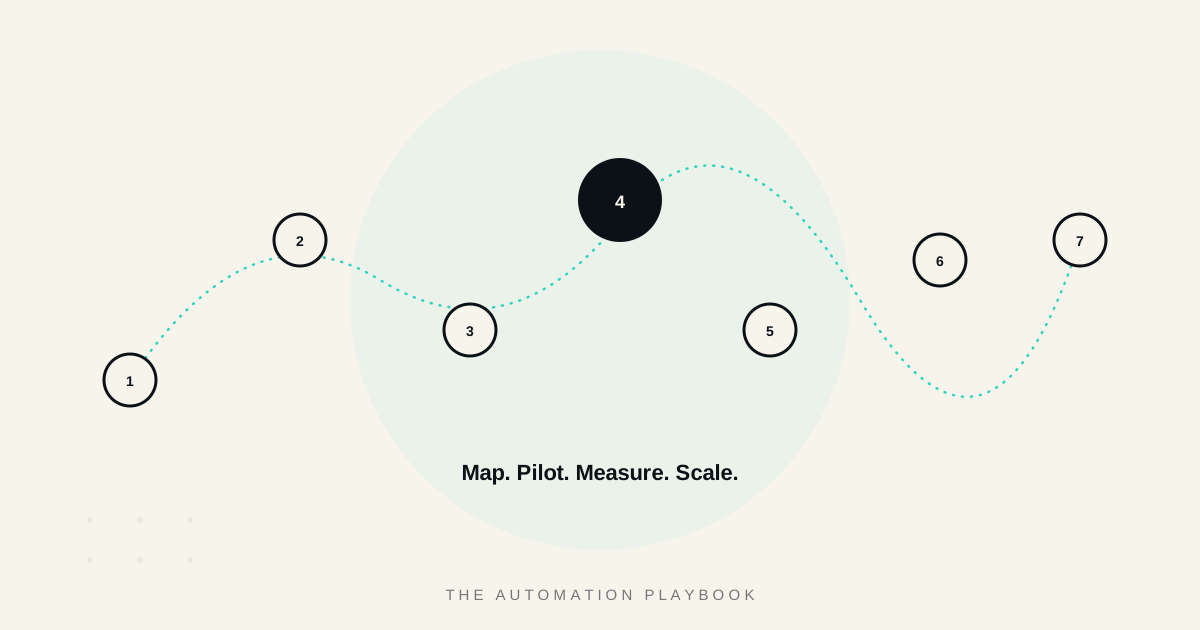
Most business process automation advice jumps straight to tool comparisons, which tool is best, which platform has the most integrations, skipping the actual first step entirely. This is a practical, seven-part framework that starts where automation projects should actually start, mapping your real processes, and ends with the governance discipline that keeps automation genuinely useful as you scale past your first pilot.
Step 1: Map Your Processes
Before any tool gets chosen, write down what your team actually does, step by step, for the processes you suspect could be automated. This sounds basic and is skipped constantly, which is exactly why so many automation projects end up automating the wrong thing, or automating a broken process faster rather than fixing it.
A useful map captures who is involved at each step, what triggers the process to start, what information or systems each step touches, and roughly how long each step takes. This does not need to be a formal, heavyweight exercise, a genuine, honest walk-through with the people who actually do the work daily is often more accurate than a diagram built from assumption in a meeting room.
Pay particular attention to the informal workarounds people have quietly built into a process over time, the extra check someone added after a specific mistake happened once, the manual cross-reference nobody documented but everyone relies on. These informal adjustments often carry real, important information about edge cases a formal process description would miss entirely, and skipping them is a common way an otherwise well-intentioned automation ends up handling the easy cases well while quietly mishandling exactly the situations experienced staff learned to watch for.
Step 2: Pick the Right Candidates
Not every process is a good automation candidate, and choosing well here determines whether your first automation builds confidence or creates doubt about the whole approach.
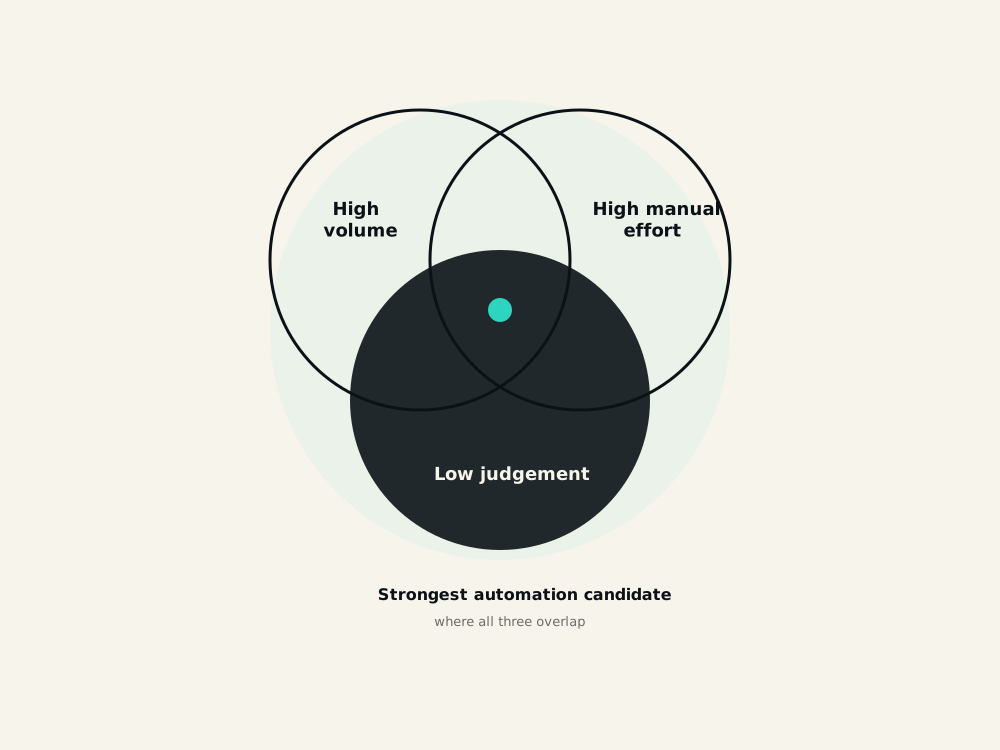
High volume matters because the return on automation scales directly with how often a process repeats, automating something done twice a month rarely justifies the effort compared to something done fifty times a week.
High manual effort relative to complexity is the sweet spot, a process eating significant staff time despite being fundamentally repetitive and rule-based.
Low judgement required is the final filter. A process following consistent, describable rules, if this happens, do that, is a strong candidate. A process requiring meaningful case-by-case human judgement is a weaker starting point, not because it can never be automated, but because it is a harder, riskier first project.
A worked example makes this concrete. Invoice processing, checking a submitted invoice against a purchase order and flagging discrepancies, typically scores well on all three, it happens often, consumes real staff hours, and follows describable rules a person could write down clearly. Handling customer complaints, by contrast, often scores poorly as a first candidate, the volume may be high, but the judgement required to respond appropriately to each individual situation is significant and hard to reduce to consistent rules. This does not mean complaint handling can never benefit from automation, parts of it, initial categorisation, routing to the right team, often can, but it is a harder, less forgiving place to start than a process like invoice matching.
Step 3: Choose the Right Tooling
This is where most guides start, and it should genuinely come third, once you know exactly what you are automating and why.
Start with the simplest tool that actually solves the problem. For many first automations, this means a no-code platform, fast to set up, low upfront cost, well suited to a single, well-defined workflow. Move toward custom engineering only once you hit a genuine limit, complex logic a no-code tool cannot express cleanly, volume where per-task pricing becomes expensive, or data sovereignty requirements that mean self-hosting matters. We cover this specific decision, and where the honest line between no-code and custom actually sits, in more depth in our comparison of n8n, Zapier, and Make.
| Signal | Points toward |
|---|---|
| Single, linear workflow with a clear trigger | No-code platform |
| Complex branching logic or high transaction volume | Custom engineering |
| Data sovereignty or strict compliance requirements | Self-hosted or custom |
| Non-technical team needs to build and maintain it | No-code platform |
| Genuine judgement, reading unstructured input | Custom-engineered AI system |
Step 4: Run a Real Pilot
Automate one process, fully, before expanding to a second. A pilot proves the approach on a real, bounded scope with limited exposure, and gives you genuine data rather than a hopeful projection about how automation will perform more broadly.
A properly run pilot has a clearly defined scope, a specific success metric agreed before it starts, and a realistic timeframe, long enough to capture normal, representative usage rather than an unusually smooth or unusually rough early stretch that does not reflect how the process actually behaves week to week.
Keep the pilot's scope genuinely narrow, resist the temptation to expand it mid-flight just because early results look promising, or to quietly add extra functionality because it seems easy while you are already in there. A pilot that keeps growing loses the one thing that makes a pilot useful in the first place, a clean, bounded comparison between how the process performed before and after, with nothing else changing at the same time to confuse the result.
Step 5: Measure What Actually Happened
Compare the pilot's real results against the metric you defined before starting, not against a vague sense of whether things feel better. Hours saved, error rate, processing time, whichever metric genuinely mattered for that specific process, measured honestly, including where the automation underperformed or needed adjustment, not just its successes.
This step is also where you decide, based on real evidence, whether to expand the automation's scope, move to a more capable tool if the current one is genuinely straining, or conclude that this particular process was not actually the right candidate after all. All three are legitimate outcomes of a well-run pilot.
Returning to the invoice matching example, a genuine measurement would track something specific and concrete, hours of manual reconciliation time before automation versus after, the error rate in matched invoices, and how many cases still required human review because the automation correctly identified something it could not confidently resolve on its own. A result showing real time saved but a higher-than-expected rate of cases needing human review is not a failure, it is useful, specific information about where the automation's boundaries actually sit, and exactly the kind of insight a rushed, unmeasured rollout would never surface.
Step 6: Scale Deliberately
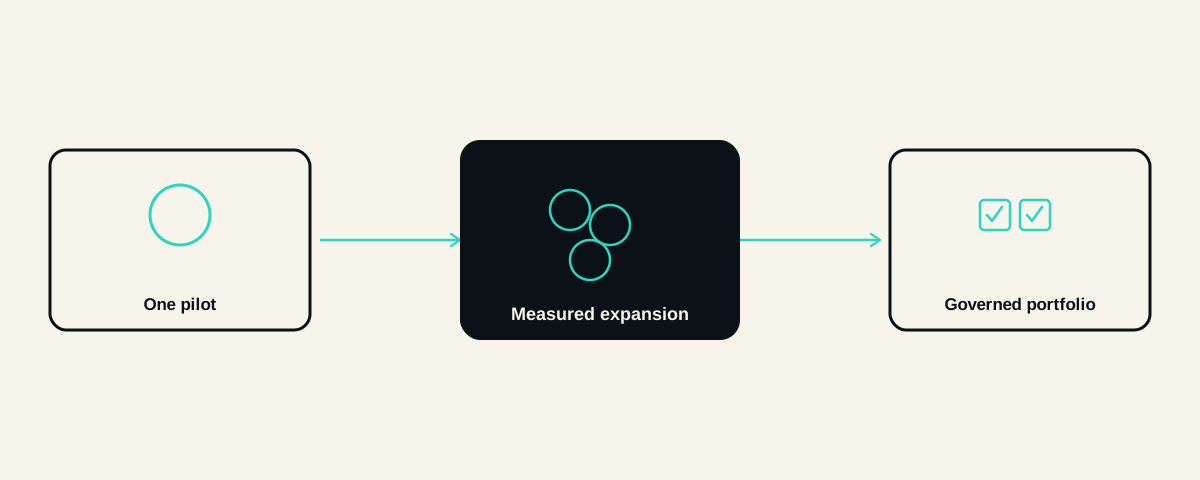
Once a pilot has genuinely proven itself, expanding to additional processes should follow the same disciplined sequence, map, pick candidates, choose appropriate tooling, pilot, measure, rather than skipping straight to a broad rollout on the strength of one early success.
Scaling deliberately also means resisting the urge to automate everything at once simply because the first automation worked. Each additional process still deserves its own honest evaluation against the same candidate criteria from Step 2, not automatic inclusion just because momentum and enthusiasm are high.
Step 7: Build in Governance
This is the step most businesses skip entirely, and the one that determines whether automation remains genuinely useful as it accumulates, or slowly turns into a collection of unmaintained, poorly understood systems nobody fully trusts.
A clear owner for each automation, a specific person responsible for knowing what it does, why, and who to call if it breaks, not diffuse, unclear ownership across whoever happened to be involved in building it.
A defined process for exceptions, what happens when an automation encounters something it was not built to handle, does it fail safely, alert someone, or quietly do the wrong thing. This should be a deliberate design decision, not something discovered by accident in production.
Ongoing monitoring, not a one-time check at launch, since the processes and data an automation depends on change over time, and a system that worked correctly at launch can quietly degrade as those underlying conditions shift.
Documentation that survives staff turnover, a written record of what each automation does and why, so institutional knowledge does not walk out the door with whoever originally built it.
A periodic review cadence, a scheduled point, quarterly is common, to revisit every live automation and confirm it is still doing what it was built to do, still handling the volume it was designed for, and still worth the maintenance it requires. Automations that quietly outlive their usefulness, built for a process that has since changed or been discontinued, are a real, easily overlooked cost that periodic review catches before it accumulates unnoticed across a growing portfolio of automated processes.
In Practice
This same disciplined framework, mapping first, choosing tools deliberately, piloting before scaling, is exactly how we approach every automation engagement, and it is covered in more architectural depth in our complete guide to AI automation for UK businesses. If you want help mapping which of your own processes are genuinely worth automating first, our free technical audit is a concrete, no-obligation first step, exactly the kind of process mapping this playbook describes, applied to your actual business.
The businesses that get real, lasting value from automation are rarely the ones who moved fastest to a tool, they are the ones who mapped honestly, picked the right first candidate, piloted properly, and built in the governance that keeps automation trustworthy as it grows well beyond that first project.
FAQ
Questions, Answered.
Read next
More on AI Automation
10 High ROI Automations Every SME Should Consider in 2026
Ten concrete, high-ROI automations for UK SMEs, with real effort and payoff for each, plus how to prioritise and where to actually start.
AI Automation for Accountants and Finance Teams
How AI automation actually applies to accounting firms and finance teams, invoice and reconciliation, document extraction, reporting, MTD compliance, and real ROI.
AI Automation for Professional Services Firms
Real AI automation for professional services, client intake, document workflows, reporting, genuine time recovery, and honest ROI.