
Resources
How Much Does It Cost to Build Custom Software in the UK
Real GBP cost ranges, what actually drives the price, fixed-price versus time and materials, and how to avoid overspending on a custom software project.

Ahmad Saeed
Full-Stack Engineer, Devity Technologies
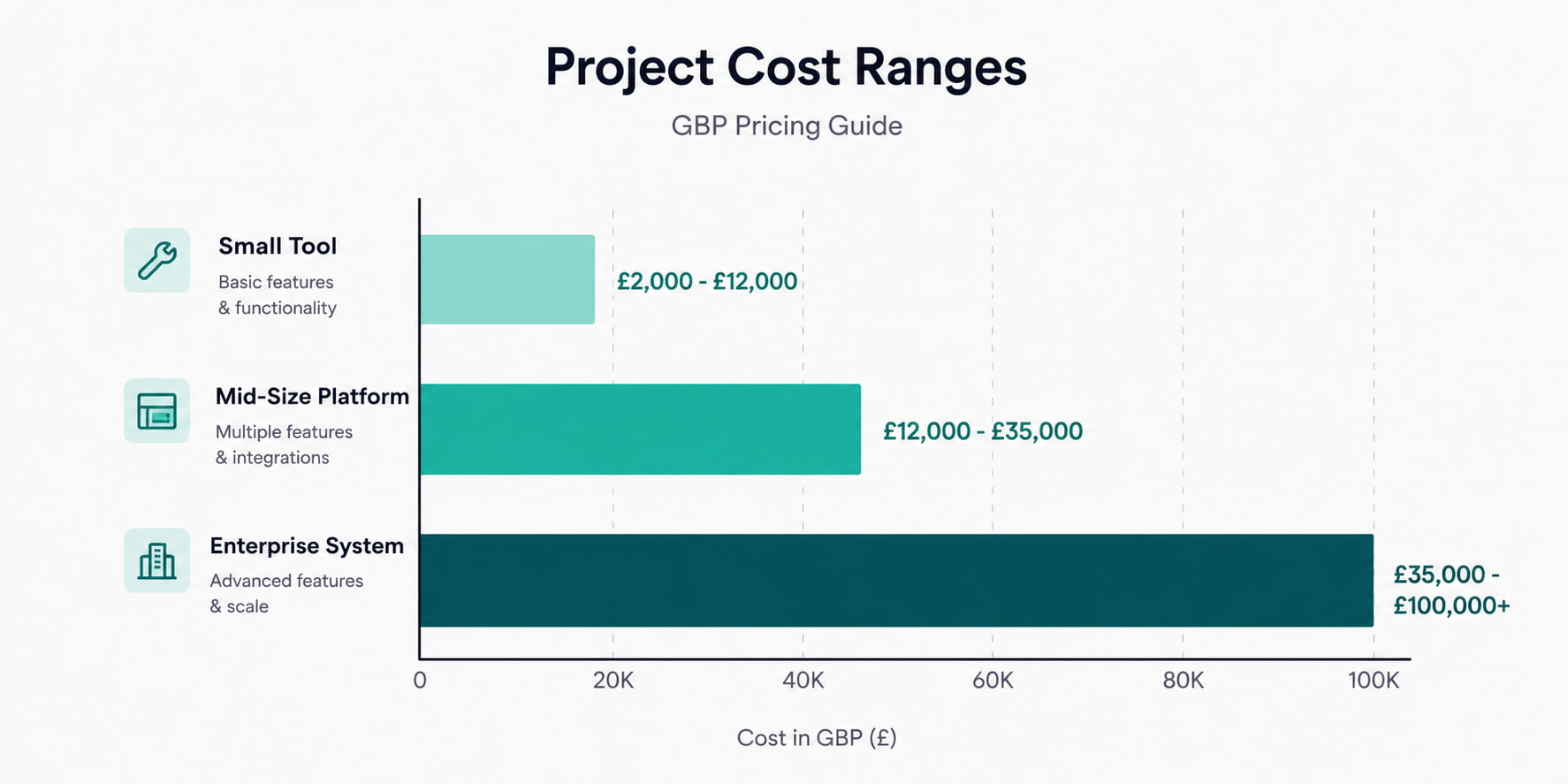
Search "how much does custom software cost UK" and you will find a wide range of answers, £10,000 to £500,000 or more, all technically correct and none of them useful on their own. The honest answer is that the range is wide because the question is incomplete. This guide breaks down what actually drives the cost, gives real sample ranges in GBP, explains the difference between fixed-price and time and materials, and covers how to avoid the most common ways businesses overspend.
What Actually Drives the Cost
A handful of factors explain almost all of the variation you will see between quotes:
Integration complexity. Connecting your new software to existing systems, a legacy database, a third-party API, an accounting platform, is consistently the single biggest driver of cost variation. Two projects with a similar feature list can differ enormously in price purely based on what they need to talk to.
Number of user roles and permission levels. A tool with one type of user is straightforward. A system with admins, managers, and end users each seeing different data and having different capabilities adds real design and engineering work at every layer.
Data complexity and volume. Software handling a modest, well-structured dataset is simpler than software handling large volumes of messy, inconsistent, or rapidly growing data.
Compliance requirements. GDPR-aligned data handling is table stakes for most UK software now, but sector-specific requirements, healthcare data standards, financial audit trails, ISO certifications, add real, quantifiable cost on top of that baseline.
Design depth. A functional internal tool needs far less design investment than a customer-facing product where the interface directly affects conversion and brand perception.
Team composition and location. A senior UK-based team working directly with you costs more per day than an offshore team managed through several layers, but often costs less overall once you account for miscommunication, rework, and slower iteration.
Timeline pressure. Compressing a realistic six-month build into three months usually means a larger team working in parallel, which adds coordination overhead and cost, rather than simply moving faster for free. Rushed timelines are also where technical shortcuts tend to creep in, shortcuts that often surface as maintenance cost later.
Testing and quality assurance depth. A simple internal tool with low consequences for a bug behaves very differently, cost-wise, than a customer-facing product where a failure means lost revenue or a compliance breach. The QA investment scales with what is actually at stake if something goes wrong, not just the size of the codebase.
Fixed-Price vs Time and Materials
This decision affects both your budget certainty and how well the final product actually fits what you need.
Fixed-price means agreeing a scope and a price upfront, and the developer delivers that scope for that price. This works well when requirements are genuinely well understood and unlikely to change, a well-defined internal tool replacing a known manual process, for example. The risk is that any change to scope becomes a separate negotiation, and a developer pricing a fixed contract will typically build in a buffer for the unknowns they cannot fully see yet, which you pay for whether or not those risks materialise.
Time and materials means paying for the actual work done, typically billed weekly or monthly against an agreed team and rate. This suits projects where you expect to learn and adjust as you go, which describes most early-stage products more accurately than a fixed-price contract does, since a genuinely new product's first version is rarely exactly right the first time.
Neither model is inherently better. The mistake is choosing fixed-price for a genuinely exploratory product (locking in specifics you do not actually know yet), or choosing time and materials with no budget cap or milestone structure at all (removing any real cost discipline).
A third, increasingly common middle ground is a hybrid approach: fixed-price for an initial discovery and design phase, where scope genuinely can be defined tightly, followed by time and materials for the build itself once real requirements and priorities are clearer. This gives you cost certainty for the planning stage while keeping flexibility where it actually matters, during development, when the product is still being shaped by what you learn.
Sample Ranges in GBP
These ranges reflect UK market rates for a properly resourced team, not the lowest possible price available:
| Project type | Typical range | What's included |
|---|---|---|
| Small internal tool | £10,000 to £25,000 | Single user type, straightforward workflow, minimal integrations |
| SME business system | £25,000 to £80,000 | Multiple user roles, a handful of integrations, moderate design investment |
| Customer-facing product or MVP | £30,000 to £120,000 | Polished design, authentication, payments or subscriptions, scalable architecture |
| Complex platform with compliance needs | £100,000 to £300,000+ | Multiple integrations, regulatory requirements, high availability, extensive testing |
These are indicative, not a quote. A responsible number for your specific project only comes after a real conversation about what you actually need.
Worth watching for specifically: some quotes at the lower end of a range exclude things a reasonable person would assume are included, project management time, a defined testing phase, or any post-launch support. A £15,000 quote that excludes those is not necessarily cheaper than a £22,000 quote that includes them, it may just be an incomplete number wearing a lower price tag.
What Actually Changes the Price Mid-Project
Even a well-scoped project can see costs shift, usually for one of these reasons:
- New requirements surface once real users interact with an early version. This is not a failure of planning, it is a normal part of building something genuinely useful, but it does affect cost if not managed with a clear change process.
- An integration turns out to be more complex than either side assumed. Third-party APIs are not always as well documented or as reliable as their marketing suggests.
- Compliance requirements change or were not fully identified upfront. This is more common in regulated industries where requirements can be genuinely unclear until a formal review.
- The client requests additional polish or features beyond the original scope. Reasonable and common, but worth tracking explicitly rather than letting scope quietly expand without anyone noticing the cumulative cost.
A development partner who flags these changes as they happen, rather than absorbing them silently or discovering them all at the final invoice, is the difference between a manageable budget conversation and an unpleasant surprise.
How to Avoid Overspending
Scope the first version tightly around the core problem. The temptation to build every feature you can imagine into version one is the single most common source of budget overrun. A focused first version that solves the actual problem, launched sooner, is almost always the better investment than a bloated version one that takes twice as long and costs twice as much before you have learned anything from real users.
Ask what happens when requirements change. A partner with a clear, calm process for handling scope changes is a better sign than one who promises the price will never move, since that promise is rarely honest for anything beyond a very simple, static project.
Get the integration list nailed down early. Since integration complexity is the biggest cost variable, spending real time upfront confirming exactly which systems need to connect, and how reliable those connections actually are, prevents the most common source of mid-project cost surprises.
Budget for the year after launch, not just the build. Hosting, monitoring, security patches, and the inevitable small fixes and feature requests that come from real usage are an ongoing cost. Treating the initial invoice as the entire budget is a common and avoidable planning mistake.
Ask for a written breakdown, not just a total. A quote broken down by phase or feature lets you see where the money is actually going, and gives you the option to trim specific items rather than negotiating a single opaque number.
Involve real users before committing to the full feature set. A short discovery phase that includes talking to the actual people who will use the software often reveals that some planned features matter far less than assumed, while a genuinely important need was missing from the original brief entirely. This is a cheap way to correct scope before it becomes an expensive mid-project change.
In Practice
Devity's own approach reflects this directly, every engagement starts with a discovery phase specifically to define scope and give a clear pricing range before any commitment is made, exactly the kind of transparency this guide has been arguing for throughout. If you have a project in mind and want a specific, honest quote rather than a generic range, our web platform development service is a good starting point, or reach out directly for a project quote.
The honest answer to "how much does custom software cost" is always going to start with "it depends," but it should not end there. A good partner turns that into a specific, defensible number once they actually understand what you are building, not a guess pulled from a generic pricing page.
FAQ
Questions, Answered.
Read next
More on Web Platforms
API First Architecture: Building Software That Scales and Integrates
What API-first architecture actually means, the real benefits, how it enables genuine integration and reuse, and when it matters versus when it's unnecessary overhead.
Build vs No Code for Web Apps: Where the Line Really Is
Where no-code web app builders genuinely excel, where they break down, and how to think about performance, ownership, and the migration path before you commit.
Core Web Vitals: A Practical Guide to a Faster, Higher Ranking Site
What LCP, INP, and CLS actually measure, the fixes that move each metric, how to measure them correctly, and the real business impact of getting them right.