
Resources
Manufacturing and Operations: Custom Software That Cuts Waste
A practical guide to reducing manufacturing waste through custom software, process digitisation, real-time data capture, MES integration, automation, and honest ROI.

Mohid Bhatti
AI Systems Engineer, Devity Technologies
Manufacturing waste is rarely one dramatic failure, it accumulates quietly through disconnected systems, manual data entry, and decisions made on information that is already out of date by the time anyone acts on it. Custom software, built around how a specific operation actually runs rather than a generic template, is where a meaningful amount of this waste genuinely gets addressed. This guide covers process digitisation, real-time data capture, integration, automation, and honest ROI.
| Where waste accumulates | What closes the gap |
|---|---|
| Paper-based process tracking | Structured digital workflows |
| Delayed floor visibility | Real-time data capture |
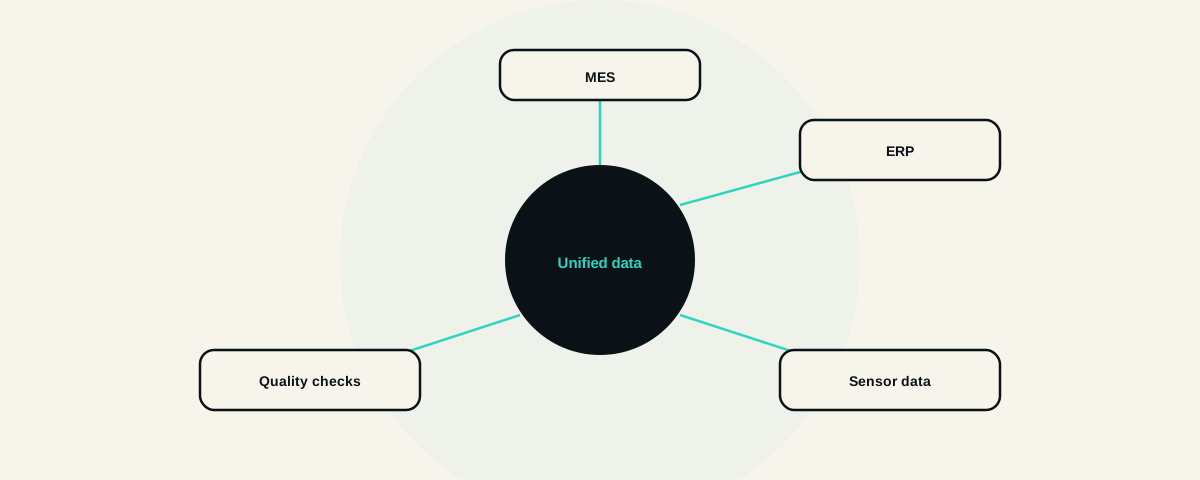
| Disconnected MES, ERP, and sensor data | Deliberate systems integration |
| Manual quality checks | Automated anomaly flagging |
| Reactive, unplanned downtime | Predictive maintenance |
Process Digitisation
Replacing paper and spreadsheet-based processes with structured digital workflows is typically the highest-leverage starting point, since it is the foundation genuine automation and real-time visibility both depend on, a process still tracked on paper cannot be automated or measured accurately no matter how sophisticated the systems around it are.
Digitisation should follow the real process, not a generic template. A production line's actual workflow, its specific quality checks, its particular handoffs between shifts or stations, needs software built around how the work genuinely happens, not a standard template that forces the process to bend around the software's assumptions instead.
Data Capture
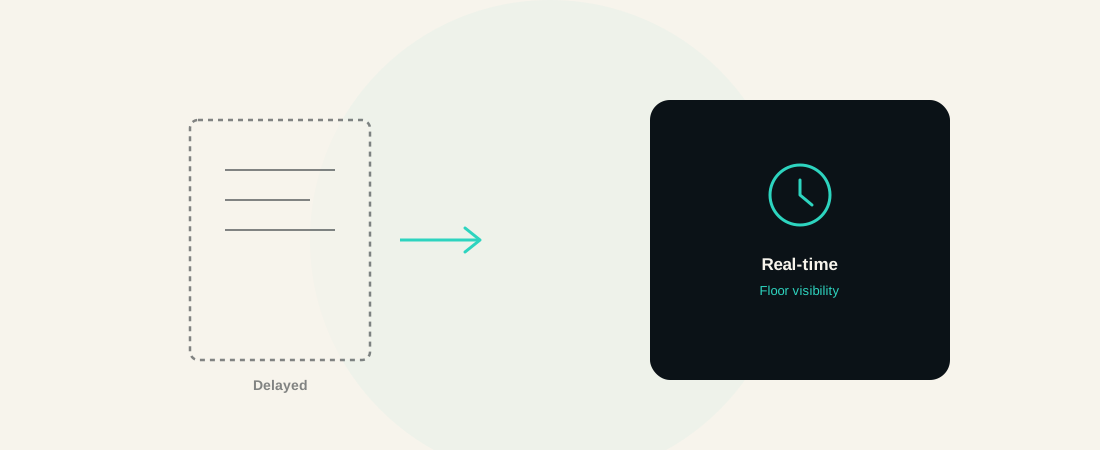
Real-time data capture from the production floor, connecting sensors, machine data, and manual quality checks into a single, current view, closes the gap between what is actually happening on the floor and what management can currently see, a gap that in many operations is measured in hours or shifts, not minutes.
Structured, consistent data entry at the point of work, rather than end-of-shift batch entry reconstructed from memory, produces meaningfully more accurate data, and removes a real, recurring source of error that compounds when decisions get made on data that was never quite accurate to begin with.
A concrete illustration: a production line logging quality checks on paper, transcribed into a spreadsheet at the end of each shift, means a quality issue that occurred mid-shift is often not visible to management until hours later, by which point additional units have already been produced with the same underlying defect. The same check captured digitally at the point of inspection surfaces the deviation immediately, giving the team a genuine chance to intervene before the defect compounds across a larger batch, the difference between catching a problem early and discovering its full cost only after the fact.
Integration
Custom software often adds the most value by integrating cleanly with systems already in place, an existing MES, SCADA system, or ERP, rather than replacing them wholesale, connecting genuinely disconnected systems and capturing the specific data gaps between them that no single existing system was ever designed to handle.
MES integration specifically deserves careful, deliberate architecture, since a manufacturing execution system typically sits at the centre of production data, and a poorly integrated connection to it can introduce genuine reliability risk into a process where downtime carries a direct, measurable cost.
Operational technology and information technology increasingly need to work together, sensor and machine data feeding into the same systems used for planning, quality, and reporting, rather than living in separate, disconnected worlds that require manual reconciliation to bridge.
Genuine integration work also means planning for the people, not just the systems. A floor team accustomed to a paper-based or legacy process needs real, deliberate change management alongside any new digital system, training, a genuine transition period, and visible support during the switch, since a technically excellent integration that nobody on the floor actually adopts delivers none of its intended value.
Automation
Automated quality checks and anomaly flagging, catching a deviation from expected parameters immediately rather than at the next scheduled manual inspection, reduces the volume of defective output that reaches later stages of production before being caught.
Automated reporting and dashboarding, pulling real, current data directly from the floor rather than requiring a person to manually compile it, frees genuine time for the people currently doing that compilation and gives management a materially more current view to actually act on.
Predictive maintenance, built on real equipment data rather than a fixed maintenance schedule, shifts maintenance from reactive, disruptive downtime to planned, scheduled work, a pattern with a well-documented, strong return once genuinely embedded into how maintenance decisions actually get made.
Automated inventory and material tracking, updating stock levels directly from actual production consumption rather than periodic manual counts, closes another common source of waste, over-ordering material that was actually still in stock, or discovering a shortage only once a production line has already stopped for it.
ROI
The honest way to calculate ROI here is against your current, real cost of the specific waste being addressed, hours spent on manual data reconciliation, defective output that reached a later production stage before being caught, unplanned downtime that predictive maintenance would have flagged in advance.
This is genuinely higher-value, bespoke engineering work, not a templated solution, and the cost reflects that, but the return compounds directly with production volume, a percentage improvement in a high-volume operation represents a materially larger absolute saving than the same percentage improvement would in a smaller one.
In Practice
Manufacturing and operations software is exactly the kind of project where genuine engineering depth, correctly integrating with existing MES and floor-level systems, building real-time data capture that's actually reliable in a production environment, matters more than a generic business software template. Our web platform development and AI automation services cover both sides of a genuinely useful manufacturing build, the core systems and the automation layered on top of them.
The manufacturing operations getting real value from custom software are not the ones with the most ambitious feature list, they are the ones who started with honest visibility into where their actual waste was accumulating, and built software specifically to close that gap.
FAQ
Questions, Answered.
Read next
More on AI Automation
10 High ROI Automations Every SME Should Consider in 2026
Ten concrete, high-ROI automations for UK SMEs, with real effort and payoff for each, plus how to prioritise and where to actually start.
AI Automation for Accountants and Finance Teams
How AI automation actually applies to accounting firms and finance teams, invoice and reconciliation, document extraction, reporting, MTD compliance, and real ROI.

AI Automation for Professional Services Firms
Real AI automation for professional services, client intake, document workflows, reporting, genuine time recovery, and honest ROI.