
Resources
Custom AI Agents Explained: What They Are and What They Can Do
What an AI agent actually is, how it differs from a chatbot and simple automation, real use cases, the tools behind it, and the honest limits worth knowing.

Mohid Bhatti
AI Systems Engineer, Devity Technologies
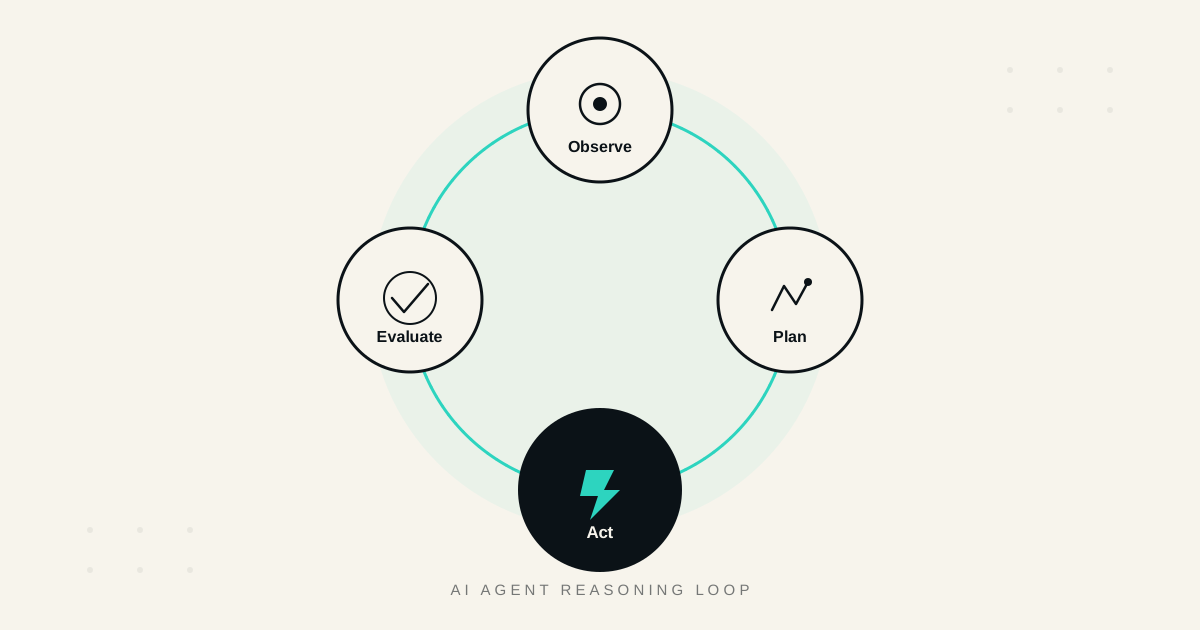
"AI agent" has become one of the most overused terms in software marketing, applied to everything from a simple chatbot with a new label to a genuinely autonomous system that plans and executes multi-step work on its own. This guide gives a precise, honest answer. An AI agent is a system built around a large language model that can reason about a task, use external tools, retain context across steps, and take action to complete a goal without a human directing each individual step.
Agents vs Chatbots vs Simple Automation
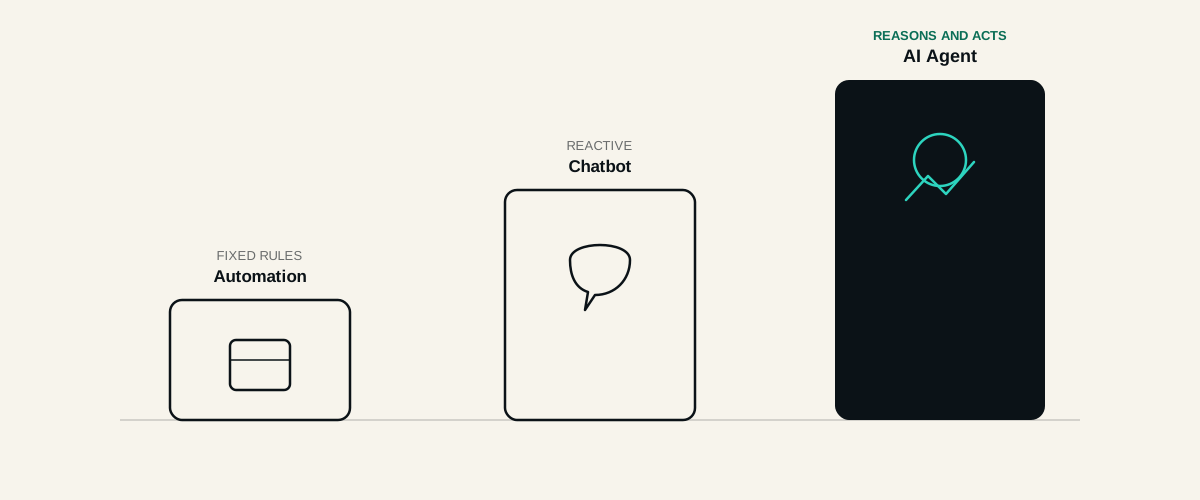
These three terms get used interchangeably in marketing copy, and they describe genuinely different systems.
Simple automation runs fixed rules without interpreting context. If a specific condition is met, a specific action happens, the same way every time, with no reasoning involved at all.
A chatbot answers questions based on predefined logic or a knowledge base. A rule-based chatbot follows a scripted decision tree. A more advanced AI chatbot uses a language model to understand natural language and answer from a knowledge base, but it remains fundamentally reactive, it responds to what it is asked, and nothing more.
An AI agent goes further than either. It reasons about what needs to happen, decides what action to take, executes that action using real tools connected to real systems, and evaluates whether the goal was actually achieved, chaining multiple steps together autonomously rather than stopping after a single response.
Technically, this behaviour comes from what is often called a reasoning loop. The agent observes the current situation, plans what to do next, acts by calling a tool or taking a step, then evaluates whether that action actually moved the task toward completion, repeating this cycle until the goal is met or it determines a human needs to step in. This loop is what separates an agent from a single-shot response, a chatbot answers once and stops, an agent keeps working through the problem, step by step, until it is genuinely resolved.
The clearest distinction: if a system only replies, it is a chatbot. If it can decide what to do next and take action across connected tools, it is an agent. None of the three compete with each other directly, the strongest real-world deployments often combine all three, simple automation for fixed, predictable steps, a chatbot for straightforward FAQ-style questions, and an agent for the parts of a workflow that genuinely require judgement and multi-step action.
| Simple automation | Chatbot | AI agent | |
|---|---|---|---|
| Reasoning | None, fixed rules only | Limited, matches input to a response | Full, reasons about the task and plans steps |
| Takes action across systems | Only pre-defined, fixed actions | Rarely, mostly conversational | Yes, calls tools and updates real systems |
| Handles multi-step tasks | No | No | Yes |
| Adapts to unexpected input | No | Poorly | Yes, within its defined scope |
| Best for | Predictable, repetitive triggers | Simple, bounded questions | Tasks requiring judgement across steps |
Real Use Cases
AI agents earn their place specifically where a task spans multiple systems, requires a decision that depends on context, or involves several steps a human would otherwise coordinate manually.
Customer support resolution, not just answering a question but actually completing the request, checking an order, processing a change, updating a record, and escalating to a human only when a case genuinely requires judgement.
Operations monitoring and remediation, an agent watching a system for anomalies, cross-referencing known issues, attempting a defined remediation step, and escalating to a person with a structured summary if the automated fix does not resolve it.
Document and data processing, reading unstructured input, extracting the relevant information, checking it against existing records, and taking the appropriate next action, a booking, an update, a flag for human review, without a person manually reading and re-entering the data.
Lead qualification and follow-up, reviewing an inbound enquiry, checking it against defined criteria, and either routing it appropriately or initiating a follow-up sequence, tasks that involve genuine judgement across multiple pieces of information, not a single fixed rule.
Tools and RAG: What Actually Makes an Agent Work
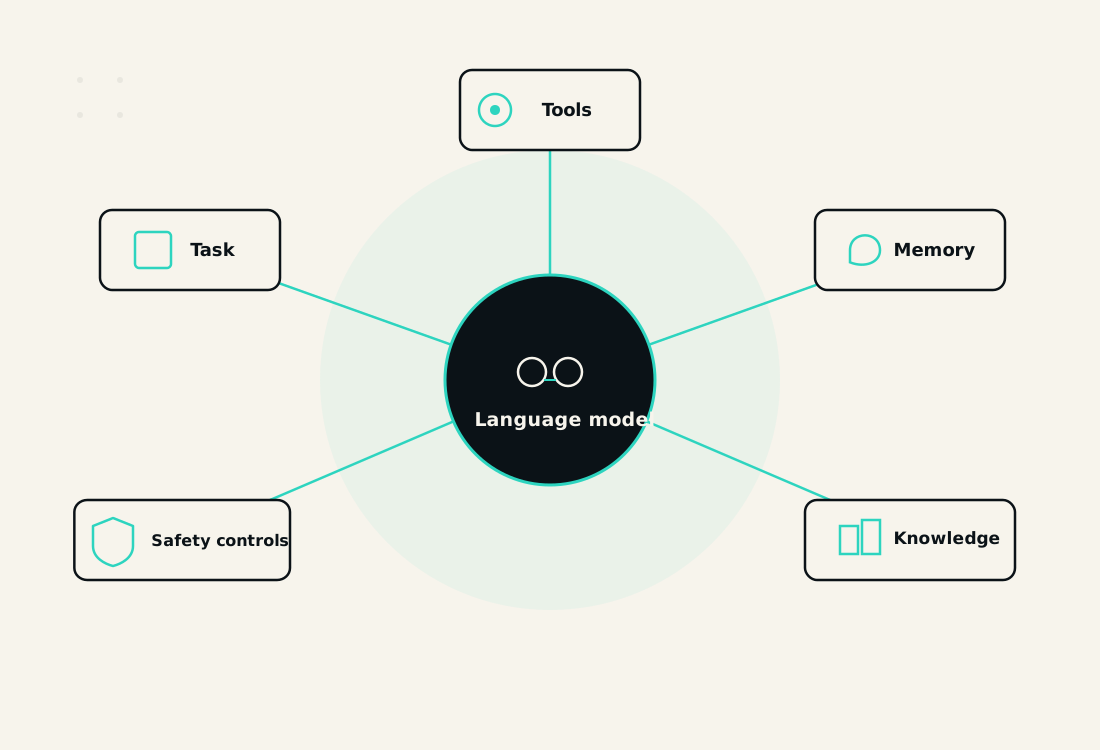
An agent's capability comes from what it is connected to, not just the underlying language model.
Tools give an agent the ability to act, calling an API, updating a database, sending a message, rather than just generating text. Function calling, the mechanism that lets a language model reliably invoke a specific tool with the correct parameters, is what turned agents from a research concept into something genuinely deployable in production.
Retrieval-augmented generation (RAG) gives an agent access to specific, current knowledge beyond what the underlying model already knows, retrieving relevant information from your own documents or systems before generating a response, rather than relying purely on the model's general training. We cover this specific piece of the architecture in more depth separately, since it deserves its own explanation.
Memory lets an agent retain relevant context across multiple steps or interactions, rather than treating every request as if it were the first, which is what allows genuinely multi-step tasks to be completed coherently rather than in disconnected fragments.
An increasingly common industry standard, the Model Context Protocol, has emerged specifically to give agents a consistent, well-defined way to connect to external tools and data sources, rather than every integration needing to be built from scratch in a proprietary way each time.
Build Considerations
Building a genuine agent, not a rebadged chatbot, requires a handful of deliberate architectural decisions.
Scope the task tightly before building anything. Agents perform best on well-defined tasks with a clear definition of success, not open-ended goals with no way to measure whether the agent actually achieved them.
Define what the agent can act on autonomously, and what needs human approval. A well-built agent has explicit safety boundaries, certain actions it can take independently, and others that require a human to confirm before anything happens in a real system.
Plan for monitoring from day one. An agent operating with real autonomy needs visibility into what it actually decided and did, not just whether the final output looked correct, since a plausible-looking result and a genuinely correct one are not always the same thing.
Start with a lower level of autonomy and expand it deliberately. Most successful agent deployments do not launch at full autonomy on day one, they start with the agent recommending an action for a human to approve, build a track record of accuracy, and only expand toward fully autonomous action once that track record justifies the trust. Jumping straight to full autonomy on an unproven system is a common source of the failed deployments that damage confidence in the technology broadly.
Honest Limits
Agents are genuinely capable, and also genuinely limited in ways worth understanding before committing budget to one.
They struggle with open-ended tasks that have no clear definition of success, an agent cannot reliably optimise toward a goal nobody has actually specified. They are a poor fit for high-stakes judgement calls with significant real-world consequences and no human oversight, autonomy should scale with how tolerable a mistake actually is, not with how impressive full automation sounds. And they inherit the limitations of whatever data and systems they connect to, an agent working against messy, undocumented, or unreliable data will make confidently wrong decisions just as easily as correct ones.
It is also worth being honest that much of what gets marketed as an "AI agent" in 2026 is a simpler system further along a maturity spectrum, closer to an advanced retrieval-based chatbot than a system with genuine multi-step autonomy. A useful, direct test when evaluating any vendor's claim is asking specifically what actions the system can take on its own, in which real systems, and what happens when it encounters something it was not explicitly built to handle, a genuine agent has clear, specific answers to all three.
In Practice
Building an agent that genuinely works in production, not just in a demo, is exactly the kind of engineering we cover in our AI automation service, tying scope, tooling, and safety boundaries to a measurable outcome before any code gets written. If you are trying to work out honestly whether your specific workflow needs an agent, a simpler chatbot, or straightforward automation, that discovery conversation is the right place to start.
The organisations getting real value from AI agents in 2026 are not the ones chasing the most autonomous system possible, they are the ones who scoped the task honestly, built in the right safety boundaries, and matched the level of autonomy to how much a mistake would actually cost if it happened.
FAQ
Questions, Answered.
Read next
More on AI Automation
10 High ROI Automations Every SME Should Consider in 2026
Ten concrete, high-ROI automations for UK SMEs, with real effort and payoff for each, plus how to prioritise and where to actually start.
AI Automation for Accountants and Finance Teams
How AI automation actually applies to accounting firms and finance teams, invoice and reconciliation, document extraction, reporting, MTD compliance, and real ROI.
AI Automation for Professional Services Firms
Real AI automation for professional services, client intake, document workflows, reporting, genuine time recovery, and honest ROI.