
Resources
Build vs Buy: Custom Automation or Off the Shelf Tools
A genuinely balanced look at total cost of ownership, control, speed, and when off the shelf tools are actually the smarter choice over a custom build.

Mohid Bhatti
AI Systems Engineer, Devity Technologies
Build versus buy gets treated as a simple cost question more often than it should, when the more useful question is which option actually fits your specific situation over the timeframe that matters. This is a genuinely balanced look, total cost of ownership, control and lock-in, speed, when off-the-shelf is clearly enough, and the hybrid approach that describes how most mature businesses actually operate.
The Short Comparison, Then the Detail
| Off the shelf | Custom build | |
|---|---|---|
| Upfront cost | Low | Higher |
| Cost at scale | Can grow significantly with usage or seats | Lower marginal cost per user |
| Time to first use | Hours to days | Weeks at minimum |
| Fit to unusual workflows | Limited to vendor's configuration options | Built exactly around your process |
| Ongoing maintenance | Handled by the vendor | Your responsibility |
| Best suited to | Standard, widely shared needs | Genuinely differentiated workflows |
Total Cost of Ownership
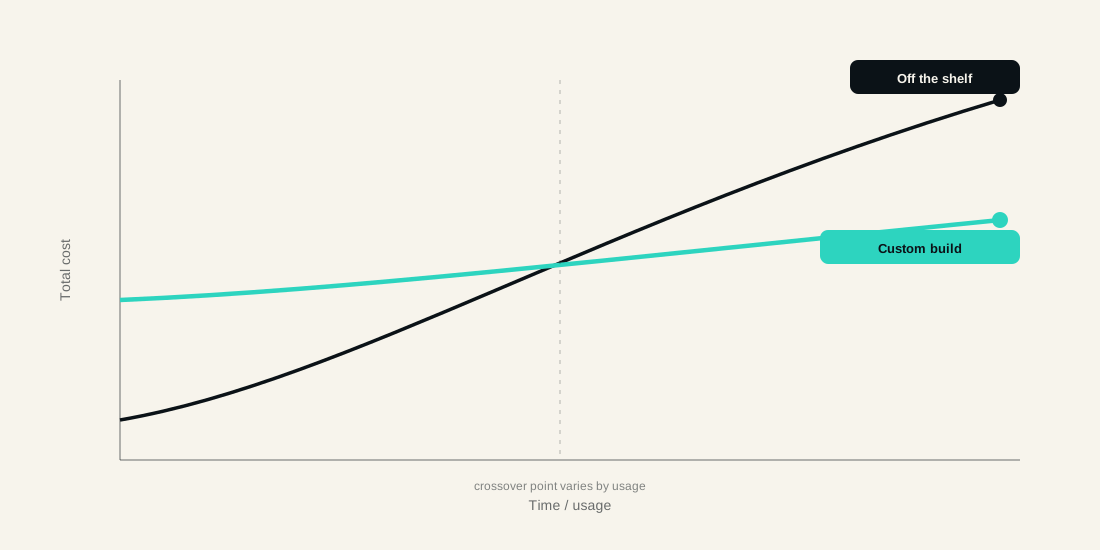
The sticker price comparison, a monthly subscription versus a build quote, is almost always the wrong comparison to make, since it ignores how each cost actually behaves over time.
Off-the-shelf tools typically carry a low upfront cost and a recurring subscription that scales with usage, seats, volume, or feature tier. This is genuinely the cheaper option early on, and can remain cheaper indefinitely for a business whose usage stays modest. The risk is at scale, per-seat or per-usage pricing that felt trivial at ten users can become a significant, ongoing cost at two hundred, with no ceiling built in.
Custom builds carry a higher upfront cost and a much lower marginal cost per additional user or unit of usage, since you are not paying a vendor's margin on every seat or transaction. The real total cost of ownership calculation needs to project both models forward across a realistic multi-year horizon, not compare today's invoice against today's subscription.
Hidden costs on both sides deserve honest accounting. Off-the-shelf tools carry the cost of workarounds for whatever they do not do natively, and the cost of switching later if the vendor changes pricing or discontinues a feature you depend on. Custom builds carry the ongoing cost of maintenance, security patches, and the engineering capacity needed to keep the system running, costs a SaaS vendor absorbs into their subscription price for you.
Control and Lock-In
Off-the-shelf tools mean accepting the vendor's roadmap, their release schedule, their feature priorities, and their pricing changes, on their terms, not yours. Your business's ability to adapt the tool to a genuinely unusual need is limited to whatever configuration options the vendor happens to expose.
Custom builds give you full control over the roadmap, the architecture, and how the system evolves, at the cost of that control being your responsibility to exercise well, a custom system with no clear ongoing ownership can drift just as easily as an off-the-shelf tool you have outgrown.
Data portability is worth checking either way. An off-the-shelf tool that makes it genuinely difficult to export your own data is a real lock-in risk regardless of price. A custom build should be architected so you are never dependent on the specific team that built it to keep running or to move to someone else later.
Speed
Off-the-shelf tools win decisively on initial speed, you can often be using a mature product within hours of signing up, with years of refinement already built in. This is a genuine, significant advantage when the need is urgent and the tool genuinely fits.
Custom builds take real time to design, build, and test properly, weeks at minimum for even a focused build. This is not a reason to avoid building custom when it is genuinely the right call, but it is a real trade-off worth being honest about, particularly against a pressing deadline.
When Off the Shelf Is Clearly Enough
Being genuinely balanced means naming this clearly, not as a token concession before pivoting back to advocating for custom builds.
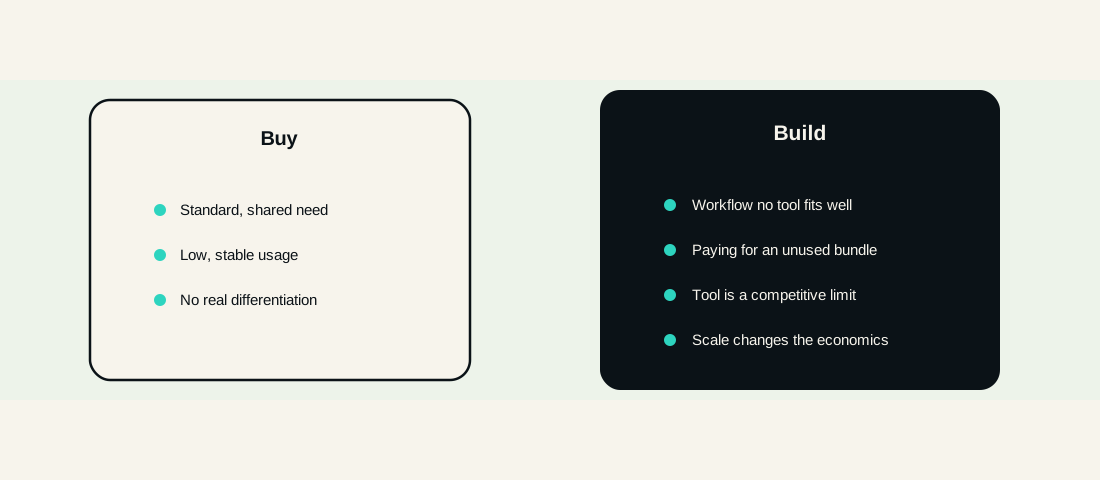
Standard, widely shared needs are almost always better served by an established product. Accounting, standard CRM functionality, common project management workflows, and email marketing have all been solved thoroughly by mature tools built by companies who specialise in exactly that problem, with years of refinement you cannot realistically replicate from scratch.
Low, stable usage favours off-the-shelf, since the pricing risk that shows up at scale simply does not apply if your usage stays modest and predictable.
No genuine differentiation in the workflow is the clearest signal. If your process for this specific task looks like every other business's process, you are not giving up any competitive advantage by using the same tool everyone else uses, and you are benefiting from a product that has already been refined by a much larger user base than your own feedback alone could produce.
A concrete example makes this tangible. A retail business tracking standard financial accounts, VAT returns, and payroll gains nothing from building custom accounting software, established platforms have solved this problem thoroughly, benefit from continuous regulatory updates the vendor maintains for you, and cost a fraction of what a custom build would require to reach the same maturity. This is exactly the kind of decision where buying is not a compromise, it is simply the correct answer.
When a Custom Build Genuinely Wins
Your workflow is specific enough that no off-the-shelf tool fits well. Forcing a genuinely unusual process into a generic tool's structure often means either accepting a worse process than you actually need, or building elaborate workarounds that end up costing more in engineering time than a proper custom build would have.
You are paying for a bundle when you only need one piece. Many off-the-shelf platforms bundle features together, and a business only using a fraction of what it pays for is subsidising capability it never uses.
The tool has become a competitive constraint, not infrastructure. If your ability to serve customers well is genuinely limited by what a generic tool allows, and your competitors using the same tool face the identical ceiling, a custom system built specifically around your actual workflow is a real, defensible advantage, not an indulgence.
Genuine scale changes the economics. At high enough usage, the marginal cost advantage of a custom build, no per-seat fee, no usage-based pricing spike, can make the total cost of ownership favour building even after accounting for the higher upfront investment and ongoing maintenance.
The same retail business, running a highly specific inventory allocation process across fourteen warehouses that no off-the-shelf platform handles well without extensive, expensive customisation, is a genuinely different situation from its accounting needs. Here, forcing the process into a generic tool means either accepting a worse process or paying for endless configuration and workarounds, while a custom system built specifically around the real warehouse logic becomes a genuine operational advantage, not an indulgence. The two decisions, accounting bought, warehouse logistics built, sit inside the same business and are both correct for the same underlying reason, matching the tool to how standard or how differentiated the actual need is.
The Hybrid Approach
Most mature businesses do not make one single build-or-buy decision, they run on a genuine mix, buying for standard, well-solved needs and building custom specifically for the parts of the business that are actually differentiated. Your accounting software is very likely bought. The specific workflow that makes your business genuinely competitive is a much stronger candidate for custom investment.
This is not indecision, it is the economically sensible default, since it means capital and engineering effort go toward the parts of the business where custom investment genuinely pays off, rather than being spread thin rebuilding solved problems or stretched thin trying to force a generic tool to do something it was never designed for.
In Practice
We build the custom half of that equation, AI automation and web platforms specifically for the workflows that are genuinely differentiated enough to justify it, and we are equally direct when a client's need would be better and more cheaply served by an existing tool. If you are trying to work out honestly which side of this line your own specific need sits on, that conversation costs nothing to have.
The businesses that get build versus buy right are not the ones with a fixed philosophy in either direction, they are the ones who evaluate each specific need honestly against total cost, control, speed, and genuine differentiation, and are willing to buy for the boring, solved problems so they can invest properly in the ones that actually matter.
FAQ
Questions, Answered.
Read next
More on AI Automation
10 High ROI Automations Every SME Should Consider in 2026
Ten concrete, high-ROI automations for UK SMEs, with real effort and payoff for each, plus how to prioritise and where to actually start.
AI Automation for Accountants and Finance Teams
How AI automation actually applies to accounting firms and finance teams, invoice and reconciliation, document extraction, reporting, MTD compliance, and real ROI.
AI Automation for Professional Services Firms
Real AI automation for professional services, client intake, document workflows, reporting, genuine time recovery, and honest ROI.