
Resources
AI Voice Agents for UK Businesses: Use Cases and ROI
What AI voice agents actually do, inbound versus outbound use cases, real CRM integration, honest ROI framing, and the UK call recording and compliance rules most providers gloss over.

Mohid Bhatti
AI Systems Engineer, Devity Technologies
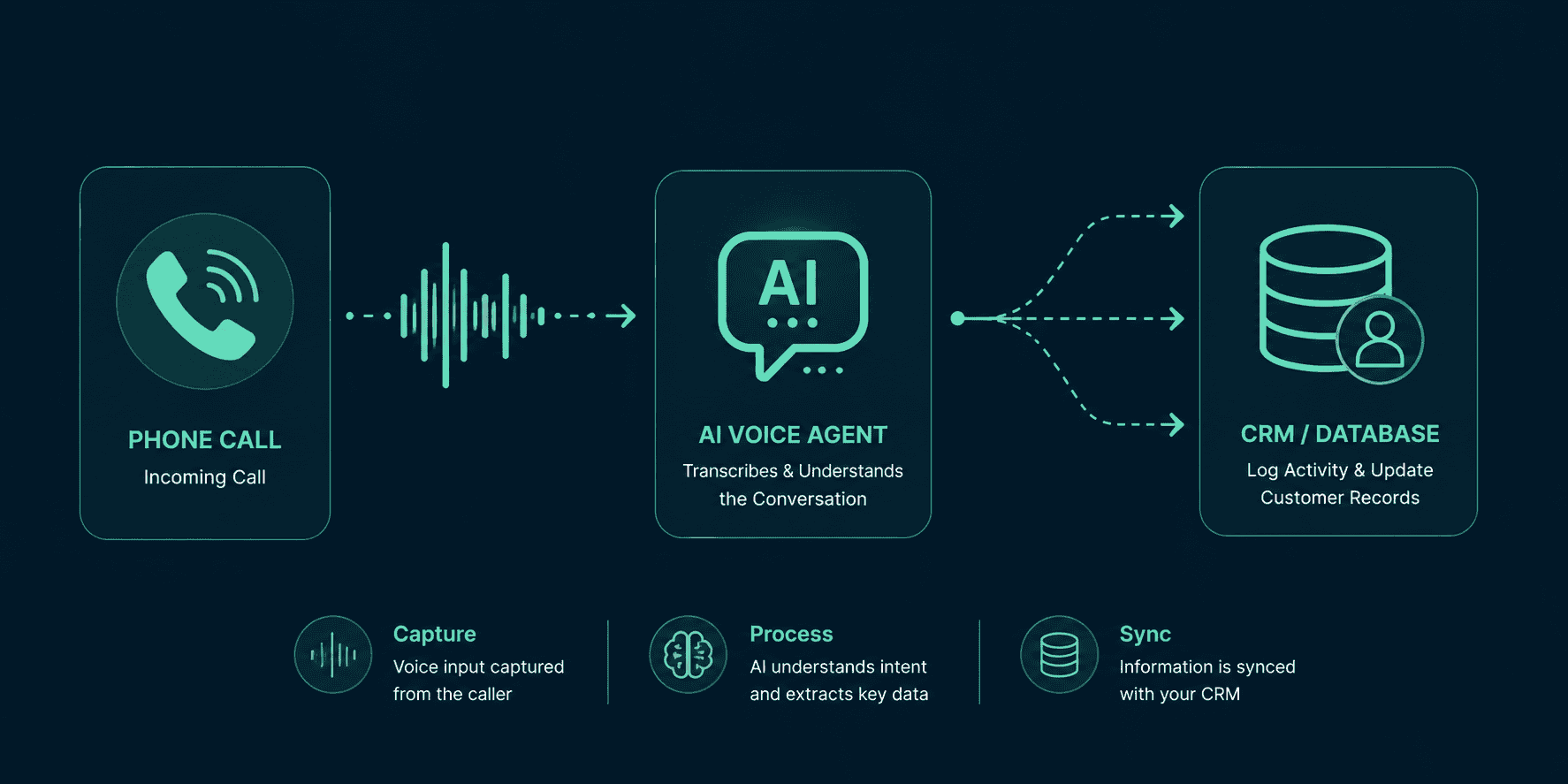
Search "AI voice agent UK" and you will land in one of the most heavily marketed corners of the entire AI automation space, dozens of subscription products promising dramatic ROI figures, all fairly similar underneath the branding. Some of that is genuinely useful for a simple use case. Much of it glosses over the engineering quality that actually determines whether a voice agent works well on your specific calls, and the compliance obligations that come with recording and automating a phone conversation in the UK. This guide covers what voice agents actually do, the real inbound and outbound use cases, genuine CRM integration, honest ROI framing, and the recording and compliance rules too many providers treat as an afterthought.
What Voice Agents Actually Do
A modern AI voice agent conducts a real, live phone conversation, listening to the caller, understanding intent through a language model rather than a rigid menu tree, looking up relevant context from your CRM or booking system in real time, and either resolving the request directly or handing off to a human with a clear, structured summary of what was discussed.
This is a meaningfully different thing from the IVR systems most callers already dislike, "press 1 for sales." Those systems force the caller to navigate a fixed structure. A genuine voice agent understands natural, unstructured speech, "I need to move my appointment to next Tuesday afternoon," and acts on it directly, the same way a competent human receptionist would.
Under the hood, a properly built voice agent typically combines three layers, real-time speech recognition to turn the caller's voice into text, a language model to understand intent and decide what to do next, and natural-sounding speech synthesis to respond, all fast enough that the conversation feels like a normal phone call rather than a series of delayed, robotic exchanges. Latency matters enormously here, a voice agent with even a second or two of lag per exchange feels noticeably worse than a human conversation, which is why the underlying engineering quality shows up immediately to a real caller, not just in a demo.
Inbound and Outbound: Two Different Jobs
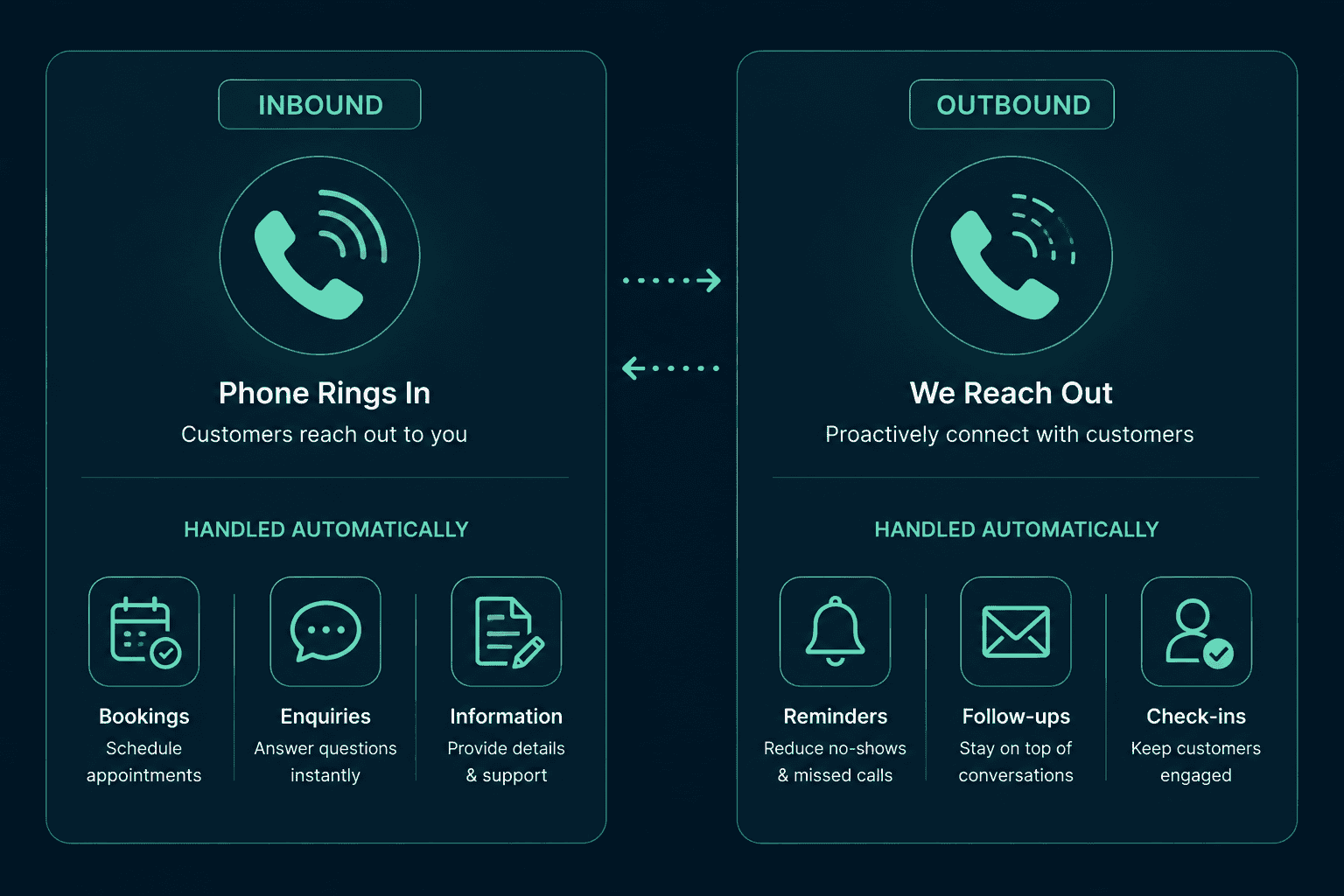
Inbound voice agents answer calls as they come in, handling appointment bookings, common questions, order status checks, and initial enquiry capture, particularly valuable for the calls that would otherwise go unanswered outside business hours or during a busy period when every line is already occupied. For many service businesses, a meaningful share of calls happen precisely when nobody is free to answer, and each unanswered call is a real chance most callers do not repeat.
Outbound voice agents initiate calls rather than receiving them, appointment reminders, follow-ups on quotes that have gone quiet, and re-engagement with leads who enquired but never converted. Outbound reminder calls in particular tend to produce the clearest, fastest, most measurable return, since reducing no-shows has a direct, easily calculated cost saving attached to it.
Most businesses deploying a voice agent for the first time start with inbound coverage, since that addresses the most immediate, visible pain, then add outbound capability once the inbound results are measured and proven.
Escalation handling deserves specific attention regardless of direction. A well-built agent recognises when a call genuinely needs a human, a complex complaint, an unusual request, clear caller frustration, and hands off gracefully with full context, rather than looping the caller through repeated misunderstandings or forcing them to repeat themselves to whoever picks up next. This is one of the clearest signals of engineering quality, a poorly built agent tends to either escalate everything unnecessarily, defeating the purpose of automating anything, or fails to escalate when it genuinely should, frustrating the exact callers who needed a human most.
CRM Integration: Where the Real Value Actually Sits
A voice agent that just answers calls politely without connecting to anything else is a marginal improvement over voicemail. The genuine value shows up when the agent writes directly into your CRM or booking system during the call, logging the enquiry, updating a customer record, or creating a calendar booking, without a human needing to transcribe or re-enter anything afterward.
This is also where the gap between a generic subscription product and a properly engineered system tends to show up clearly. A templated voice agent typically covers a handful of popular CRM integrations well and struggles or fails entirely with anything outside that list. A custom-built agent can be engineered against your actual systems, however specific or unusual your setup is, rather than asking your business to adapt its workflow to whatever the subscription product happens to support natively.
A concrete example makes this tangible. A trades business taking a call about a leaking boiler needs the agent to check the caller's address against existing customer records, look up whether they are an existing customer with service history, offer realistic appointment slots based on actual engineer availability, and log all of it back into the scheduling system automatically. A generic voice agent product built around simple appointment booking for a single, common calendar tool may handle the booking step reasonably well while having no real way to check service history or engineer availability specific to that business's own systems, silently reducing the agent to a slightly smarter answering machine rather than the genuine assistant it was meant to be.
Honest ROI Framing
The genuine calculation is straightforward, and worth doing properly rather than trusting a marketing page's headline percentage.
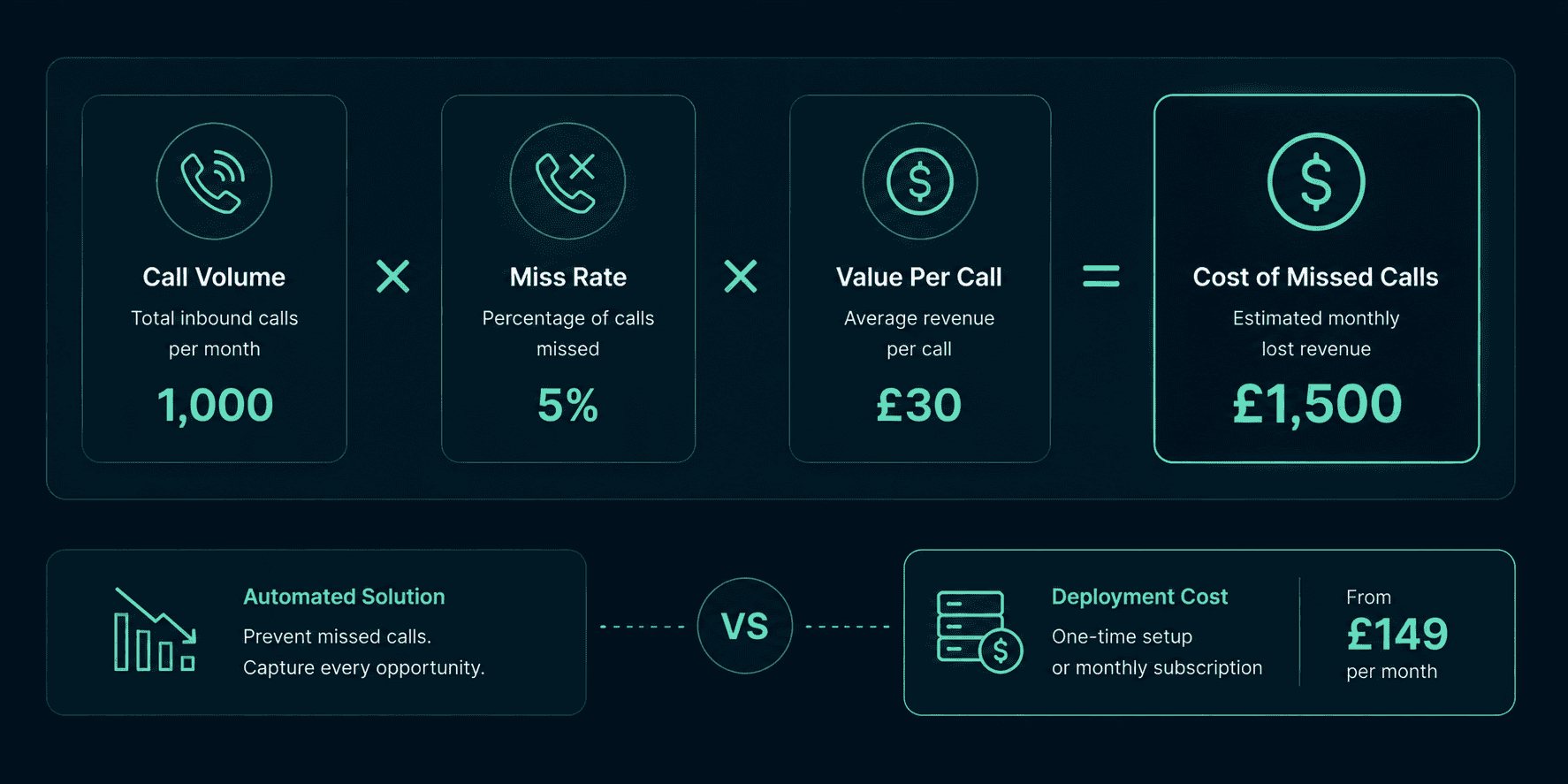
Calculate your current cost of missed or poorly handled calls. A meaningful share of calls to a busy service business go unanswered, and most of those callers do not call back, they call a competitor instead. Multiply your typical call volume, your miss rate, and your average value per converted call to get a real, specific number for what missed calls are currently costing you, not a generic industry estimate.
Compare that against a genuine deployment cost, both the build and the ongoing monthly cost of running the system, telephony, AI usage, and support. A voice agent handling appointment booking and basic enquiries for a service business with real call volume typically pays for itself well within months once measured against actual recovered revenue, not a hypothetical scenario.
Be skeptical of ROI percentages quoted without a specific calculation behind them. A headline figure like "285% ROI" means very little without knowing what it is measuring, over what timeframe, and for what call volume. A credible provider should be able to walk through your specific numbers with you, not just repeat a marketing statistic.
Recording and Compliance: What Too Many Providers Skip
This is the section most heavily marketed voice agent providers rush past, and it deserves genuine attention, not a footnote.
Callers need to be informed. UK data protection and privacy in electronic communications rules require that callers be told, clearly, at the start of the call, that they may be speaking with an automated system and that the call may be recorded. This needs to be built into the call flow as a genuine first step, not an easily missed disclaimer buried in terms and conditions elsewhere.
Recordings and transcripts are personal data. Once a call is recorded or transcribed, that data falls under the same UK GDPR obligations as any other personal data your business holds, meaning genuine, defensible answers are needed for how long it is retained, who can access it, and how a caller could request its deletion if they asked.
Sector-specific rules can add further requirements. Businesses in regulated sectors, financial services, healthcare, legal, may have additional obligations around call recording and data handling beyond the general baseline, worth confirming specifically rather than assuming a generic voice agent product has already handled it correctly for your industry.
A provider who treats these questions as routine, with clear, specific answers, is a stronger signal of engineering seriousness than any marketing claim about conversation quality or setup speed.
In Practice
This is exactly the kind of deployment where genuine engineering depth matters more than the marketing usually suggests, real CRM integration, properly handled compliance, and a system built around your actual call patterns rather than a generic template. Our AI automation service covers this kind of build directly, and we are equally honest when a simpler, off-the-shelf option would genuinely serve a business better than a custom build. If your business also handles field service scheduling alongside call volume, our field services automation guide covers how voice and scheduling workflows often work together.
The businesses that get real value from a voice agent are not the ones chasing the highest advertised ROI percentage, they are the ones who calculated their own specific numbers honestly, chose a build that actually integrates with their real systems, and got the compliance basics right from day one rather than discovering the gaps after a caller complained.
FAQ
Questions, Answered.
Read next
More on AI Automation
10 High ROI Automations Every SME Should Consider in 2026
Ten concrete, high-ROI automations for UK SMEs, with real effort and payoff for each, plus how to prioritise and where to actually start.
AI Automation for Accountants and Finance Teams
How AI automation actually applies to accounting firms and finance teams, invoice and reconciliation, document extraction, reporting, MTD compliance, and real ROI.
AI Automation for Professional Services Firms
Real AI automation for professional services, client intake, document workflows, reporting, genuine time recovery, and honest ROI.